Clinical Knowledge › Internal medicine › Endocrinology › Thyroid disorders
Toxic multinodular goitre and toxic adenoma
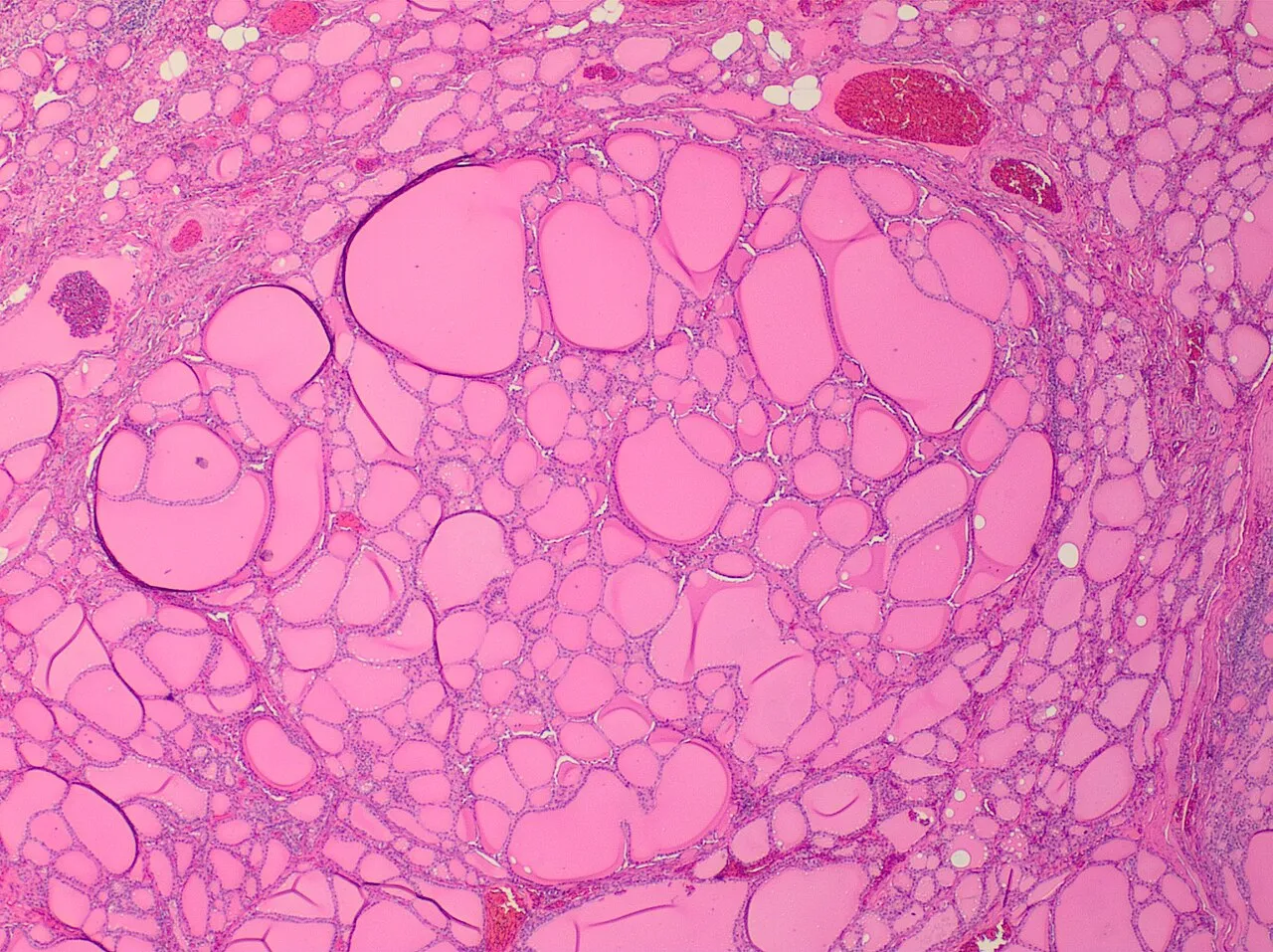
Toxic multinodular goitre (Plummer disease) and toxic adenoma are forms of hyperthyroidism in which one or more thyroid nodules make thyroid hormone independently of TSH. Most autonomous nodules carry a somatic activating mutation of the TSH receptor, or less often of the Gs alpha protein (GNAS), so they keep growing and secreting hormone while the rest of the gland is switched off. Together they are the second commonest cause of hyperthyroidism after Graves disease, and the commonest in older people living in areas of past or present iodine deficiency. The onset is gradual and often subclinical, with a suppressed TSH and normal or mildly raised free T4 and free T3; T3 toxicosis is common. Older patients may present with atrial fibrillation, heart failure, weight loss or bone loss rather than classic symptoms, and a large goitre can compress the trachea or oesophagus. An iodine load such as amiodarone or contrast can trigger overt hyperthyroidism (Jod-Basedow effect). Diagnosis rests on TSH, free hormones, negative TSH-receptor antibodies and radionuclide scintigraphy showing a 'hot' nodule or patchy uptake. Unlike Graves disease, autonomy does not remit, so definitive treatment with radioiodine or surgery is preferred after beta-blockade and antithyroid drugs.
Patient case, mechanism, investigations, management, flashcards and exam-style questions.Open the lesson →
Key facts
- Autonomous nodules make hormone independently of TSH because of somatic activating TSH-receptor (or GNAS) mutations; the condition does not remit
- Second commonest cause of hyperthyroidism overall and the commonest in older adults from iodine-deficient regions
- Biochemistry: suppressed TSH with normal or mildly raised free T4 and/or free T3; T3 toxicosis and subclinical disease are common
- TSH-receptor antibodies are negative; there is no orbitopathy, pretibial myxoedema or acropachy
- Scintigraphy: toxic adenoma = single 'hot' nodule with suppressed background; toxic multinodular goitre = patchy hot and cold areas
- Hyperfunctioning ('hot') nodules are rarely malignant and usually do not need fine-needle aspiration; cold or suspicious nodules do
- Iodine excess (amiodarone, iodinated contrast, supplements) can precipitate thyrotoxicosis in autonomous nodules (Jod-Basedow)
- Definitive treatment is radioiodine or surgery (lobectomy for toxic adenoma, total thyroidectomy for large or compressive goitre); long-term low-dose methimazole is an alternative in selected patients
Differential diagnosis
| Condition | Clues | Key test |
|---|---|---|
| Graves disease | Diffuse goitre with bruit, orbitopathy, pretibial myxoedema, younger patient | TSH-receptor antibodies positive; diffuse increased uptake on scan |
| Painless or subacute thyroiditis | Recent viral illness or postpartum; tender gland in subacute form; self-limiting | Low uptake on scintigraphy; raised ESR/CRP in subacute form |
| Amiodarone-induced thyrotoxicosis type 2 | On amiodarone, normal gland, destructive thyroiditis | Low uptake, absent vascularity on Doppler; responds to glucocorticoids |
| Non-toxic multinodular goitre | Nodular goitre with normal TSH | TSH normal; scan not needed unless TSH low |
| Exogenous thyroid hormone (factitious) | No goitre, small gland, history of supplements | Low thyroglobulin and low uptake |
| Thyroid cancer in a nodular goitre | Dominant cold, hard or growing nodule, lymphadenopathy, voice change | Ultrasound risk score and fine-needle aspiration |
| TSH-secreting pituitary adenoma | Raised free T4 with normal or high TSH | TSH not suppressed; pituitary MRI |
Exam pearls
Guideline
American Thyroid Association 2016 guidelines for hyperthyroidism and other causes of thyrotoxicosis, with the European Thyroid Association 2023 thyroid nodule guideline and NICE NG145 (2019)
References
- Ross DS, Burch HB, Cooper DS, et al.. 2016 American Thyroid Association Guidelines for Diagnosis and Management of Hyperthyroidism and Other Causes of Thyrotoxicosis. Thyroid 2016.
- Durante C, Hegedüs L, Czarniecka A, et al.. 2023 European Thyroid Association Clinical Practice Guidelines for thyroid nodule management. Eur Thyroid J 2023.
- Kahaly GJ, Bartalena L, Hegedüs L, et al.. 2018 European Thyroid Association Guideline for the Management of Graves' Hyperthyroidism. Eur Thyroid J 2018.
- National Institute for Health and Care Excellence (NICE). Thyroid disease: assessment and management (NG145). NICE guideline 2019.
- Haugen BR, Alexander EK, Bible KC, et al.. 2015 American Thyroid Association Management Guidelines for Adult Patients with Thyroid Nodules and Differentiated Thyroid Cancer. Thyroid 2016.
- Satoh T, Isozaki O, Suzuki A, et al.. 2016 Guidelines for the management of thyroid storm from The Japan Thyroid Association and Japan Endocrine Society (First edition). Endocr J 2016.
Related topics
By Dr Khalid Seidi (B.Sc., M.D.) · MedEd World Clinical Knowledge library. Original teaching content checked against current guidelines (November 2026); confirm the latest local guidance before clinical use. Not a substitute for clinical judgement.