Clinical Knowledge › Internal medicine › Rheumatology and immunology › Immunodeficiency
DiGeorge syndrome (22q11.2 deletion)
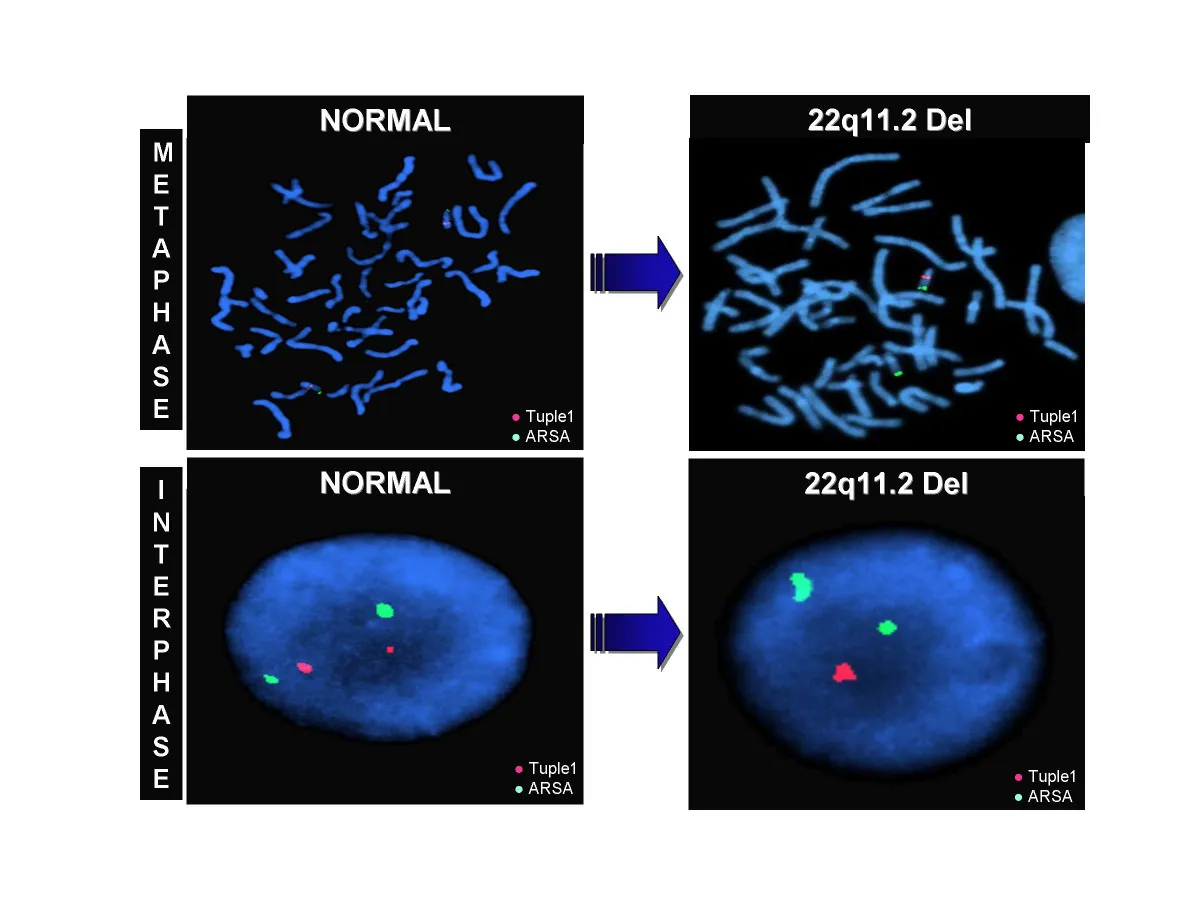
DiGeorge syndrome is the immunological and endocrine face of 22q11.2 deletion syndrome, the commonest human microdeletion (about 1 in 2000 to 4000 live births). Loss of one copy of a 1.5–3 Mb segment including TBX1 disturbs development of the third and fourth pharyngeal pouches and the cardiac outflow tract. The result is a variable mix of conotruncal heart defects (tetralogy of Fallot, interrupted aortic arch type B, truncus arteriosus), palatal anomalies with nasal speech, hypoparathyroidism with neonatal hypocalcaemic seizures, thymic hypoplasia with low T cells, autoimmunity, learning difficulties and a high risk of schizophrenia. Most patients have partial T-cell deficiency that improves with age; fewer than 1% are athymic and have a SCID-like illness detected by low TRECs on newborn screening, needing thymus tissue implantation. Diagnosis is by chromosomal microarray or MLPA. Lifelong care includes calcium monitoring, cardiac repair, irradiated blood products until T cells are known to be adequate, careful use of live vaccines, and genetic counselling (50% transmission risk).
Patient case, mechanism, investigations, management, flashcards and exam-style questions.Open the lesson →
Key facts
- 22q11.2 deletion is the commonest microdeletion syndrome, about 1 in 2000–4000 live births; around 90% are de novo
- Haploinsufficiency of TBX1 disturbs the third and fourth pharyngeal pouches (thymus, parathyroids) and the cardiac outflow tract
- Conotruncal heart defects occur in about 60–75%: tetralogy of Fallot, interrupted aortic arch type B, truncus arteriosus, VSD
- Hypoparathyroidism causes neonatal hypocalcaemic tetany or seizures and may recur at times of stress, surgery, puberty or pregnancy
- Most have partial T-cell lymphopenia; complete DiGeorge (athymia, under 1%) behaves like SCID and needs thymus tissue implantation
- Low TRECs on newborn SCID screening may be the first clue
- About one in four adults develops a psychotic illness; learning difficulty, anxiety and ADHD are common
- Diagnosis: chromosomal microarray or MLPA (FISH is older); offer parental testing because transmission risk is 50%
Differential diagnosis
| Condition | Clues | Key test |
|---|---|---|
| CHARGE syndrome (CHD7) | Coloboma, choanal atresia, ear anomalies; may also be athymic | CHD7 sequencing; normal 22q11.2 microarray |
| Severe combined immunodeficiency | Low TRECs, failure to thrive, no cardiac or calcium features | Lymphocyte subsets, naive T cells, SCID gene panel |
| Autoimmune polyendocrine syndrome type 1 (AIRE) | Hypoparathyroidism with chronic candidiasis and Addison disease, later onset | AIRE genetics, anti-interferon antibodies |
| HDR syndrome (GATA3) | Hypoparathyroidism, sensorineural deafness, renal dysplasia; normal T cells | GATA3 testing |
| Noonan syndrome | Pulmonary stenosis, hypertrophic cardiomyopathy, short stature; normal calcium | RASopathy gene panel |
| Diabetic embryopathy or retinoic acid embryopathy | Conotruncal defects after maternal exposure | Maternal history; normal microarray |
| Isolated tetralogy of Fallot | Heart defect only, normal calcium and T cells | Microarray still advised in every conotruncal defect |
Exam pearls
Guideline
Updated clinical practice recommendations for children and adults with 22q11.2 deletion syndrome (2023), IUIS classification of inborn errors of immunity (2024 update) and ESID working definitions (2019)
References
- Óskarsdóttir S, Boot E, Crowley TB, et al.. Updated clinical practice recommendations for managing children with 22q11.2 deletion syndrome. Genet Med 2023.
- Boot E, Óskarsdóttir S, Loo JCY, et al.. Updated clinical practice recommendations for managing adults with 22q11.2 deletion syndrome. Genet Med 2023.
- Poli MC, Aksentijevich I, Bousfiha AA, et al.. Human inborn errors of immunity: 2024 update on the classification from the International Union of Immunological Societies Expert Committee. J Hum Immun 2025.
- McDonald-McGinn DM, Sullivan KE, Marino B, et al.. 22q11.2 deletion syndrome. Nat Rev Dis Primers 2015.
- Seidel MG, Kindle G, Gathmann B, et al.. The European Society for Immunodeficiencies (ESID) Registry working definitions for the clinical diagnosis of inborn errors of immunity. J Allergy Clin Immunol Pract 2019.
- Bonilla FA, Khan DA, Ballas ZK, et al.. Practice parameter for the diagnosis and management of primary immunodeficiency. J Allergy Clin Immunol 2015.
Related topics
By Dr Khalid Seidi (B.Sc., M.D.) · MedEd World Clinical Knowledge library. Original teaching content checked against current guidelines (November 2026); confirm the latest local guidance before clinical use. Not a substitute for clinical judgement.