Clinical Knowledge › Internal medicine › Rheumatology and immunology › Immunodeficiency
Hyper-IgM syndrome
Hyper-IgM syndromes are inborn errors of immunity in which B cells cannot switch from making IgM to IgG, IgA and IgE. Serum IgM is normal or high while the other classes are very low. The commonest form is X-linked CD40 ligand deficiency: activated CD4 T cells lack CD40L, so they cannot signal through CD40 on B cells, macrophages and dendritic cells. Boys therefore have both antibody deficiency and a cellular defect, presenting in infancy with Pneumocystis pneumonia, recurrent sinopulmonary infection, neutropenia with oral ulcers, and chronic Cryptosporidium infection that leads to sclerosing cholangitis, cirrhosis and cholangiocarcinoma. Autosomal recessive CD40 deficiency behaves similarly, whereas B-cell intrinsic forms (AID, UNG) cause antibody deficiency with large lymph nodes but no opportunistic infections. Diagnosis rests on the immunoglobulin pattern, absent CD40L on activated T cells by flow cytometry and genetic testing. Management combines immunoglobulin, co-trimoxazole prophylaxis, safe water, G-CSF for neutropenia and early haematopoietic cell transplantation.
Patient case, mechanism, investigations, management, flashcards and exam-style questions.Open the lesson →
Key facts
- Pattern: IgM normal or raised; IgG, IgA and IgE very low; B-cell numbers normal
- X-linked CD40L (CD40LG) deficiency causes about two thirds of cases and is a combined immunodeficiency
- CD40L on activated CD4 T cells drives class-switch recombination, germinal centres and macrophage activation
- Pneumocystis pneumonia in infancy is the presenting illness in about a third to a half of boys
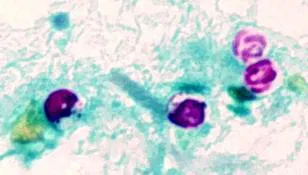
- Cryptosporidium causes chronic diarrhoea and sclerosing cholangitis, a leading cause of death
- Intermittent or chronic neutropenia with oral ulcers affects about half
- B-cell intrinsic forms (AID, UNG) give antibody deficiency with lymphoid hyperplasia and no opportunistic infections
- Diagnosis: CD40L flow cytometry on activated T cells and gene testing; cure for CD40L deficiency is HCT
Differential diagnosis
| Condition | Clues | Key test |
|---|---|---|
| Common variable immunodeficiency | Adult onset; IgM usually low too | IgG, IgA, IgM; switched memory B cells |
| X-linked agammaglobulinaemia | Boy with absent B cells and all classes low | CD19 count, BTK genetics |
| Severe combined immunodeficiency | Low T cells, failure to thrive, low TRECs | Lymphocyte subsets |
| Transient hypogammaglobulinaemia of infancy | Low IgG with normal vaccine responses, resolves | Repeat immunoglobulins, vaccine responses |
| HIV infection | PCP in an infant; polyclonal hypergammaglobulinaemia | HIV DNA/RNA PCR |
| Congenital rubella or other secondary causes | Raised IgM from infection | Specific serology or PCR |
| Primary sclerosing cholangitis with IBD | Cholangitis in an older child or adult | Normal immunoglobulin pattern, colonoscopy |
Exam pearls
Guideline
IUIS classification of inborn errors of immunity (2024 update), ESID working definitions (2019) and EBMT/ESID-IEWP-PIDTC HCT outcome study for CD40L deficiency (2019)
References
- Poli MC, Aksentijevich I, Bousfiha AA, et al.. Human inborn errors of immunity: 2024 update on the classification from the International Union of Immunological Societies Expert Committee. J Hum Immun 2025.
- Seidel MG, Kindle G, Gathmann B, et al.. The European Society for Immunodeficiencies (ESID) Registry working definitions for the clinical diagnosis of inborn errors of immunity. J Allergy Clin Immunol Pract 2019.
- Winkelstein JA, Marino MC, Ochs H, et al.. The X-linked hyper-IgM syndrome: clinical and immunologic features of 79 patients. Medicine (Baltimore) 2003.
- de la Morena MT, Leonard D, Torgerson TR, et al.. Long-term outcomes of 176 patients with X-linked hyper-IgM syndrome treated with or without hematopoietic cell transplantation. J Allergy Clin Immunol 2017.
- Ferrua F, Galimberti S, Courteille V, et al.. Hematopoietic stem cell transplantation for CD40 ligand deficiency: results from an EBMT/ESID-IEWP-SCETIDE-PIDTC study. J Allergy Clin Immunol 2019.
- Bonilla FA, Khan DA, Ballas ZK, et al.. Practice parameter for the diagnosis and management of primary immunodeficiency. J Allergy Clin Immunol 2015.
Related topics
By Dr Khalid Seidi (B.Sc., M.D.) · MedEd World Clinical Knowledge library. Original teaching content checked against current guidelines (November 2026); confirm the latest local guidance before clinical use. Not a substitute for clinical judgement.