Clinical Knowledge › Internal medicine › Rheumatology and immunology › Immunodeficiency
Wiskott–Aldrich syndrome
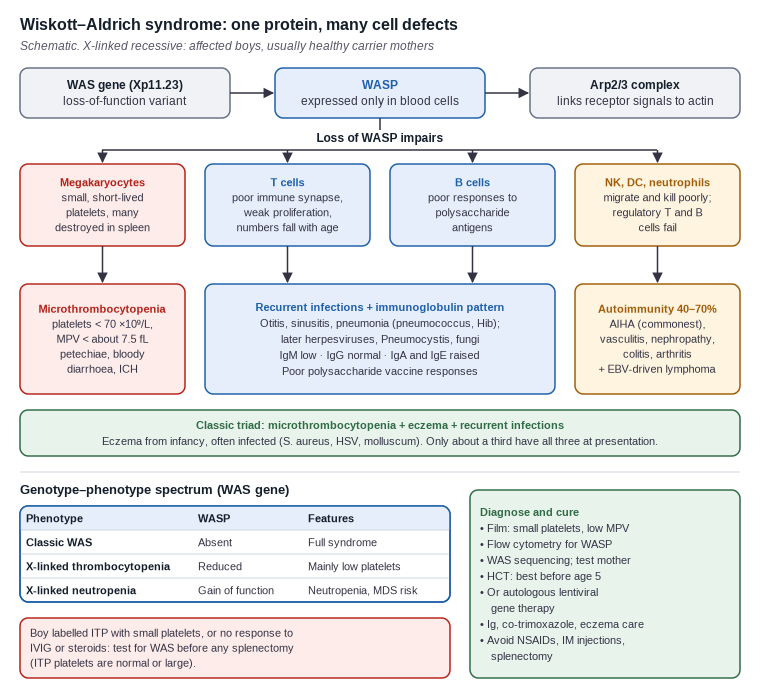
Wiskott–Aldrich syndrome (WAS) is an X-linked combined immunodeficiency caused by loss-of-function variants in the WAS gene, which encodes WASP, a regulator of the actin cytoskeleton in blood cells. Boys present in infancy with the classic triad of microthrombocytopenia (low platelet count with small platelets), eczema and recurrent infections, often first noticed as bloody diarrhoea, petechiae or bleeding after circumcision. Autoimmunity (haemolytic anaemia, vasculitis, nephropathy, colitis) and EBV-driven lymphoma are frequent and shorten life. Typical immunoglobulins show low IgM, normal IgG and raised IgA and IgE, with poor polysaccharide vaccine responses and progressive T-cell lymphopenia. A low mean platelet volume, absent WASP on flow cytometry and WAS sequencing confirm the diagnosis. Haematopoietic cell transplantation, ideally before age 5, is curative; lentiviral gene therapy is an alternative and was licensed in the USA in late 2025. Supportive care includes immunoglobulin, antibiotic prophylaxis, eczema care and avoiding splenectomy where possible.
Patient case, mechanism, investigations, management, flashcards and exam-style questions.Open the lesson →
Key facts
- X-linked recessive: affects boys; mothers are usually healthy carriers
- WASP links cell-surface signals to actin polymerisation; its loss impairs immune synapses, cell migration and platelet formation
- Classic triad: thrombocytopenia with small platelets, eczema and recurrent infections; only about a third show all three at presentation
- Low mean platelet volume distinguishes WAS from immune thrombocytopenia, where platelets are normal or large
- Immunoglobulins: IgM low, IgG normal, IgA and IgE raised; poor responses to polysaccharide antigens
- Autoimmunity affects about 40–70% (autoimmune haemolytic anaemia most often); lymphoma risk is greatly increased
- Diagnosis: WASP flow cytometry and WAS gene sequencing
- Cure: HCT (best results under 5 years) or autologous lentiviral gene therapy
Differential diagnosis
| Condition | Clues | Key test |
|---|---|---|
| Immune thrombocytopenia (ITP) | Normal or large platelets, no eczema, boys and girls | Blood film, MPV; normal WASP |
| X-linked thrombocytopenia (milder WAS variant) | Microthrombocytopenia with mild or no eczema and infections | WASP flow (reduced, not absent); WAS sequencing |
| Hyper-IgE syndrome (STAT3 or DOCK8) | Eczema, high IgE, abscesses; platelets normal | Platelet count, STAT3/DOCK8 genetics |
| Atopic dermatitis with infection | Eczema and skin sepsis without thrombocytopenia | FBC with film |
| ARPC1B deficiency | WAS-like picture in a girl or with autosomal recessive inheritance | Gene panel |
| Bernard–Soulier syndrome | Bleeding with giant platelets | Platelet glycoprotein Ib flow cytometry |
| Cow's milk protein allergy | Bloody stools and eczema in infancy | Normal platelet count |
Exam pearls
Guideline
IUIS classification of inborn errors of immunity (2024 update), ESID working definitions (2019) and PIDTC transplant outcome reports (2020, 2026)
References
- Poli MC, Aksentijevich I, Bousfiha AA, et al.. Human inborn errors of immunity: 2024 update on the classification from the International Union of Immunological Societies Expert Committee. J Hum Immun 2025.
- Seidel MG, Kindle G, Gathmann B, et al.. The European Society for Immunodeficiencies (ESID) Registry working definitions for the clinical diagnosis of inborn errors of immunity. J Allergy Clin Immunol Pract 2019.
- Burroughs LM, Petrovic A, Brazauskas R, et al.. Excellent outcomes following hematopoietic cell transplantation for Wiskott-Aldrich syndrome: a PIDTC report. Blood 2020.
- Alexander JL, Dávila Saldaña BJ, Brazauskas R, et al.. Hematopoietic cell transplantation for Wiskott-Aldrich syndrome: a PIDTC report. Blood Adv 2026.
- Ferrua F, Cicalese MP, Galimberti S, et al.. Lentiviral haemopoietic stem/progenitor cell gene therapy for treatment of Wiskott-Aldrich syndrome: interim results of a non-randomised, open-label, phase 1/2 clinical study. Lancet Haematol 2019.
- Candotti F. Clinical manifestations and pathophysiological mechanisms of the Wiskott-Aldrich syndrome. J Clin Immunol 2018.
Related topics
By Dr Khalid Seidi (B.Sc., M.D.) · MedEd World Clinical Knowledge library. Original teaching content checked against current guidelines (November 2026); confirm the latest local guidance before clinical use. Not a substitute for clinical judgement.