Clinical Knowledge › Internal medicine › Rheumatology and immunology › Immunodeficiency
Severe combined immunodeficiency (SCID)
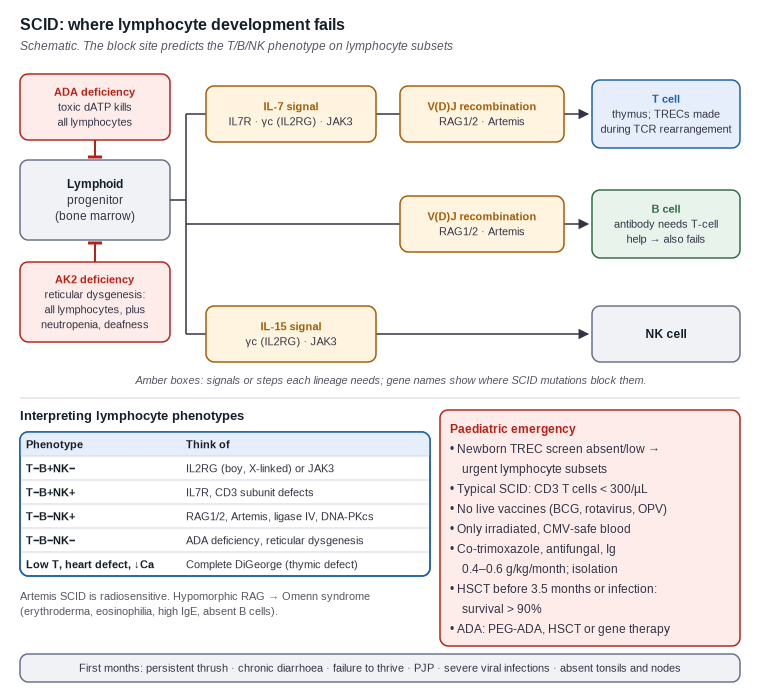
Severe combined immunodeficiency (SCID) is a group of inborn errors in which T-cell development fails, with secondary loss of antibody function and, in some forms, absent B or NK cells. It affects about 1 in 40 000–75 000 newborns and is commoner where consanguinity is frequent. Causes include IL2RG (X-linked), JAK3, IL7R, RAG1/2, Artemis and adenosine deaminase (ADA) deficiency. Infants are well at birth but within the first months develop persistent thrush, chronic diarrhoea, failure to thrive, Pneumocystis pneumonia and severe viral infections; live vaccines (BCG, rotavirus) and non-irradiated blood can cause fatal infection or graft-versus-host disease. Lymphopenia, an absent thymic shadow and very low T cells on flow cytometry suggest the diagnosis, and newborn screening detects absent T-cell receptor excision circles (TRECs) before symptoms. SCID is a paediatric emergency: protective measures, prophylaxis and immunoglobulin are followed by haematopoietic stem cell transplantation, ideally before infection; ADA-SCID can also be treated with enzyme replacement or gene therapy.
Patient case, mechanism, investigations, management, flashcards and exam-style questions.Open the lesson →
Key facts
- SCID is fatal in the first 1–2 years without haematopoietic stem cell transplantation (HSCT), gene therapy or, for ADA-SCID, enzyme replacement
- Commonest form in many Western series is X-linked SCID from IL2RG (common gamma chain) mutations: T−B+NK− phenotype
- ADA deficiency causes toxic accumulation of deoxyadenosine and dATP, killing lymphocytes: T−B−NK− and autosomal recessive
- RAG1/RAG2 and Artemis (DCLRE1C) defects prevent V(D)J recombination: T−B−NK+; Artemis SCID is radiosensitive
- Presents in the first months: persistent oral thrush, chronic diarrhoea, failure to thrive, Pneumocystis pneumonia, severe viral infections
- Newborn screening by TREC PCR on dried blood spots detects SCID before infection; universal in the USA since 2018 and expanding elsewhere
- Never give live vaccines (BCG, rotavirus, oral polio); give only blood products that are both irradiated and CMV-safe (CMV-seronegative or leucodepleted) to prevent transfusion-associated GvHD and CMV
- HSCT before 3.5 months of age or before infection gives survival above 90%; outcomes are much worse once active infection is present
Differential diagnosis
| Condition | Clues | Key test |
|---|---|---|
| DiGeorge syndrome (complete) | Conotruncal heart defect, hypocalcaemia, facial features | 22q11.2 deletion; T cells low, B cells normal |
| HIV infection in infancy | Maternal HIV, lymphadenopathy, hepatosplenomegaly | HIV DNA/RNA PCR |
| Omenn syndrome (leaky SCID) | Erythroderma, lymphadenopathy, hepatosplenomegaly, eosinophilia, high IgE | Oligoclonal activated T cells; hypomorphic RAG variants |
| X-linked agammaglobulinaemia | Presents after 6 months with bacterial infections only | Normal T cells, absent B cells |
| Cystic fibrosis | Failure to thrive, diarrhoea, chest infections | Sweat chloride; normal lymphocytes |
| Secondary lymphopenia (chylothorax, gut lymphangiectasia, prematurity) | Low T cells from loss or prematurity | TREC may be low; investigate cause; repeat |
| Cow's milk protein allergy or infective enteritis | Diarrhoea and poor growth | Normal lymphocyte count and responses |
Exam pearls
Guideline
EBMT/ESID Inborn Errors Working Party guidelines for HSCT in inborn errors of immunity (2021), PIDTC 2022 diagnostic definitions of SCID, IUIS classification (2024 update, published 2025) and newborn TREC screening policy (UK NSC evidence review and consultation 2025)
References
- Lankester AC, Albert MH, Booth C, et al.. EBMT/ESID inborn errors working party guidelines for hematopoietic stem cell transplantation for inborn errors of immunity. Bone Marrow Transplant 2021.
- Dvorak CC, Haddad E, Heimall J, et al.. The diagnosis of severe combined immunodeficiency: implementation of the PIDTC 2022 definitions. J Allergy Clin Immunol 2023.
- Poli MC, Aksentijevich I, Bousfiha AA, et al.. Human inborn errors of immunity: 2024 update on the classification from the International Union of Immunological Societies Expert Committee. J Hum Immun 2025.
- UK National Screening Committee. Newborn screening for severe combined immunodeficiency (SCID): evidence summary and consultation on extending the in-service evaluation. UK NSC 2025.
- Pai SY, Logan BR, Griffith LM, et al.. Transplantation outcomes for severe combined immunodeficiency, 2000-2009. N Engl J Med 2014.
- Murphy K, Weaver C, Berg L. Janeway's Immunobiology. 2022.
Related topics
By Dr Khalid Seidi (B.Sc., M.D.) · MedEd World Clinical Knowledge library. Original teaching content checked against current guidelines (November 2026); confirm the latest local guidance before clinical use. Not a substitute for clinical judgement.