Clinical Knowledge › Internal medicine › Rheumatology and immunology › Immunodeficiency
Leucocyte adhesion deficiency
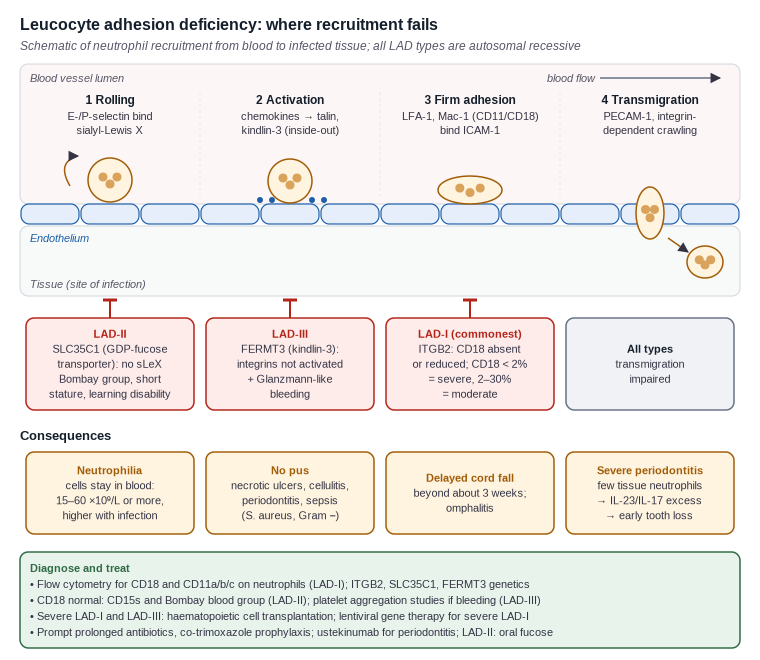
Leucocyte adhesion deficiency (LAD) comprises autosomal recessive disorders in which neutrophils cannot leave the bloodstream to reach infected tissue. In LAD-I, the commonest, mutations in ITGB2 remove the CD18 β2-integrin subunit, so neutrophils cannot bind endothelial ICAM-1 firmly and transmigrate. Newborns show delayed separation of the umbilical cord and omphalitis, then recurrent bacterial and fungal skin, mucosal and deep infections that form no pus, poorly healing ulcers and severe periodontitis with early tooth loss. Blood neutrophil counts stay strikingly high. Flow cytometry showing absent or reduced CD18 on neutrophils confirms the diagnosis; under 2% expression defines severe disease, which is usually fatal in early childhood without haematopoietic cell transplantation. LAD-II (fucosylation defect) adds the Bombay blood group, short stature and learning disability; LAD-III (kindlin-3) adds a Glanzmann-like bleeding tendency. Severe forms need HCT; lentiviral gene therapy for severe LAD-I was approved in the USA in 2026, and IL-12/23 blockade helps periodontitis.
Patient case, mechanism, investigations, management, flashcards and exam-style questions.Open the lesson →
Key facts
- All forms are autosomal recessive; LAD-I (ITGB2, CD18) is by far the commonest
- Defect in neutrophil adhesion and transmigration: neutrophils stay in the blood and do not reach tissues
- Delayed umbilical cord separation (beyond about 3 weeks) and omphalitis are classic neonatal clues
- Infections without pus: necrotic skin ulcers, cellulitis, periodontitis, otitis, sepsis with S. aureus and Gram-negative bacteria
- Persistent marked neutrophilia, often 15–60 × 10⁹/L or more, rising further with infection
- Diagnosis: flow cytometry for CD18/CD11 on neutrophils; under 2% expression = severe LAD-I
- LAD-II: SLC35C1, absent sialyl-Lewis X, Bombay phenotype, short stature; LAD-III: FERMT3 (kindlin-3), bleeding
- Severe LAD-I and LAD-III need HCT; gene therapy is an emerging option; ustekinumab helps periodontitis
Differential diagnosis
| Condition | Clues | Key test |
|---|---|---|
| Chronic granulomatous disease | Abscesses with pus and granulomas; normal cord separation | DHR test |
| Severe congenital neutropenia | Ulcers and periodontitis but low neutrophils | Repeated neutrophil counts, ELANE genetics |
| Leukaemoid reaction from infection | Neutrophilia that resolves when infection clears | Repeat FBC when well; CD18 normal |
| Juvenile myelomonocytic leukaemia | Leucocytosis, splenomegaly, monocytosis | Blood film, marrow, genetics |
| Glanzmann thrombasthenia | Bleeding with normal platelet count (overlaps LAD-III) | Platelet aggregation, CD41/CD61; no infections |
| STAT3 hyper-IgE syndrome | Recurrent staphylococcal abscesses and eczema | High IgE; abscesses form pus-like collections |
| Omphalitis from poor cord care | Umbilical infection in a neonate | Normal neutrophil count and cord separation |
Exam pearls
Guideline
IUIS classification of inborn errors of immunity (2024 update), ESID working definitions (2019) and published evidence on LAD-I treatment (case review 2018; lentiviral gene therapy trial 2025)
References
- Poli MC, Aksentijevich I, Bousfiha AA, et al.. Human inborn errors of immunity: 2024 update on the classification from the International Union of Immunological Societies Expert Committee. J Hum Immun 2025.
- Seidel MG, Kindle G, Gathmann B, et al.. The European Society for Immunodeficiencies (ESID) Registry working definitions for the clinical diagnosis of inborn errors of immunity. J Allergy Clin Immunol Pract 2019.
- Almarza Novoa E, Kasbekar S, Thrasher AJ, et al.. Leukocyte adhesion deficiency-I: a comprehensive review of all published cases. J Allergy Clin Immunol Pract 2018.
- Booth C, Sevilla J, Almarza E, et al.. Lentiviral gene therapy for severe leukocyte adhesion deficiency type 1. N Engl J Med 2025.
- Moutsopoulos NM, Zerbe CS, Wild T, et al.. Interleukin-12 and interleukin-23 blockade in leukocyte adhesion deficiency type 1. N Engl J Med 2017.
- Svensson L, Howarth K, McDowall A, et al.. Leukocyte adhesion deficiency-III is caused by mutations in KINDLIN3 affecting integrin activation. Nat Med 2009.
Related topics
By Dr Khalid Seidi (B.Sc., M.D.) · MedEd World Clinical Knowledge library. Original teaching content checked against current guidelines (November 2026); confirm the latest local guidance before clinical use. Not a substitute for clinical judgement.