Clinical Knowledge › Neurology › Dementia and cognitive disorders
Frontotemporal dementia
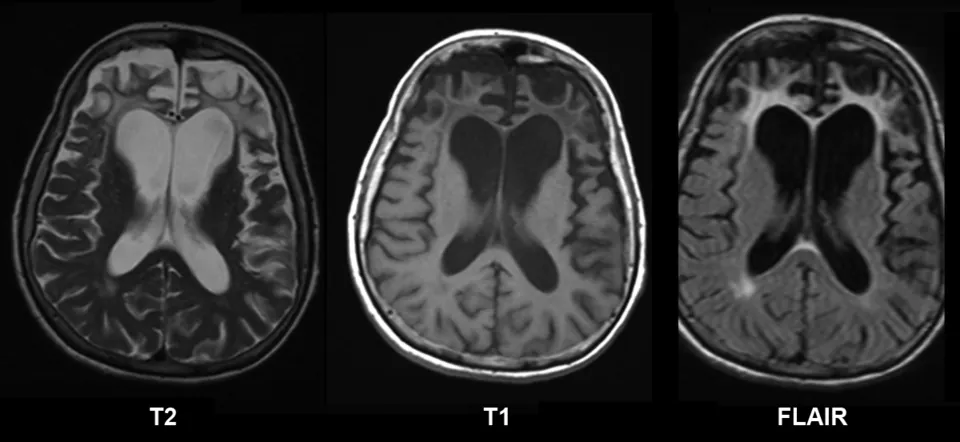
Frontotemporal dementia (FTD) is a group of neurodegenerative disorders caused by frontotemporal lobar degeneration (FTLD), with progressive atrophy of the frontal and/or anterior temporal lobes. The behavioural variant (bvFTD) presents with disinhibition, apathy, loss of empathy, compulsive or ritualistic behaviour, hyperorality and dysexecutive function, with relatively preserved memory and visuospatial skills early on. The language presentations are the primary progressive aphasias: non-fluent/agrammatic and semantic variants. Up to 40% have a family history; C9orf72 repeat expansions, MAPT and GRN mutations are the main genes, and FTD overlaps with MND, PSP and corticobasal syndrome. Diagnosis uses the Rascovsky (bvFTD) and Gorno-Tempini (PPA) criteria with MRI showing frontal or anterior temporal atrophy and FDG-PET hypometabolism. There is no disease-modifying therapy: management is supportive, with SSRIs or trazodone for behaviour, carer support, safety planning and genetic counselling. Cholinesterase inhibitors do not help and may worsen behaviour.
Patient case, mechanism, investigations, management, flashcards and exam-style questions.Open the lesson →
Key facts
- FTD is the second commonest young-onset dementia after Alzheimer disease, usually beginning between 45 and 65 years
- bvFTD needs 3 of 6 Rascovsky features: disinhibition, apathy, loss of empathy, compulsive behaviour, hyperorality and an executive-predominant cognitive profile
- Episodic memory and visuospatial function are relatively spared early, so MMSE can be normal while behaviour is grossly abnormal
- Semantic variant PPA: fluent speech with loss of word meaning and anterior temporal (often left) atrophy; usually TDP-43 type C pathology
- Non-fluent/agrammatic PPA: effortful, agrammatic speech and apraxia of speech with left posterior frontoinsular atrophy; often tauopathy
- C9orf72 hexanucleotide repeat expansion is the commonest genetic cause and links FTD with motor neurone disease
- Cholinesterase inhibitors and memantine are not effective in FTD and may worsen agitation
- Up to 15% of people with FTD develop motor neurone disease; look for fasciculations, wasting and bulbar signs
Differential diagnosis
| Condition | Clues | Key test |
|---|---|---|
| Alzheimer disease (including frontal variant) | Early episodic memory loss, older onset, logopenic language | CSF or plasma amyloid/tau biomarkers; amyloid PET |
| Late-onset bipolar disorder or depression | Mood episodes, preserved insight, no progressive atrophy | Psychiatric assessment; normal serial MRI and FDG-PET |
| Dementia with Lewy bodies | Visual hallucinations, fluctuation, parkinsonism, REM sleep behaviour disorder | DaT-SPECT showing reduced striatal uptake |
| Huntington disease | Chorea, family history, psychiatric change | HTT CAG repeat genetic test |
| Frontal lobe tumour or subdural haematoma | Headache, focal signs, papilloedema | MRI brain with contrast |
| Behavioural variant phenocopy | Long-standing static symptoms in men, no atrophy, no progression | Serial MRI and FDG-PET normal over years |
| Neurosyphilis, HIV or autoimmune encephalitis | Subacute course, systemic or CSF features | Syphilis and HIV serology, CSF, antineuronal antibodies |
Exam pearls
Guideline
International bvFTD Criteria Consortium (Rascovsky 2011), international PPA classification (Gorno-Tempini 2011), NICE NG97 Dementia (2018) and DSM-5-TR (2022)
References
- Rascovsky K, Hodges JR, Knopman D, et al.. Sensitivity of revised diagnostic criteria for the behavioural variant of frontotemporal dementia. Brain 2011.
- Gorno-Tempini ML, Hillis AE, Weintraub S, et al.. Classification of primary progressive aphasia and its variants. Neurology 2011.
- National Institute for Health and Care Excellence. Dementia: assessment, management and support for people living with dementia and their carers (NG97). NICE 2018.
- Bang J, Spina S, Miller BL. Frontotemporal dementia. Lancet 2015.
- American Psychiatric Association. Diagnostic and Statistical Manual of Mental Disorders, Fifth Edition, Text Revision (DSM-5-TR). 2022.
- Penman ID, Ralston SH, Strachan MWJ, Hobson RP, eds.. Davidson's Principles and Practice of Medicine. 2022.
Related topics
By Dr Khalid Seidi (B.Sc., M.D.) · MedEd World Clinical Knowledge library. Original teaching content checked against current guidelines (November 2026); confirm the latest local guidance before clinical use. Not a substitute for clinical judgement.