Clinical Knowledge › Neurology › Dementia and cognitive disorders
Transient global amnesia
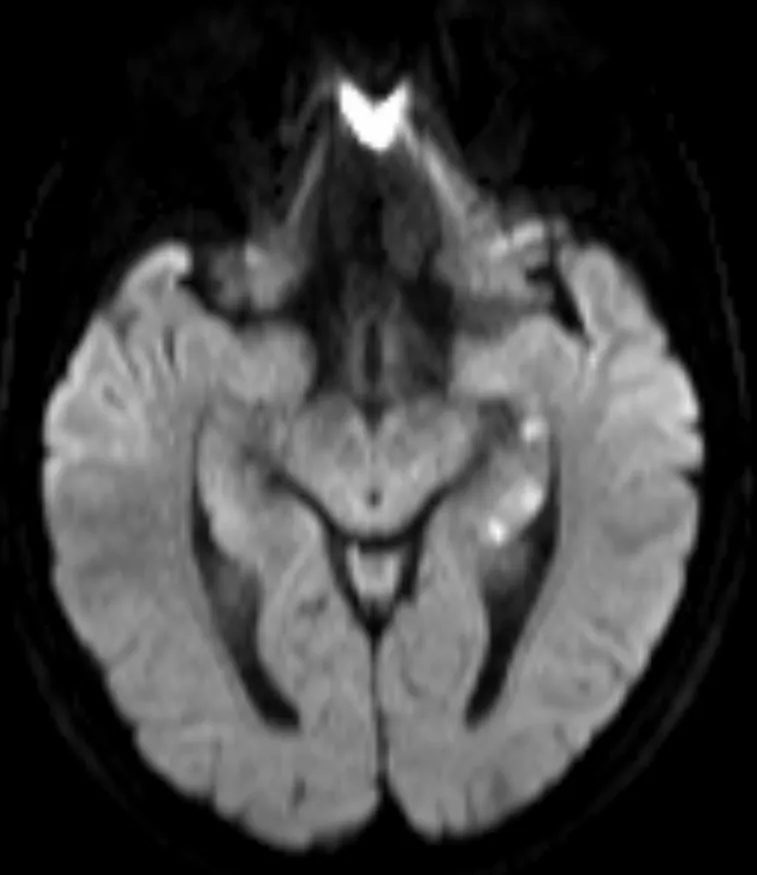
Transient global amnesia (TGA) is a benign syndrome of sudden, isolated, dense anterograde amnesia lasting up to 24 hours (typically 4–8 hours) in a person who remains alert, attentive and able to perform complex tasks. Patients repeatedly ask the same questions ('Where am I? What are we doing here?'), and there is a variable retrograde amnesia that shrinks as the episode resolves, leaving a permanent gap for the attack itself. It mainly affects people aged 50–70 and is often triggered by physical exertion, cold water immersion, emotional stress, sexual intercourse or Valsalva-type activity. Diagnosis rests on the Hodges and Warlow criteria: witnessed attack, no clouding of consciousness or loss of personal identity, cognition limited to amnesia, no focal signs or epileptic features, resolution within 24 hours, and no recent head injury or active epilepsy. Delayed MRI DWI (24–72 hours) often shows tiny punctate lesions in the CA1 field of the hippocampus. No treatment is needed; recurrence occurs in under 10% per lifetime, and TGA does not increase stroke risk.
Patient case, mechanism, investigations, management, flashcards and exam-style questions.Open the lesson →
Key facts
- Sudden anterograde amnesia with repetitive questioning, preserved alertness and personal identity, resolving within 24 hours
- Typical age 50–70; episodes usually last 4–8 hours
- Common precipitants: exertion, cold water, emotional stress, sexual intercourse, Valsalva manoeuvres, medical procedures
- Hodges and Warlow criteria require a witness, no focal signs, no epileptic features, no recent head injury or active epilepsy
- Delayed DWI MRI (24–72 h) shows punctate CA1 hippocampal lesions in up to 70%
- Recurrence rate is low (about 5–10% overall) and there is no increase in stroke risk
- Attacks lasting under 1 hour, recurrent brief attacks or attacks on waking suggest transient epileptic amnesia
- No specific treatment, antiplatelet therapy or driving restriction is usually needed after a typical episode (check local licensing rules)
Differential diagnosis
| Condition | Clues | Key test |
|---|---|---|
| Transient ischaemic attack or posterior circulation stroke | Focal signs (hemianopia, ataxia, dysarthria), vascular risk factors | MRI DWI showing infarct; vascular imaging |
| Transient epileptic amnesia | Brief (under 1 hour) recurrent episodes, often on waking, olfactory aura | EEG (sleep-deprived); response to antiseizure medicine |
| Psychogenic (dissociative) amnesia | Loss of personal identity, emotional trigger, inconsistent deficits | Psychiatric assessment |
| Drug or alcohol intoxication | Benzodiazepines, alcohol blackout, impaired attention | Toxicology; history |
| Hypoglycaemia | Diabetes on insulin or sulfonylurea, autonomic symptoms | Capillary glucose |
| Head injury (post-traumatic amnesia) | Trauma history, headache, vomiting | CT head |
| Herpes simplex encephalitis | Fever, headache, behavioural change, seizures | MRI temporal lobes and CSF HSV PCR |
Exam pearls
Guideline
Hodges and Warlow diagnostic criteria for TGA (1990), with contemporary reviews (Bartsch and Deuschl 2010; Arena and Rabinstein 2015)
References
- Hodges JR, Warlow CP. Syndromes of transient amnesia: towards a classification. A study of 153 cases. J Neurol Neurosurg Psychiatry 1990.
- Bartsch T, Deuschl G. Transient global amnesia: functional anatomy and clinical implications. Lancet Neurol 2010.
- Arena JE, Rabinstein AA. Transient global amnesia. Mayo Clin Proc 2015.
- Penman ID, Ralston SH, Strachan MWJ, Hobson RP, eds.. Davidson's Principles and Practice of Medicine. 2022.
- Loscalzo J, Fauci AS, Kasper DL, et al., eds.. Harrison's Principles of Internal Medicine. 2022.
- Papadakis MA, McPhee SJ, Rabow MW, et al., eds.. Current Medical Diagnosis and Treatment 2026. 2026.
Related topics
By Dr Khalid Seidi (B.Sc., M.D.) · MedEd World Clinical Knowledge library. Original teaching content checked against current guidelines (November 2026); confirm the latest local guidance before clinical use. Not a substitute for clinical judgement.