Clinical Knowledge › Neurology › Dementia and cognitive disorders
Normal pressure hydrocephalus
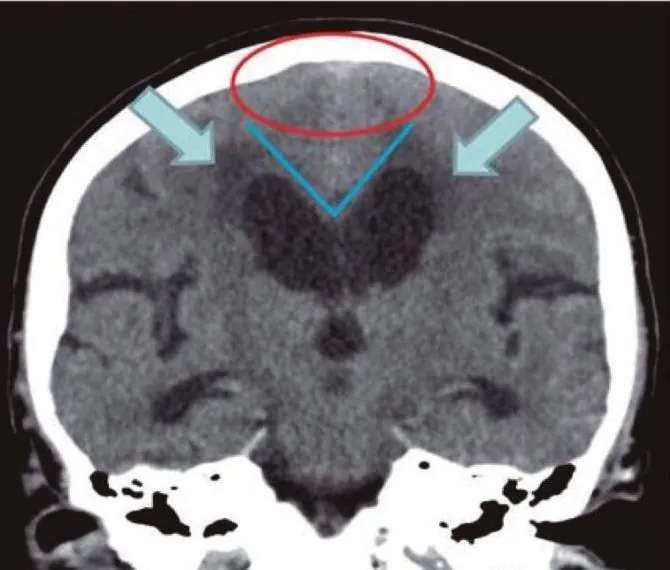
Normal pressure hydrocephalus (NPH) is a syndrome of ventricular enlargement with normal or near-normal opening CSF pressure, classically causing the triad of gait disturbance, cognitive impairment and urinary urgency or incontinence. Idiopathic NPH (iNPH) affects older adults, usually over 60, and is linked to impaired CSF absorption and reduced compliance; secondary NPH follows subarachnoid haemorrhage, meningitis or head injury. Gait is the earliest and most responsive feature: broad-based, magnetic, short-stepped and shuffling with poor turning, but with preserved arm swing and no rest tremor. MRI or CT shows ventriculomegaly (Evans index over 0.3) out of proportion to sulcal atrophy, often with DESH and a narrow callosal angle. Diagnosis is supported by improvement after a large-volume lumbar tap test or extended lumbar drainage. Ventriculoperitoneal or lumboperitoneal shunting improves gait in most carefully selected patients, with less benefit for cognition. Shunt complications include over-drainage subdural haematoma, infection and obstruction.
Patient case, mechanism, investigations, management, flashcards and exam-style questions.Open the lesson →
Key facts
- Classic triad: gait apraxia, cognitive impairment (subcortical, frontal) and urinary urgency or incontinence ('wet, wobbly and wacky')
- Gait disturbance is usually the first and most shunt-responsive feature; the full triad is present in only about half
- Evans index (frontal horn width/maximal inner skull width) greater than 0.3 defines ventriculomegaly
- DESH: tight high-convexity sulci with enlarged Sylvian fissures, plus callosal angle less than 90 degrees, supports iNPH
- Opening pressure at lumbar puncture is normal or mildly raised (typically up to about 20–25 cmH2O)
- CSF tap test (30–50 mL) with timed gait assessment before and after predicts shunt response; a negative test does not exclude benefit
- Programmable-valve ventriculoperitoneal shunting improves gait in about 70–90% of well-selected patients
- Subdural haematoma from over-drainage is the commonest shunt complication after obstruction
Differential diagnosis
| Condition | Clues | Key test |
|---|---|---|
| Parkinson disease | Rest tremor, asymmetric bradykinesia, reduced arm swing, levodopa response | DaT-SPECT; levodopa trial |
| Vascular parkinsonism (lower-body) | Vascular risk factors, white matter disease, step-wise course | MRI white matter hyperintensities and lacunes |
| Alzheimer disease | Early episodic memory loss, gait preserved until late | Amyloid and tau biomarkers; hippocampal atrophy |
| Progressive supranuclear palsy | Early falls, vertical gaze palsy, axial rigidity | MRI midbrain atrophy ('hummingbird' sign) |
| Cervical myelopathy or lumbar canal stenosis | Spasticity, sensory level or neurogenic claudication | MRI spine |
| Obstructive hydrocephalus | Headache, papilloedema, raised pressure | MRI showing obstructing lesion (for example aqueduct stenosis) |
| Ex vacuo ventriculomegaly from atrophy | Sulci also widened proportionally | MRI: no DESH, normal callosal angle |
Exam pearls
Guideline
Japanese Guidelines for Management of Idiopathic NPH, 3rd edition (2021), International iNPH Guidelines (Relkin 2005) and NICE NG97 Dementia (2018)
References
- Nakajima M, Yamada S, Miyajima M, et al.. Guidelines for Management of Idiopathic Normal Pressure Hydrocephalus (Third Edition): Endorsed by the Japanese Society of Normal Pressure Hydrocephalus. Neurol Med Chir (Tokyo) 2021.
- Relkin N, Marmarou A, Klinge P, et al.. Diagnosing idiopathic normal-pressure hydrocephalus. Neurosurgery 2005.
- National Institute for Health and Care Excellence. Dementia: assessment, management and support for people living with dementia and their carers (NG97). NICE 2018.
- Penman ID, Ralston SH, Strachan MWJ, Hobson RP, eds.. Davidson's Principles and Practice of Medicine. 2022.
- Loscalzo J, Fauci AS, Kasper DL, et al., eds.. Harrison's Principles of Internal Medicine. 2022.
- Papadakis MA, McPhee SJ, Rabow MW, et al., eds.. Current Medical Diagnosis and Treatment 2026. 2026.
Related topics
By Dr Khalid Seidi (B.Sc., M.D.) · MedEd World Clinical Knowledge library. Original teaching content checked against current guidelines (November 2026); confirm the latest local guidance before clinical use. Not a substitute for clinical judgement.