Clinical Knowledge › Internal medicine › Gastroenterology and hepatology › Diseases of the stomach and duodenum
Gastric cancer
Gastric cancer is almost always an adenocarcinoma arising from the gastric mucosa. It is the fifth commonest cancer worldwide and is most frequent in East Asia, Eastern Europe and the Andes. Chronic Helicobacter pylori infection drives most non-cardia tumours through the sequence of chronic gastritis, atrophy, intestinal metaplasia and dysplasia; a minority of diffuse tumours are hereditary, notably CDH1-related. Early disease is silent or causes vague dyspepsia, so most patients outside Japan and Korea present late with weight loss, early satiety, anaemia, vomiting or dysphagia. Diagnosis is by endoscopy with multiple biopsies, followed by CT staging, laparoscopy with peritoneal washings for potentially resectable tumours and biomarker testing. Early mucosal cancers can be removed endoscopically; locally advanced tumours are treated with perioperative chemotherapy, now combined with immunotherapy, and gastrectomy with D2 lymphadenectomy. Prevention rests on H. pylori eradication and surveillance of extensive atrophy or intestinal metaplasia.
Patient case, mechanism, investigations, management, flashcards and exam-style questions.Open the lesson →
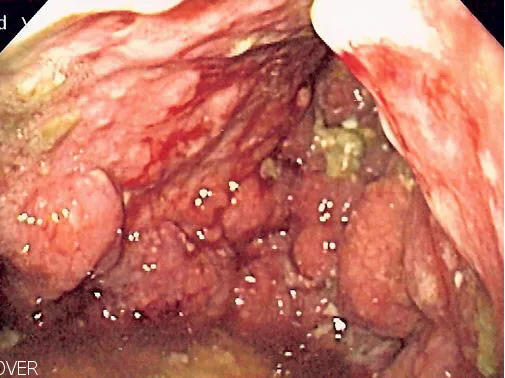
Key facts
- About 95% of gastric cancers are adenocarcinomas; Lauren classification separates intestinal and diffuse (signet-ring) types
- H. pylori is a class I carcinogen and causes most non-cardia gastric cancer via the Correa cascade
- Alarm features (weight loss, dysphagia, anaemia, persistent vomiting, GI bleeding, mass) need urgent endoscopy with biopsy
- Staging: CT chest, abdomen and pelvis; endoscopic ultrasound for early tumours; staging laparoscopy with washings before radical surgery
- Test every advanced or resectable cancer for HER2, PD-L1 (CPS), mismatch repair/MSI and claudin 18.2
- Resectable cT2+ or node-positive disease: perioperative FLOT, now with durvalumab (MATTERHORN), plus gastrectomy with D2 lymphadenectomy
- Endoscopic submucosal dissection cures carefully selected early (mucosal) gastric cancers
- Total gastrectomy causes lifelong vitamin B12 deficiency: give intramuscular hydroxocobalamin
Differential diagnosis
| Condition | Clues | Key test |
|---|---|---|
| Peptic ulcer disease | Episodic epigastric pain, NSAID or H. pylori history; benign-looking ulcer | Endoscopy with biopsy of every gastric ulcer and repeat endoscopy to confirm healing |
| Functional dyspepsia | Long history, young patient, no weight loss or anaemia | Normal endoscopy; H. pylori test-and-treat |
| Gastric MALT lymphoma | Similar symptoms; H. pylori positive; may regress with eradication | Biopsy with immunohistochemistry and t(11;18) testing |
| Gastrointestinal stromal tumour | Submucosal mass with central ulceration and bleeding | EUS-guided biopsy; KIT (CD117) and DOG1 staining |
| Oesophageal adenocarcinoma | Progressive dysphagia, Barrett history; tumour above the junction | Endoscopy; Siewert classification of junctional tumours |
| Pancreatic cancer | Weight loss, back pain, painless jaundice, new diabetes | Pancreas-protocol CT |
| Gastric outlet obstruction from benign stricture | Vomiting of undigested food, succussion splash, chronic ulcer history | Endoscopy with biopsy after gastric decompression |
Exam pearls
Guideline
ESMO Clinical Practice Guideline for gastric cancer (2022, with later ESMO updates), MAPS III (ESGE/EHMSG/ESP 2025), BSG guidelines on patients at risk of gastric adenocarcinoma (2019) and Maastricht VI/Florence consensus (2022)
References
- Lordick F, Carneiro F, Cascinu S, Fleitas T, Haustermans K, Piessen G, Vogel A, Smyth EC; ESMO Guidelines Committee.. Gastric cancer: ESMO Clinical Practice Guideline for diagnosis, treatment and follow-up. Ann Oncol 2022.
- Janjigian YY, Al-Batran SE, Wainberg ZA, et al.. Perioperative durvalumab in gastric and gastroesophageal junction cancer. N Engl J Med 2025.
- Al-Batran SE, Homann N, Pauligk C, et al.. Perioperative chemotherapy with fluorouracil plus leucovorin, oxaliplatin, and docetaxel versus fluorouracil or capecitabine plus cisplatin and epirubicin for locally advanced, resectable gastric or gastro-oesophageal junction adenocarcinoma (FLOT4): a randomised, phase 2/3 trial. Lancet 2019.
- Janjigian YY, Shitara K, Moehler M, et al.. First-line nivolumab plus chemotherapy versus chemotherapy alone for advanced gastric, gastro-oesophageal junction, and oesophageal adenocarcinoma (CheckMate 649): a randomised, open-label, phase 3 trial. Lancet 2021.
- Banks M, Graham D, Jansen M, et al.. British Society of Gastroenterology guidelines on the diagnosis and management of patients at risk of gastric adenocarcinoma. Gut 2019.
- Dinis-Ribeiro M, Libânio D, Uchima H, et al.. Management of epithelial precancerous conditions and early neoplasia of the stomach (MAPS III): European Society of Gastrointestinal Endoscopy (ESGE), European Helicobacter and Microbiota Study Group (EHMSG) and European Society of Pathology (ESP) Guideline update 2025. Endoscopy 2025.
Related topics
By Dr Khalid Seidi (B.Sc., M.D.) · MedEd World Clinical Knowledge library. Original teaching content checked against current guidelines (November 2026); confirm the latest local guidance before clinical use. Not a substitute for clinical judgement.