Clinical Knowledge › Internal medicine › Gastroenterology and hepatology › Diseases of the stomach and duodenum
Gastrointestinal stromal tumour (GIST)
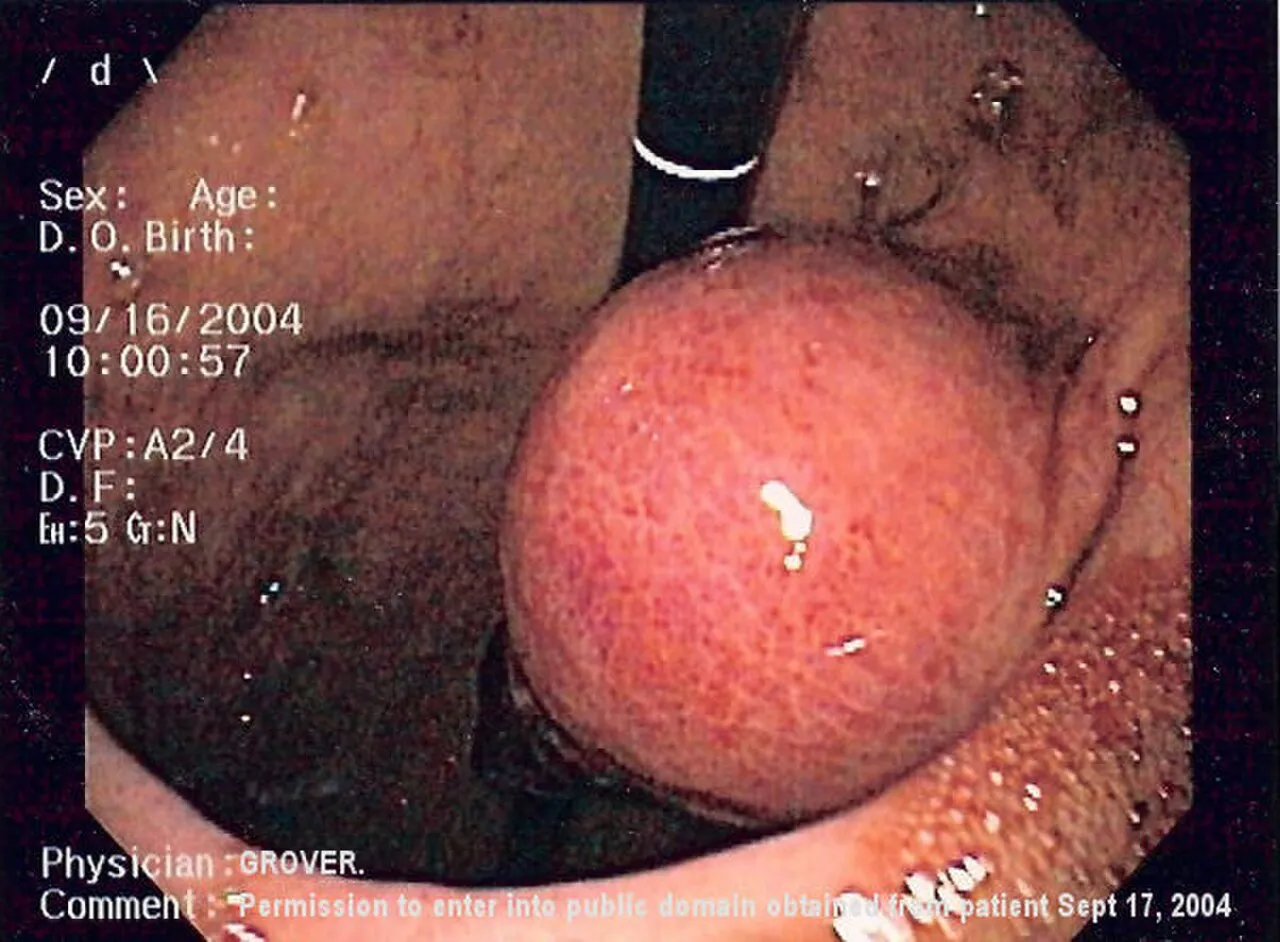
Gastrointestinal stromal tumour (GIST) is the commonest mesenchymal tumour of the gastrointestinal tract, arising from the interstitial cells of Cajal or their precursors. Most are driven by activating mutations of the KIT or PDGFRA receptor tyrosine kinases, and almost all stain for KIT (CD117) and DOG1. About 60% occur in the stomach and 30% in the small bowel. Small tumours are often incidental; larger ones cause bleeding from mucosal ulceration, anaemia, pain, a mass or obstruction, and can rupture. At endoscopy a GIST appears as a smooth subepithelial bulge, sometimes with central ulceration; endoscopic ultrasound shows a hypoechoic mass arising from the muscularis propria, and contrast CT stages the disease. Recurrence risk is estimated from tumour size, mitotic count, site and rupture. Localised GISTs are removed with clear margins and an intact capsule, without routine lymphadenectomy. High-risk patients receive adjuvant imatinib for 3 years, and advanced disease is treated sequentially with imatinib, sunitinib, regorafenib and ripretinib, guided by mutation analysis (avapritinib for PDGFRA D842V).
Patient case, mechanism, investigations, management, flashcards and exam-style questions.Open the lesson →
Key facts
- GIST arises from interstitial cells of Cajal; most have activating KIT (about 75–80%) or PDGFRA (about 10%) mutations
- Immunohistochemistry: CD117 (KIT) and DOG1 positive in almost all cases; DOG1 helps in KIT-negative tumours
- Stomach about 60%, small intestine about 30%, duodenum, rectum and oesophagus less often; spread is to liver and peritoneum, rarely to lymph nodes
- Risk of recurrence depends on size, mitotic count per 5 mm², site (gastric better than small bowel) and tumour rupture
- Surgery: R0 excision with intact pseudocapsule, no routine lymphadenectomy; avoid rupture
- Adjuvant imatinib 400 mg daily for 3 years for high-risk resected GIST improves recurrence-free and overall survival
- Mutation analysis guides therapy: KIT exon 9 needs imatinib 800 mg in advanced disease; PDGFRA D842V is imatinib-resistant and responds to avapritinib
- Advanced disease: imatinib, then sunitinib, regorafenib and ripretinib; imatinib should be continued indefinitely while it works
Differential diagnosis
| Condition | Clues | Key test |
|---|---|---|
| Leiomyoma | Subepithelial lesion often in oesophagus; desmin and SMA positive | EUS-guided biopsy: KIT and DOG1 negative |
| Schwannoma | Gastric subepithelial mass with lymphoid cuff | Biopsy: S100 positive, KIT negative |
| Gastric adenocarcinoma | Mucosal ulcer with irregular margins, weight loss | Endoscopic mucosal biopsy |
| Ectopic pancreas (pancreatic rest) | Antral submucosal nodule with central umbilication | EUS: heterogeneous lesion in submucosa with ductal structures |
| Gastric neuroendocrine tumour | Small polypoid lesion, often multiple with atrophic gastritis | Biopsy: chromogranin and synaptophysin positive |
| Lymphoma | Thick folds or mass with lymphadenopathy, B symptoms | Biopsy with lymphoid markers |
| Desmoid tumour (mesenteric fibromatosis) | Mesenteric mass, often after surgery or in FAP | Biopsy: nuclear beta-catenin, KIT negative |
Exam pearls
Guideline
ESMO–EURACAN–GENTURIS Clinical Practice Guidelines for gastrointestinal stromal tumours (2022) and NCCN Guidelines for GIST (current annual version)
References
- Casali PG, Blay JY, Abecassis N, et al.. Gastrointestinal stromal tumours: ESMO-EURACAN-GENTURIS Clinical Practice Guidelines for diagnosis, treatment and follow-up. Ann Oncol 2022.
- National Comprehensive Cancer Network. NCCN Clinical Practice Guidelines in Oncology: Gastrointestinal Stromal Tumors (GISTs). NCCN 2025.
- Joensuu H.. Risk stratification of patients diagnosed with gastrointestinal stromal tumor. Hum Pathol 2008.
- Joensuu H, Eriksson M, Sundby Hall K, et al.. One vs three years of adjuvant imatinib for operable gastrointestinal stromal tumor: a randomized trial. JAMA 2012.
- Blay JY, Serrano C, Heinrich MC, et al.. Ripretinib in patients with advanced gastrointestinal stromal tumours (INVICTUS): a double-blind, randomised, placebo-controlled, phase 3 trial. Lancet Oncol 2020.
- Heinrich MC, Jones RL, von Mehren M, et al.. Avapritinib in advanced PDGFRA D842V-mutant gastrointestinal stromal tumour (NAVIGATOR): a multicentre, open-label, phase 1 trial. Lancet Oncol 2020.
Related topics
By Dr Khalid Seidi (B.Sc., M.D.) · MedEd World Clinical Knowledge library. Original teaching content checked against current guidelines (November 2026); confirm the latest local guidance before clinical use. Not a substitute for clinical judgement.