Clinical Knowledge › Internal medicine › Gastroenterology and hepatology › Diseases of the stomach and duodenum
Peptic ulcer disease
Peptic ulcer disease is a break in the lining of the stomach or duodenum that extends through the muscularis mucosae, produced when acid and pepsin overwhelm mucosal defences. Almost all ulcers are caused by Helicobacter pylori infection, non-steroidal anti-inflammatory drugs (including low-dose aspirin) or both; rarer causes include gastrinoma, critical illness and malignancy. Many ulcers cause epigastric pain, but a large share, especially in older NSAID users, are silent until a complication occurs. Bleeding is the commonest complication, followed by perforation and gastric outlet obstruction. Diagnosis is by endoscopy, with biopsy of every gastric ulcer and testing for H. pylori. Treatment heals the ulcer with a proton pump inhibitor and removes the cause: eradicate H. pylori, confirm cure and stop or protect against NSAIDs. Bleeding ulcers are managed with resuscitation, early endoscopy, endoscopic haemostasis for high-risk stigmata and high-dose PPI.
Patient case, mechanism, investigations, management, flashcards and exam-style questions.Open the lesson →
Key facts
- H. pylori and NSAIDs (including low-dose aspirin) cause the great majority of peptic ulcers
- Duodenal ulcers are more common than gastric ulcers and are almost never malignant; every gastric ulcer must be biopsied
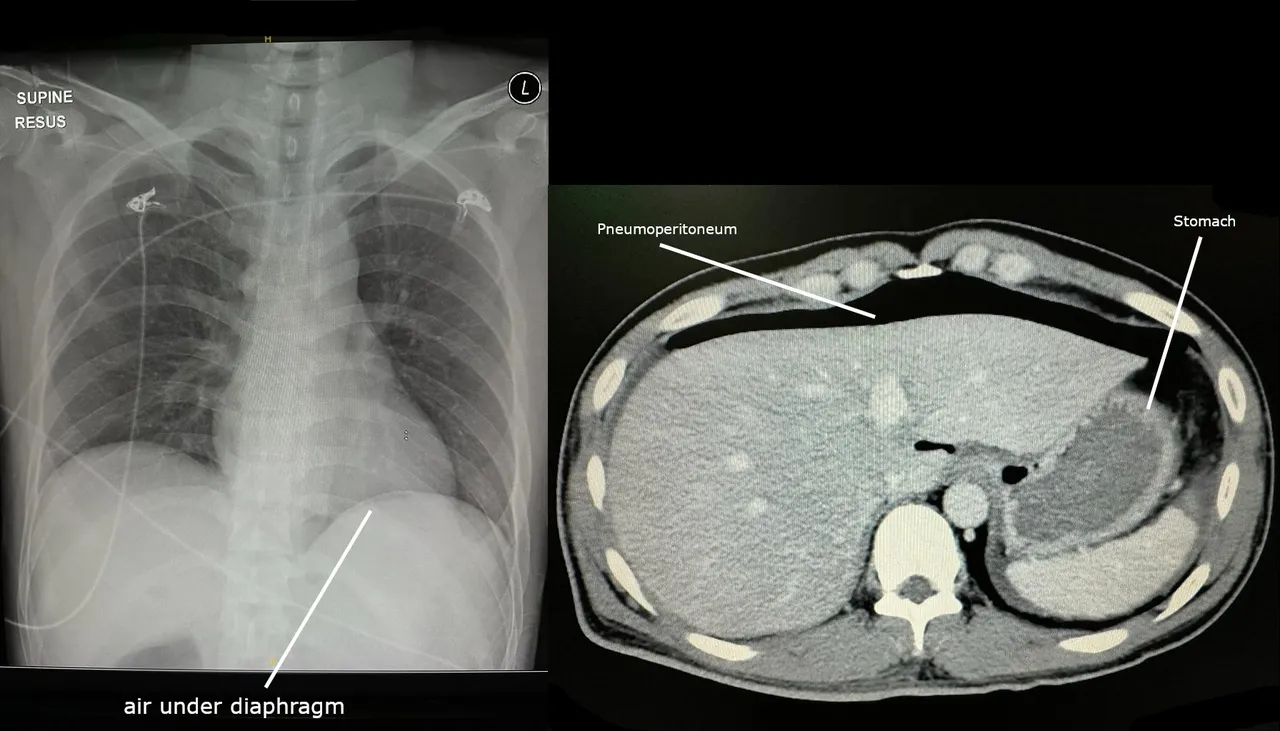
- Bleeding is the commonest complication; perforation presents with sudden severe pain, peritonism and free gas
- Heal with a PPI (for example omeprazole 20–40 mg daily for 4–8 weeks) and remove the cause
- Test all ulcer patients for H. pylori; a negative test during acute bleeding should be repeated later
- Forrest Ia, Ib (active bleeding) and IIa (visible vessel) need endoscopic therapy; IIb (adherent clot) may be treated after clot removal
- After endoscopic haemostasis give high-dose PPI for 3 days (bolus plus infusion, or intermittent high dose), then twice daily to complete 2 weeks
- Restart low-dose aspirin for secondary prevention as soon as haemostasis is secure, ideally within 3–5 days, with a PPI
Differential diagnosis
| Condition | Clues | Key test |
|---|---|---|
| Functional dyspepsia | Chronic epigastric symptoms with normal endoscopy | Endoscopy; H. pylori testing |
| Gastric cancer | Older age, weight loss, anaemia, irregular ulcer with raised edges | Endoscopy with multiple biopsies |
| Gastro-oesophageal reflux disease | Retrosternal heartburn and regurgitation | Clinical; endoscopy |
| Biliary colic or cholecystitis | Right upper quadrant pain after fatty meals; Murphy sign | Ultrasound |
| Acute pancreatitis | Severe epigastric pain radiating to the back with vomiting | Serum lipase; CT if unclear |
| Acute coronary syndrome | Epigastric pain with sweating, exertion or vascular risk | ECG and troponin |
| Zollinger–Ellison syndrome | Multiple, distal or refractory ulcers with diarrhoea | Fasting gastrin off PPI with gastric pH; secretin test |
Exam pearls
Guideline
ACG upper GI and ulcer bleeding guideline (2021), ESGE non-variceal upper GI haemorrhage guideline (2021), Maastricht VI/Florence (2022) and ACG H. pylori treatment guideline (2024)
References
- Lanas A, Chan FKL.. Peptic ulcer disease. Lancet 2017.
- Laine L, Barkun AN, Saltzman JR, Martel M, Leontiadis GI.. ACG Clinical Guideline: Upper Gastrointestinal and Ulcer Bleeding. Am J Gastroenterol 2021.
- Gralnek IM, Stanley AJ, Morris AJ, et al.. Endoscopic diagnosis and management of nonvariceal upper gastrointestinal hemorrhage (NVUGIH): European Society of Gastrointestinal Endoscopy (ESGE) Guideline - Update 2021. Endoscopy 2021.
- Malfertheiner P, Megraud F, Rokkas T, et al.. Management of Helicobacter pylori infection: the Maastricht VI/Florence consensus report. Gut 2022.
- Chey WD, Howden CW, Moss SF, Morgan DR, Greer KB, Grover S, Shah SC.. ACG Clinical Guideline: Treatment of Helicobacter pylori Infection. Am J Gastroenterol 2024.
- Tarasconi A, Coccolini F, Biffl WL, et al.. Perforated and bleeding peptic ulcer: WSES guidelines. World J Emerg Surg 2020.
Related topics
By Dr Khalid Seidi (B.Sc., M.D.) · MedEd World Clinical Knowledge library. Original teaching content checked against current guidelines (November 2026); confirm the latest local guidance before clinical use. Not a substitute for clinical judgement.