Clinical Knowledge › Internal medicine › Gastroenterology and hepatology › Diseases of the stomach and duodenum
Ménétrier disease
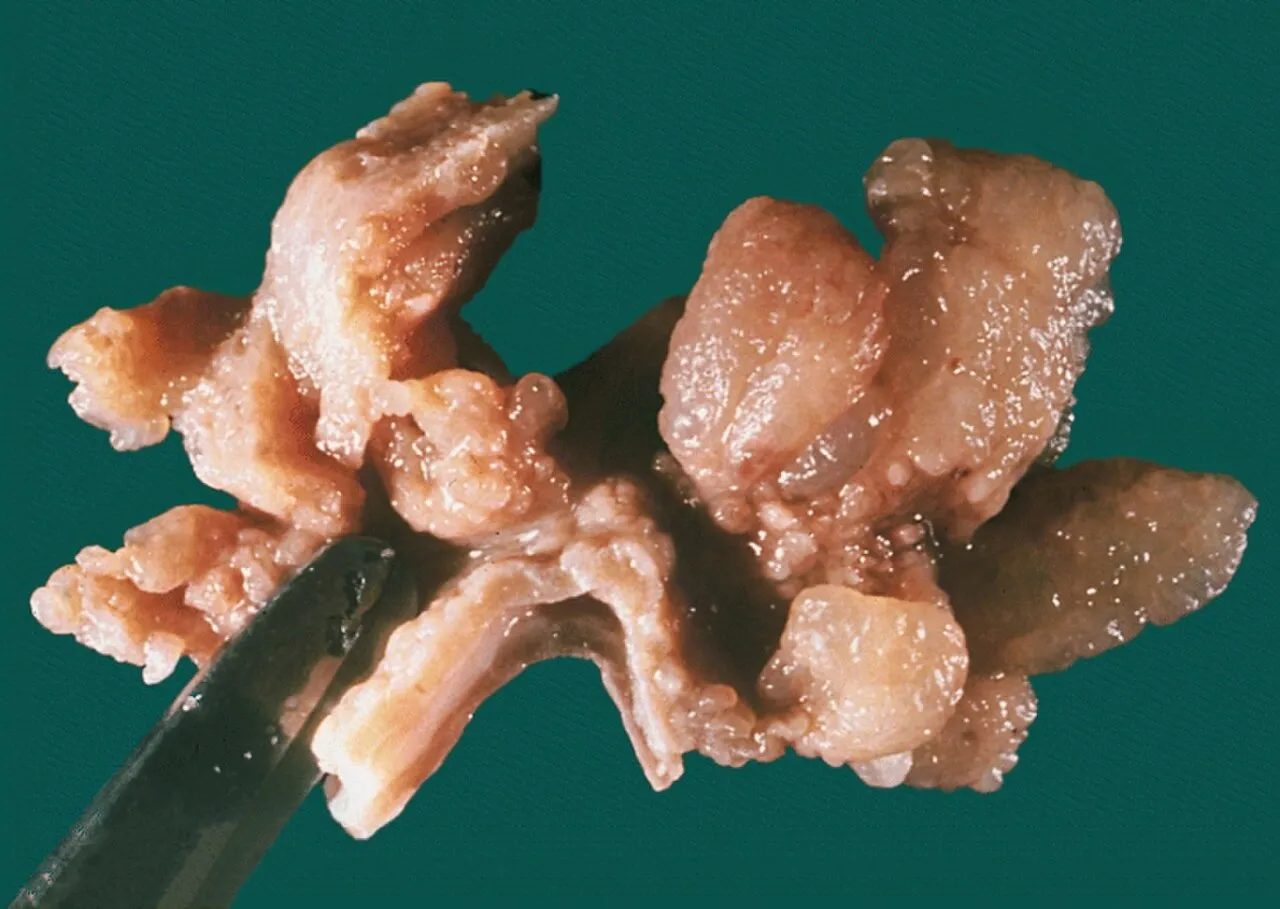
Ménétrier disease is a rare acquired hypertrophic gastropathy in which the folds of the gastric body and fundus become giant and convoluted while the antrum is usually spared. The mucosa shows massive foveolar (surface mucous cell) hyperplasia with tortuous, cystically dilated pits and loss of parietal and chief cells, caused by excessive signalling through the epidermal growth factor receptor (EGFR), driven by transforming growth factor-alpha. The result is a stomach that secretes too much mucus and too little acid, and that leaks plasma protein into the lumen. Adults, usually men in middle age, present with epigastric pain, nausea, vomiting, weight loss and peripheral oedema from hypoalbuminaemia with no liver or kidney cause. In children the disease is usually transient and linked to cytomegalovirus. Diagnosis rests on endoscopy plus a deep or full-thickness biopsy, after excluding gastrinoma, lymphoma, cancer and infiltrative disease. Treatment is supportive, with H. pylori eradication when present; the EGFR antibody cetuximab is the most effective medical therapy, and gastrectomy is reserved for refractory protein loss, bleeding or neoplasia.
Patient case, mechanism, investigations, management, flashcards and exam-style questions.Open the lesson →
Key facts
- Ménétrier disease is a protein-losing hypertrophic gastropathy with giant folds in the body and fundus, usually sparing the antrum
- Histology: massive foveolar hyperplasia with tortuous, cystic pits and reduced parietal and chief cells; little inflammation
- Mechanism: overexpression of TGF-alpha activates EGFR in the gastric mucosa
- Clinical triad: epigastric pain or vomiting, weight loss, and oedema from hypoalbuminaemia
- Hypoalbuminaemia with normal liver function and no proteinuria points to a GI protein leak (raised faecal alpha-1 antitrypsin clearance)
- Gastric acid is low (hypochlorhydria); this distinguishes it from Zollinger–Ellison syndrome, which also causes thick folds
- In children it is usually self-limiting and associated with cytomegalovirus infection
- Cetuximab (anti-EGFR) is the most effective medical therapy; total gastrectomy for refractory disease; endoscopic surveillance for gastric cancer
Differential diagnosis
| Condition | Clues | Key test |
|---|---|---|
| Zollinger–Ellison syndrome | Thick folds with ulcers and diarrhoea; high acid output | Fasting gastrin with gastric pH below 2 |
| Gastric MALT lymphoma or other lymphoma | Thick folds or ulcers; lymphoid infiltrate | Deep biopsy with immunohistochemistry |
| Diffuse (linitis plastica) gastric cancer | Rigid, non-distensible stomach; weight loss | Deep biopsies: signet-ring cells |
| Hyperplastic polyposis or Cronkhite–Canada syndrome | Multiple polyps; alopecia, nail dystrophy in Cronkhite–Canada | Endoscopy and histology of polyps and intervening mucosa |
| H. pylori lymphocytic or hypertrophic gastritis | Thick folds with inflammation | Biopsy: intense inflammation, H. pylori |
| Infiltrative diseases (amyloidosis, sarcoidosis, Crohn disease, tuberculosis, eosinophilic gastritis) | Thick wall with systemic features | Biopsy with special stains; systemic work-up |
| Nephrotic syndrome or liver disease | Hypoalbuminaemia and oedema | Urine protein; liver tests |
Exam pearls
Guideline
No disease-specific international guideline: expert clinical reviews (World Journal of Gastroenterology 2025; QJM 2026), the cetuximab study (Science Translational Medicine 2009) and the Maastricht VI/Florence H. pylori consensus (2022)
References
- Barros AR, Monteiro S, Silva J.. Ménétrier disease: A clinical review. World J Gastroenterol 2025.
- Zhang T, Chen T, Tang X.. Ménétrier's disease: a narrative review of molecular pathogenesis, clinical spectrum and evolving therapeutic strategies. QJM 2026.
- Fiske WH, Tanksley J, Nam KT, et al.. Efficacy of cetuximab in the treatment of Menetrier's disease. Sci Transl Med 2009.
- Malfertheiner P, Megraud F, Rokkas T, et al.. Management of Helicobacter pylori infection: the Maastricht VI/Florence consensus report. Gut 2022.
- Li G, Fu H, Cheng L, et al.. Ménétrier disease in Chinese children: a case report and systematic review. Front Pediatr 2026.
- Wang L, Liu Z, Zhang J, et al.. Robotic-assisted total gastrectomy for refractory hypoproteinemia in Menetrier's disease: a case report with operative video and literature review. Front Med (Lausanne) 2025.
Related topics
By Dr Khalid Seidi (B.Sc., M.D.) · MedEd World Clinical Knowledge library. Original teaching content checked against current guidelines (November 2026); confirm the latest local guidance before clinical use. Not a substitute for clinical judgement.