Clinical Knowledge › Internal medicine › Gastroenterology and hepatology › Diseases of the stomach and duodenum
Helicobacter pylori infection
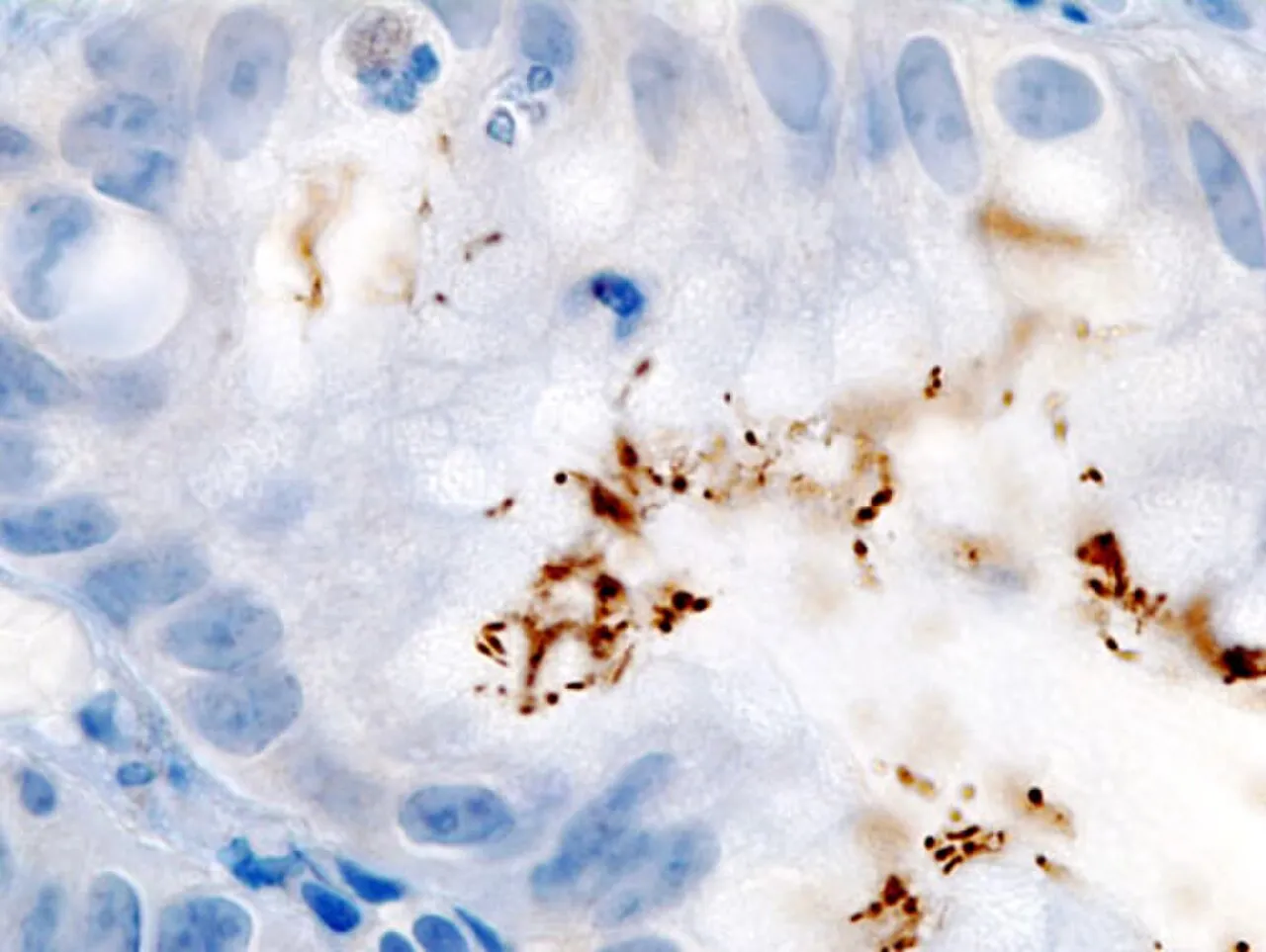
Helicobacter pylori is a spiral, flagellated, urease-producing Gram-negative bacterium that colonises the gastric mucus layer of nearly half of the world's population. Infection is usually acquired in childhood within families and persists for life unless treated. Every infected person develops chronic active gastritis, but most remain symptom-free. A minority develop peptic ulcers, and a smaller number gastric adenocarcinoma or MALT lymphoma, which is why the WHO classifies H. pylori as a group 1 carcinogen. Active infection is diagnosed by urea breath test, stool antigen test or gastric biopsy; serology cannot distinguish past from current infection. Rising clarithromycin resistance has changed treatment: current guidelines (Maastricht VI 2022, ACG 2024) favour 14 days of bismuth quadruple therapy or susceptibility-guided treatment, with vonoprazan-based or rifabutin regimens as alternatives, and require a test of cure in everyone treated.
Patient case, mechanism, investigations, management, flashcards and exam-style questions.Open the lesson →
Key facts
- About 40–50% of the world's population is infected; prevalence is highest in Africa, Latin America and parts of Asia
- Urease converts urea to ammonia and CO2, buffering acid and forming the basis of the urea breath and rapid urease tests
- All infected people have chronic gastritis; about 1 in 10 develops peptic ulcer and about 1–3% gastric cancer
- Test for active infection with urea breath test, monoclonal stool antigen or biopsy; serology is not used to diagnose current infection
- Stop PPIs for 2 weeks and antibiotics or bismuth for 4 weeks before testing to avoid false negatives
- Empirical clarithromycin triple therapy is no longer advised where resistance exceeds 15% or is unknown
- First-line: 14-day bismuth quadruple therapy (PPI, bismuth, tetracycline, metronidazole) or susceptibility-guided therapy
- Confirm eradication in every patient at least 4 weeks after treatment with breath or stool test
Differential diagnosis
| Condition | Clues | Key test |
|---|---|---|
| NSAID gastropathy | NSAID use; erosions or ulcers with negative H. pylori tests | Drug history; H. pylori testing; endoscopy |
| Autoimmune atrophic gastritis | Corpus-predominant atrophy, B12 deficiency, other autoimmune disease | Intrinsic factor and parietal cell antibodies; gastrin; biopsy |
| Functional dyspepsia | Dyspepsia with normal endoscopy and negative tests | Endoscopy; H. pylori testing |
| Gastric adenocarcinoma | Older age, weight loss, anaemia, high-incidence region | Endoscopy with biopsy |
| Gastric MALT lymphoma | Thickened folds or ulceration; usually H. pylori-positive | Endoscopic biopsy with histology and t(11;18) testing |
| Zollinger–Ellison syndrome | Multiple or refractory ulcers, diarrhoea, negative H. pylori | Fasting gastrin with gastric pH |
| Helicobacter heilmannii gastritis | Gastritis with large spiral organisms, animal contact | Histology |
Exam pearls
Guideline
Maastricht VI/Florence consensus (2022) and ACG Clinical Guideline: Treatment of H. pylori Infection (2024)
References
- Malfertheiner P, Megraud F, Rokkas T, et al.. Management of Helicobacter pylori infection: the Maastricht VI/Florence consensus report. Gut 2022.
- Chey WD, Howden CW, Moss SF, Morgan DR, Greer KB, Grover S, Shah SC.. ACG Clinical Guideline: Treatment of Helicobacter pylori Infection. Am J Gastroenterol 2024.
- Hooi JKY, Lai WY, Ng WK, et al.. Global Prevalence of Helicobacter pylori Infection: Systematic Review and Meta-Analysis. Gastroenterology 2017.
- Sugano K, Tack J, Kuipers EJ, et al.. Kyoto global consensus report on Helicobacter pylori gastritis. Gut 2015.
- Chey WD, Mégraud F, Laine L, López LJ, Hunt BJ, Howden CW.. Vonoprazan Triple and Dual Therapy for Helicobacter pylori Infection in the United States and Europe: Randomized Clinical Trial. Gastroenterology 2022.
- Choi IJ, Kim CG, Lee JY, et al.. Family History of Gastric Cancer and Helicobacter pylori Treatment. N Engl J Med 2020.
Related topics
By Dr Khalid Seidi (B.Sc., M.D.) · MedEd World Clinical Knowledge library. Original teaching content checked against current guidelines (November 2026); confirm the latest local guidance before clinical use. Not a substitute for clinical judgement.