Clinical Knowledge › Internal medicine › Gastroenterology and hepatology › Diseases of the stomach and duodenum
Gastroparesis
Gastroparesis is a chronic disorder in which symptoms of gastric retention (nausea, vomiting, early satiety and postprandial fullness) are accompanied by objectively delayed gastric emptying in the absence of mechanical obstruction. The main causes are idiopathic disease, diabetes mellitus (usually long-standing type 1 or type 2 with other microvascular complications), surgery that injures the vagus nerve, and drugs, especially opioids and GLP-1 receptor agonists; neurological, connective tissue and endocrine disorders are less common. Damage to vagal and enteric neurons and loss of interstitial cells of Cajal impair antral contraction and pyloric relaxation. Diagnosis requires an endoscopy to exclude obstruction and a 4-hour solid-meal scintigraphy or gastric emptying breath test performed off interfering drugs with reasonable glycaemic control. Management is stepwise: small low-fat, low-fibre meals of reduced particle size, glycaemic control, removal of offending drugs, prokinetics (metoclopramide or erythromycin) and antiemetics, nutritional support with jejunal feeding when weight is lost, and pyloric or device-based procedures for refractory disease.
Patient case, mechanism, investigations, management, flashcards and exam-style questions.Open the lesson →
Key facts
- Definition: symptoms plus delayed gastric emptying without mechanical obstruction
- Main causes: idiopathic, diabetic and post-surgical; opioids and GLP-1 receptor agonists are important drug causes
- Exclude obstruction with upper endoscopy first; retained food after an overnight fast supports, but does not prove, gastroparesis
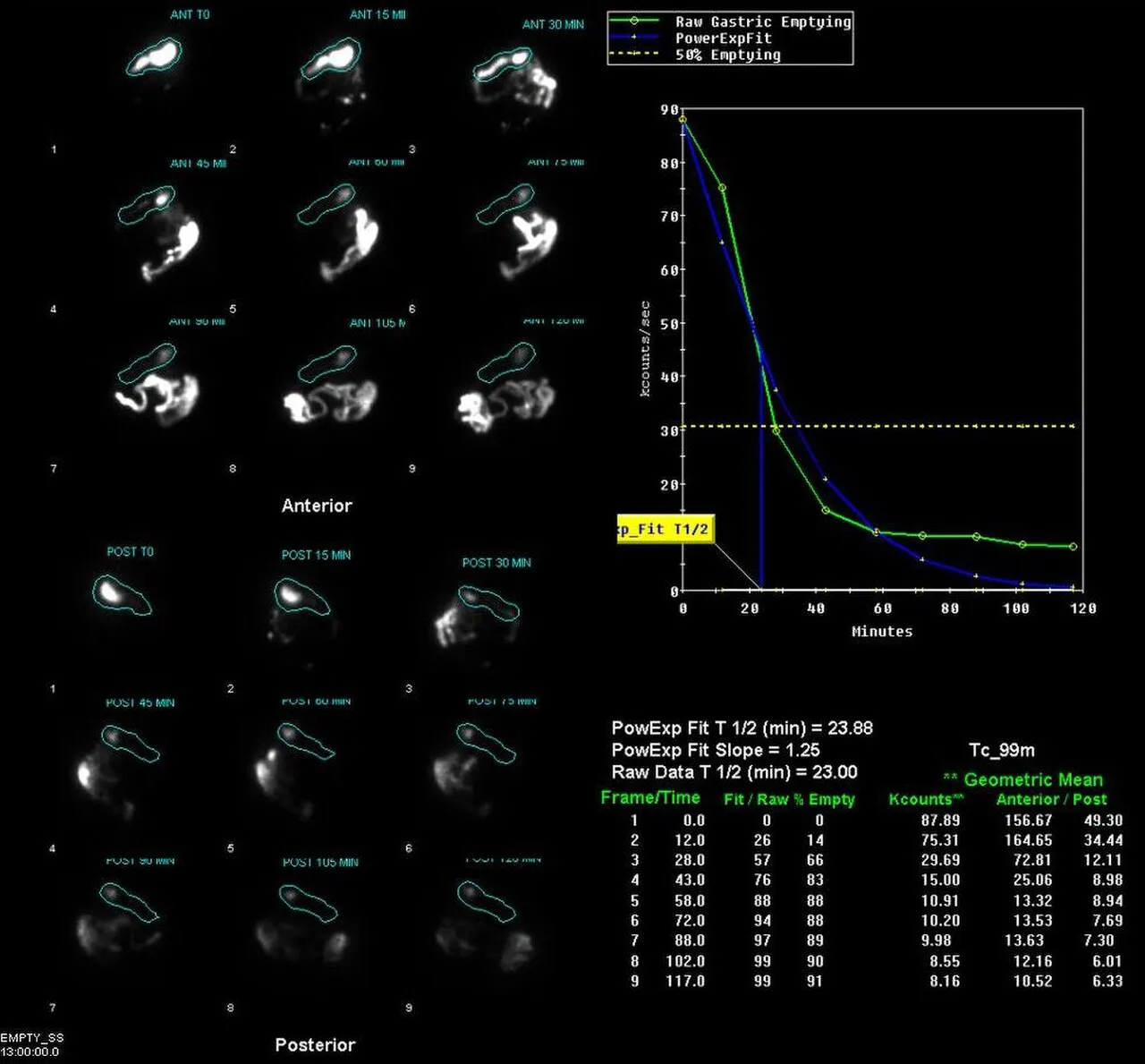
- Diagnostic test: 4-hour solid-meal scintigraphy (more than 10% retained at 4 hours is delayed) or 4-hour gastric emptying breath test; 2-hour tests are not recommended
- Test off opioids and prokinetics, and with blood glucose below about 15 mmol/L, because hyperglycaemia itself slows emptying
- Diet: small frequent meals, low fat and low insoluble fibre, smaller particle size; liquids empty better than solids
- Metoclopramide (EU/UK limited to short courses because of tardive dyskinesia) and erythromycin (tachyphylaxis, QT prolongation) are first-line prokinetics
- Refractory disease: jejunal feeding for malnutrition; G-POEM, pyloroplasty or gastric electrical stimulation in selected patients
Differential diagnosis
| Condition | Clues | Key test |
|---|---|---|
| Gastric outlet obstruction | Projectile vomiting, succussion splash, ulcer or cancer history | Upper endoscopy; CT |
| Functional dyspepsia | Postprandial fullness with normal gastric emptying | Normal endoscopy and 4-hour emptying study |
| Cannabinoid hyperemesis syndrome | Heavy cannabis use, cyclical vomiting relieved by hot showers | History; resolution after stopping cannabis |
| Cyclic vomiting syndrome | Stereotyped episodes with symptom-free intervals, migraine history | Rome criteria; normal tests between episodes |
| Rumination syndrome | Effortless regurgitation within minutes of eating, no nausea | Clinical; high-resolution manometry with impedance |
| Small bowel obstruction or pseudo-obstruction | Distension, bilious vomiting, altered bowel habit | CT abdomen |
| Eating disorders | Weight concern, restrictive eating, early satiety | Psychological assessment; emptying may be delayed secondarily |
| Medication effect | Recent GLP-1 receptor agonist or opioid | Drug review; repeat testing after withdrawal |
Exam pearls
Guideline
AGA Clinical Practice Guideline on Management of Gastroparesis (2025), ACG Clinical Guideline: Gastroparesis (2022), Rome Foundation/international consensus on idiopathic gastroparesis (2025) and SAGES surgical management consensus (2026)
References
- Staller K, Parkman HP, Greer KB, et al.. AGA Clinical Practice Guideline on Management of Gastroparesis. Gastroenterology 2025.
- Camilleri M, Kuo B, Nguyen L, et al.. ACG Clinical Guideline: Gastroparesis. Am J Gastroenterol 2022.
- Schol J, Huang IH, Carbone F, et al.. Rome Foundation and international neurogastroenterology and motility societies' consensus on idiopathic gastroparesis. Lancet Gastroenterol Hepatol 2025.
- Calabrese EC, Shehata D, Kumar S, et al.. SAGES surgical management of gastroparesis: systematic review and expert consensus. Surg Endosc 2026.
- Khashab MA, Wang AY, Cai Q.. AGA Clinical Practice Update on Gastric Peroral Endoscopic Myotomy for Gastroparesis: Commentary. Gastroenterology 2023.
- Abell TL, Camilleri M, Donohoe K, et al.. Consensus recommendations for gastric emptying scintigraphy: a joint report of the American Neurogastroenterology and Motility Society and the Society of Nuclear Medicine. Am J Gastroenterol 2008.
Related topics
By Dr Khalid Seidi (B.Sc., M.D.) · MedEd World Clinical Knowledge library. Original teaching content checked against current guidelines (November 2026); confirm the latest local guidance before clinical use. Not a substitute for clinical judgement.