Clinical Knowledge › Surgery › Paediatric surgery
Hypospadias
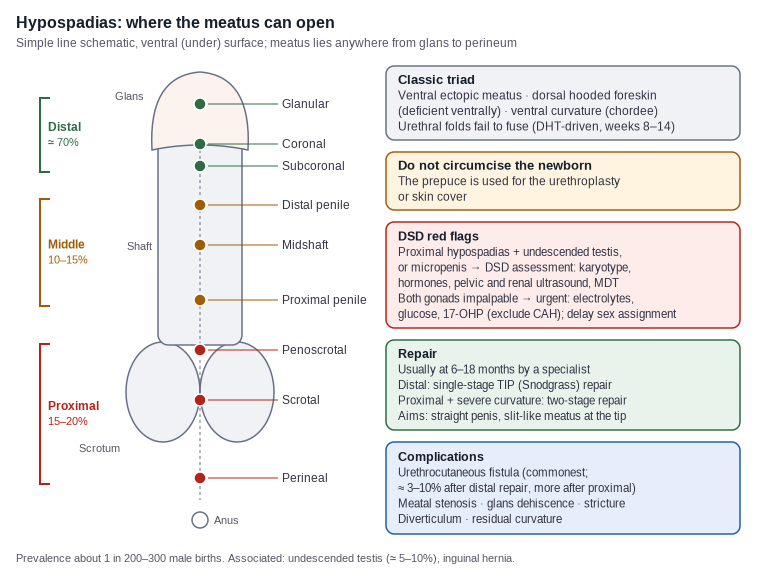
Hypospadias is a congenital anomaly of the penis in which the urethral opening lies on the ventral (under) surface, anywhere from the glans to the perineum, because the urethral folds fail to fuse completely during weeks 8–14 of gestation. It is one of the commonest congenital anomalies in boys, affecting roughly 1 in 200–300 male births. The classic triad is an ectopic ventral meatus, a hooded dorsal foreskin that is deficient ventrally, and ventral penile curvature (chordee). About 70% are distal (glanular, coronal or subcoronal); proximal forms (penoscrotal, scrotal, perineal) are more complex and, especially when combined with an undescended testis, may indicate a difference of sex development that must be investigated before any surgery. Newborns with hypospadias must not be circumcised, because the foreskin is used in the repair. Surgery by a specialist paediatric urologist or surgeon is usually performed between 6 and 18 months, aiming for a straight penis, a slit-like meatus at the tip, a forward-directed stream and a normal appearance. Distal cases are usually repaired in one stage (tubularised incised plate urethroplasty); proximal cases often need two stages. Urethrocutaneous fistula, meatal stenosis and glans dehiscence are the commonest complications.
Patient case, mechanism, investigations, management, flashcards and exam-style questions.Open the lesson →
Key facts
- Ventral ectopic urethral meatus from incomplete fusion of the urethral folds (androgen-dependent, weeks 8–14)
- Prevalence about 1 in 200–300 male births; around 70% are distal (anterior) forms
- Triad: ventral meatus, dorsal hooded foreskin, ventral curvature (chordee)
- Do not circumcise: the prepuce is used for the urethroplasty or skin cover
- Proximal hypospadias with undescended testis (or bilateral impalpable testes) requires DSD assessment, including karyotype and exclusion of CAH
- Surgery usually at 6–18 months; distal: single-stage tubularised incised plate (TIP) repair; proximal: often two-stage repair
- Commonest complication is urethrocutaneous fistula; others meatal stenosis, glans dehiscence, stricture, diverticulum, residual curvature
- Associated with undescended testis (about 5–10%), inguinal hernia and an enlarged prostatic utricle in proximal forms
Differential diagnosis
| Condition | Clues | Key test |
|---|---|---|
| Epispadias | Dorsal meatus, often with bladder exstrophy spectrum and incontinence | Examination; pelvic imaging if exstrophy suspected |
| Congenital adrenal hyperplasia (46,XX) | Severe 'hypospadias' with bilateral impalpable gonads, hyperpigmentation, salt wasting | 17-hydroxyprogesterone, electrolytes, karyotype |
| Partial androgen insensitivity or 46,XY DSD | Proximal hypospadias, micropenis, bifid scrotum, undescended testes | Karyotype, testosterone/DHT ratio, AMH, genetics |
| Isolated chordee without hypospadias | Ventral curvature with a normally placed meatus | Examination; artificial erection test at surgery |
| Megameatus intact prepuce variant | Wide glanular meatus found only at retraction or circumcision; normal foreskin | Examination |
| Buried or webbed penis | Penis concealed by fat or scrotal skin; meatus normal | Examination |
Exam pearls
Guideline
EAU/ESPU Guidelines on Paediatric Urology (2026 edition): hypospadias
References
- Radmayr C, Bogaert G, Bujons A, Burgu B, et al.. EAU Guidelines on Paediatric Urology. EAU Guidelines Office, Arnhem (presented at the EAU Annual Congress, London 2026) 2026.
- van der Horst HJR, de Wall LL. Hypospadias, all there is to know. Eur J Pediatr 2017.
- Snodgrass W. Tubularized, incised plate urethroplasty for distal hypospadias. J Urol 1994.
- Springer A, van den Heijkant M, Baumann S. Worldwide prevalence of hypospadias. J Pediatr Urol 2016.
- Holcomb GW III, Murphy JP, St Peter SD, eds.. Holcomb and Ashcraft's Pediatric Surgery. 2020.
- Partin AW, Dmochowski RR, Kavoussi LR, Peters CA, eds.. Campbell-Walsh-Wein Urology. 2020.
Related topics
By Dr Khalid Seidi (B.Sc., M.D.) · MedEd World Clinical Knowledge library. Original teaching content checked against current guidelines (November 2026); confirm the latest local guidance before clinical use. Not a substitute for clinical judgement.