Clinical Knowledge › Paediatrics › Neonatology
Neonatal abstinence syndrome
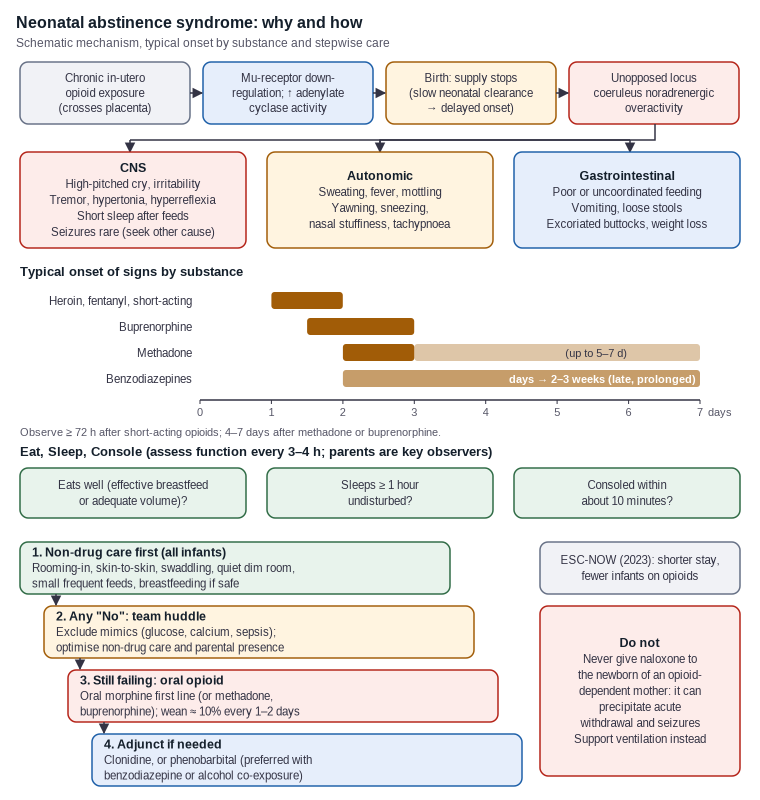
Neonatal abstinence syndrome (NAS) is the withdrawal state of a newborn exposed in utero to drugs that cause dependence, most often opioids; the opioid-specific form is called neonatal opioid withdrawal syndrome (NOWS). Opioids cross the placenta; when the supply stops at birth the infant shows central nervous system irritability, autonomic overactivity and gastrointestinal dysfunction. Signs usually start within 1–3 days (later with methadone) and include a high-pitched cry, tremor, hypertonia, poor sleep, sneezing, sweating, poor feeding, vomiting and loose stools. Assessment uses a structured tool: the Finnegan score or the function-based Eat, Sleep, Console (ESC) approach, which in a 2023 randomised trial shortened hospital stay and more than halved the use of opioid treatment. Non-drug care — rooming-in, skin-to-skin contact, breastfeeding when safe and a calm environment — comes first; oral morphine, methadone or buprenorphine is added for severe withdrawal. Care is family-centred and non-judgemental, with safeguarding and safe-sleep advice built into discharge.
Patient case, mechanism, investigations, management, flashcards and exam-style questions.Open the lesson →
Key facts
- Commonest causes: maternal opioid use — heroin, illicit fentanyl, methadone, buprenorphine and prescribed opioids; polysubstance use is frequent
- Onset: short-acting opioids within about 24–48 hours; methadone and buprenorphine about 48–72 hours, sometimes up to 5–7 days; observe at least 3 days and often 4–7 days
- Signs: CNS (high-pitched cry, tremor, hypertonia, hyperreflexia, poor sleep, rarely seizures), autonomic (sweating, sneezing, yawning, nasal stuffiness, fever, mottling), GI (poor feeding, vomiting, loose stools, weight loss)
- Assessment: modified Finnegan score every 3–4 hours or Eat, Sleep, Console (eat well, sleep at least 1 hour, consolable within 10 minutes)
- ESC-NOW (NEJM 2023): ESC shortened hospital stay by about 6 days and cut opioid treatment from about half to about a fifth of infants without excess harm
- Non-pharmacological care first: rooming-in with parent, skin-to-skin, swaddling, low stimulation, frequent small feeds, breastfeeding if safe
- First-line drug: oral morphine (or methadone/buprenorphine); adjuncts clonidine or phenobarbital (phenobarbital preferred for alcohol or benzodiazepine co-exposure)
- Never give naloxone to a newborn of an opioid-dependent mother: it can precipitate acute withdrawal and seizures
Differential diagnosis
| Condition | Clues | Key test |
|---|---|---|
| Neonatal sepsis or meningitis | Temperature instability, lethargy, poor perfusion; no exposure history | Blood culture, CRP, lumbar puncture |
| Hypoglycaemia | Jitteriness, poor feeding; often infant of diabetic mother or SGA | Blood glucose |
| Hypocalcaemia or hypomagnesaemia | Jitteriness, tetany, seizures | Calcium, magnesium |
| Hypoxic-ischaemic encephalopathy | Perinatal asphyxia, abnormal tone, seizures from first hours | Cord gas, aEEG, MRI |
| Neonatal thyrotoxicosis | Mother with Graves disease; tachycardia, goitre, weight loss | TSH, free T4, TRAb |
| SSRI neonatal adaptation syndrome | Mild jitteriness and tachypnoea within 48 hours after maternal SSRI | Maternal medication history; self-limiting |
| Intracranial haemorrhage | Seizures, bulging fontanelle | Cranial ultrasound |
Exam pearls
Guideline
AAP clinical report 'Neonatal opioid withdrawal syndrome' (2020), WHO guidance on substance use in pregnancy (2014), and the ESC-NOW (2023) and OPTimize NOW (2026) randomised trials
References
- Patrick SW, Barfield WD, Poindexter BB.. Neonatal Opioid Withdrawal Syndrome. Pediatrics 2020.
- Young LW, Ounpraseuth ST, Merhar SL, et al.. Eat, Sleep, Console Approach or Usual Care for Neonatal Opioid Withdrawal. N Engl J Med 2023.
- Devlin LA, Babineau DC, Merhar SL, et al.. Symptom-Based Dosing for Neonatal Opioid Withdrawal: The OPTimize NOW Randomized Clinical Trial. JAMA 2026.
- Kraft WK, Adeniyi-Jones SC, Chervoneva I, et al.. Buprenorphine for the Treatment of the Neonatal Abstinence Syndrome. N Engl J Med 2017.
- Jones HE, Kaltenbach K, Heil SH, et al.. Neonatal abstinence syndrome after methadone or buprenorphine exposure. N Engl J Med 2010.
- Beauman SGS, Hu Z, Rice W, et al.. Antenatal Exposure to Medication for Opioid Use Disorder and Infant Outcomes in the Eat, Sleep, Console for Neonatal Opioid Withdrawal Randomized Controlled Trial. J Pediatr 2025.
Related topics
By Dr Khalid Seidi (B.Sc., M.D.) · MedEd World Clinical Knowledge library. Original teaching content checked against current guidelines (November 2026); confirm the latest local guidance before clinical use. Not a substitute for clinical judgement.