Clinical Knowledge › Anaesthesiology › Regional and local anaesthesia
Peripheral nerve blocks
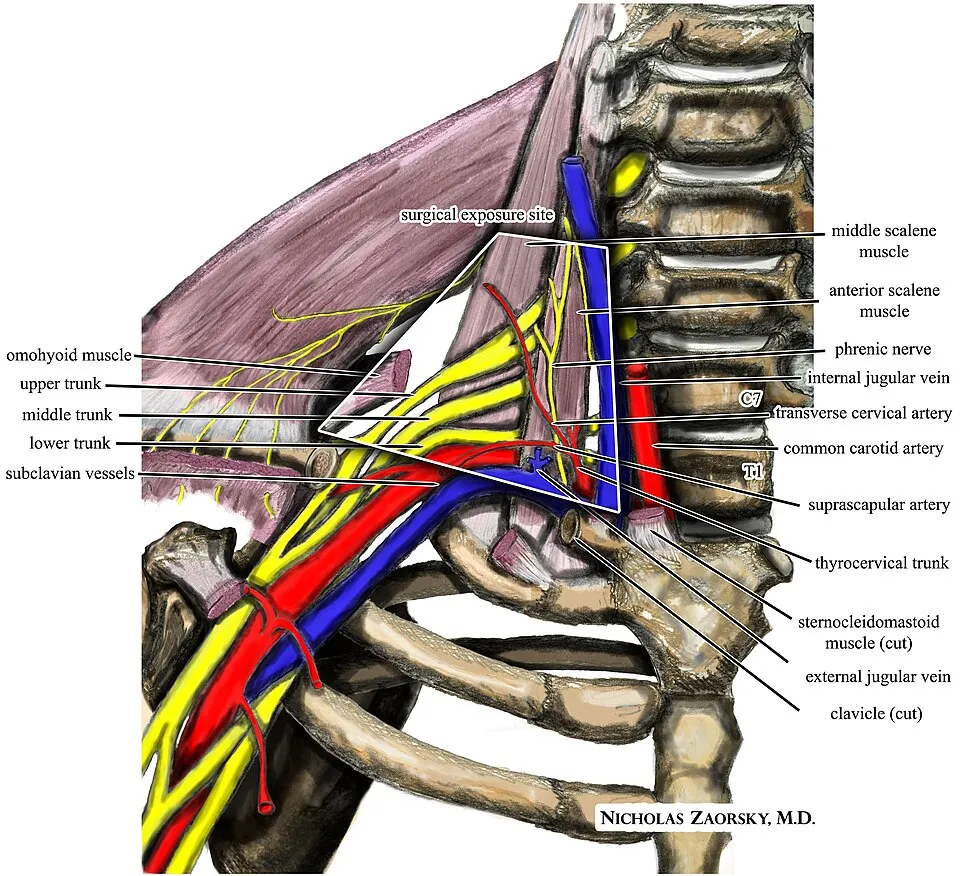
Peripheral nerve blocks inject local anaesthetic around a nerve or plexus, or into a fascial plane, to give surgical anaesthesia or targeted postoperative analgesia while avoiding the haemodynamic effects of neuraxial block. Common anaesthetic blocks include interscalene, supraclavicular, infraclavicular and axillary brachial plexus blocks for the upper limb; femoral, fascia iliaca, adductor canal and popliteal sciatic blocks for the lower limb; and fascial plane blocks such as transversus abdominis plane, rectus sheath, erector spinae and serratus anterior for the trunk. Ultrasound guidance, often combined with nerve stimulation and injection pressure awareness, improves success, speeds onset and reduces vascular puncture compared with landmark or stimulator-only techniques (Cochrane 2015). Safety rests on consent, monitoring, IV access, a 'Stop Before You Block' check to prevent wrong-side blocks, weight-based maximum doses and immediate availability of 20% lipid emulsion for local anaesthetic systemic toxicity. Block-specific side effects matter: interscalene block almost always paralyses the ipsilateral hemidiaphragm, and femoral block weakens the quadriceps and increases fall risk. Persistent nerve injury is rare, but transient paraesthesia is not uncommon.
Patient case, mechanism, investigations, management, flashcards and exam-style questions.Open the lesson →
Key facts
- Ultrasound guidance improves block success and reduces supplementation and vascular puncture compared with nerve stimulation or landmarks (Cochrane 2015)
- A nerve stimulator motor response at currents below about 0.2–0.3 mA suggests the needle tip may be intraneural; high opening injection pressure also warns of intrafascicular injection
- Interscalene block causes ipsilateral phrenic nerve palsy in nearly all patients; avoid in severe respiratory disease or contralateral diaphragm palsy
- Femoral and fascia iliaca blocks are recommended analgesia for hip fracture; femoral block weakens quadriceps, so adductor canal block is preferred after knee arthroplasty for mobility
- Teaching maximum doses: bupivacaine about 2 mg/kg, ropivacaine about 3 mg/kg, lidocaine 3 mg/kg plain or 7 mg/kg with adrenaline (check local protocol)
- LAST treatment: stop injecting, call for help, airway and oxygen, benzodiazepine for seizures, 20% lipid emulsion 1.5 mL/kg bolus then infusion, prolonged CPR if arrest
- Deep, non-compressible blocks (lumbar plexus, paravertebral, deep cervical) follow neuraxial anticoagulant intervals; superficial compressible blocks generally do not
- Late block-related neurological deficit is about 0.4 per 1,000 blocks in a large Australasian audit; most postoperative neuropathies have surgical or positioning causes
Differential diagnosis
| Condition | Clues | Key test |
|---|---|---|
| Spinal or epidural anaesthesia | Bilateral, wider block with sympathectomy; anticoagulant restrictions | Technique choice |
| Local infiltration or field block | Surgeon-delivered at wound; shorter, less extensive | Technique choice |
| Intravenous regional anaesthesia (Bier block) | Short forearm and hand procedures with a tourniquet | Procedure length |
| General anaesthesia with systemic analgesia | When block contraindicated or refused | Patient choice and contraindications |
| Wound catheter infusion | Continuous local anaesthetic at incision | Surgical site |
| Neuraxial opioid alone | Visceral analgesia without motor block | Surgery type |
Exam pearls
Guideline
ASRA practice advisories on LAST (2018) and its checklist (2020 version); ASRA neurological complications advisory 2015; ESAIC/ESRA antithrombotic guideline 2022; Association of Anaesthetists hip fracture guideline 2020
References
- Lewis SR, Price A, Walker KJ, et al.. Ultrasound guidance for upper and lower limb blocks. Cochrane Database Syst Rev 2015.
- Barrington MJ, Watts SA, Gledhill SR, et al.. Preliminary results of the Australasian Regional Anaesthesia Collaboration: a prospective audit of more than 7000 peripheral nerve and plexus blocks for neurologic and other complications. Reg Anesth Pain Med 2009.
- Brull R, McCartney CJ, Chan VW, et al.. Neurological complications after regional anesthesia: contemporary estimates of risk. Anesth Analg 2007.
- Neal JM, Barrington MJ, Brull R, et al.. The Second ASRA Practice Advisory on Neurologic Complications Associated With Regional Anesthesia and Pain Medicine: Executive Summary 2015. Reg Anesth Pain Med 2015.
- Neal JM, Barrington MJ, Fettiplace MR, et al.. The Third American Society of Regional Anesthesia and Pain Medicine Practice Advisory on Local Anesthetic Systemic Toxicity: Executive Summary 2017. Reg Anesth Pain Med 2018.
- Neal JM, Neal EJ, Weinberg GL. American Society of Regional Anesthesia and Pain Medicine Local Anesthetic Systemic Toxicity checklist: 2020 version. Reg Anesth Pain Med 2021.
Related topics
By Dr Khalid Seidi (B.Sc., M.D.) · MedEd World Clinical Knowledge library. Original teaching content checked against current guidelines (November 2026); confirm the latest local guidance before clinical use. Not a substitute for clinical judgement.