Clinical Knowledge › Anaesthesiology › Regional and local anaesthesia
Post-dural puncture headache
Post-dural puncture headache (PDPH) is a headache caused by leakage of cerebrospinal fluid through a hole in the dura after spinal anaesthesia, lumbar puncture or accidental dural puncture during an epidural. It typically starts within 1–3 days (ICHD-3: within 5 days), is fronto-occipital, worse within minutes of sitting or standing and eased by lying flat, and may come with neck stiffness, nausea, tinnitus, hearing loss, photophobia or diplopia from sixth nerve traction. Risk is highest after a 16–18 G Tuohy needle puncture (more than half of patients) and lowest with 25–27 G pencil-point needles (about 1% or less); young age, female sex, pregnancy and low body mass increase risk. The 2023 multisociety guideline does not support bed rest or routine fluids for prevention, recommends simple analgesia (paracetamol and an NSAID) as first-line symptom control, with caffeine and other drugs only weak options, and recommends an epidural blood patch (typically 15–20 mL of autologous blood) for moderate to severe headache that limits activity, ideally after 24–48 hours. Red flags such as a change in headache character, focal signs, seizures, fever or hypertension demand imaging to exclude subdural haematoma, cerebral venous sinus thrombosis, pre-eclampsia and meningitis.
Patient case, mechanism, investigations, management, flashcards and exam-style questions.Open the lesson →
Key facts
- Mechanism: CSF loss exceeds production (about 500 mL/day), causing intracranial hypotension, brain sag with traction on pain-sensitive structures and compensatory venous dilatation
- Classic features: postural fronto-occipital headache, worse within 15 minutes of sitting or standing, better lying flat, onset usually 24–72 hours after puncture
- Associated symptoms: neck stiffness, nausea, tinnitus or reduced hearing, photophobia, and diplopia from sixth cranial nerve palsy
- Risk: more than 50% after accidental Tuohy dural puncture; about 1% or less with 25–27 G pencil-point spinal needles
- Prevention: small pencil-point needles, reinsert the stylet before withdrawing an LP needle; bed rest and extra fluids do not prevent PDPH
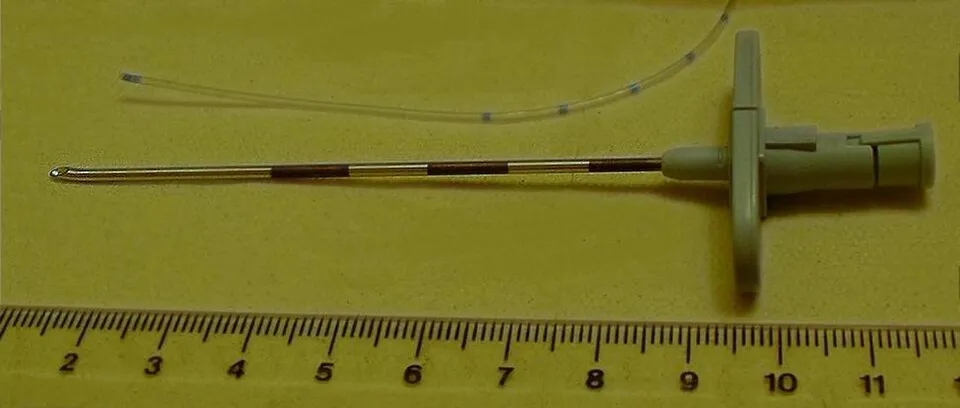
- Epidural blood patch: 15–20 mL of sterile autologous blood injected at or just below the puncture level; stop earlier if back or leg pain
- Blood patch gives early relief in most patients, but some need a second patch; it carries a small risk of repeat dural puncture, back pain and infection
- Red flags: loss of postural nature, focal neurology, seizures, reduced consciousness, fever or hypertension suggest subdural haematoma, CVST, pre-eclampsia or meningitis
Differential diagnosis
| Condition | Clues | Key test |
|---|---|---|
| Pre-eclampsia | Postpartum headache with hypertension, proteinuria, visual disturbance, hyperreflexia | BP, urine protein, platelets and liver tests |
| Cerebral venous sinus thrombosis | Progressive non-postural headache, seizures, focal signs, postpartum state | CT or MR venography |
| Subdural haematoma | Headache losing postural nature, confusion, focal signs after PDPH | CT head |
| Meningitis | Fever, neck stiffness, photophobia, raised inflammatory markers | Blood cultures, imaging, CSF if safe |
| Migraine or tension-type headache | Previous similar headaches, not postural | Clinical history |
| Subarachnoid haemorrhage | Sudden thunderclap headache | CT head; LP or CT angiography |
| Pneumocephalus | Immediate headache after loss of resistance to air | CT head |
| Caffeine withdrawal or sleep deprivation | Non-postural, diffuse, in early postpartum | History |
Exam pearls
Guideline
Multisociety international practice guidelines on post-dural puncture headache 2023 (summary JAMA Netw Open 2023; full report Reg Anesth Pain Med 2024); OAA guideline on treatment of obstetric PDPH 2018 (published 2019)
References
- Uppal V, Russell R, Sondekoppam RV, et al.. Evidence-based clinical practice guidelines on postdural puncture headache: a consensus report from a multisociety international working group. Reg Anesth Pain Med 2024.
- Uppal V, Russell R, Sondekoppam R, et al.. Consensus practice guidelines on postdural puncture headache from a multisociety, international working group: a summary report. JAMA Netw Open 2023.
- Russell R, Laxton C, Lucas DN, et al.. Treatment of obstetric post-dural puncture headache. Part 1: conservative and pharmacological management. Int J Obstet Anesth 2019.
- Russell R, Laxton C, Lucas DN, et al.. Treatment of obstetric post-dural puncture headache. Part 2: epidural blood patch. Int J Obstet Anesth 2019.
- Headache Classification Committee of the International Headache Society. The International Classification of Headache Disorders, 3rd edition (ICHD-3). Cephalalgia 2018.
- Kopp SL, Vandermeulen E, McBane RD, et al.. Regional anesthesia in the patient receiving antithrombotic or thrombolytic therapy: American Society of Regional Anesthesia and Pain Medicine Evidence-Based Guidelines (fifth edition). Reg Anesth Pain Med 2026.
Related topics
By Dr Khalid Seidi (B.Sc., M.D.) · MedEd World Clinical Knowledge library. Original teaching content checked against current guidelines (November 2026); confirm the latest local guidance before clinical use. Not a substitute for clinical judgement.