Clinical Knowledge › Anaesthesiology › Regional and local anaesthesia
Spinal anaesthesia
Spinal (subarachnoid, intrathecal) anaesthesia is a single injection of local anaesthetic, often with an opioid, into the cerebrospinal fluid below the end of the spinal cord, usually at L3–L4 or L4–L5. A small dose, typically 10–15 mg of hyperbaric 0.5% bupivacaine, gives a dense sensory and motor block within minutes that lasts about 2–3 hours, making it ideal for caesarean section, hip fracture, lower limb, perineal and urological surgery. The spread depends on baricity, dose, patient position and anatomy; sympathetic block extends a few segments higher than sensory block. The main physiological effect is sympathectomy with hypotension and sometimes bradycardia, treated with vasopressors (prophylactic phenylephrine infusion at caesarean section) and fluids. Contraindications include refusal, infection at the site, raised intracranial pressure with mass effect and coagulopathy or anticoagulant timing outside guideline limits (ASRA 5th edition). Complications range from common (hypotension, nausea, urinary retention, pruritus with opioids) to post-dural puncture headache, high spinal block and rare permanent nerve injury (NAP3: about 2–4 per 100,000 central neuraxial blocks).
Patient case, mechanism, investigations, management, flashcards and exam-style questions.Open the lesson →
Key facts
- The adult spinal cord usually ends at L1–L2 (lower in neonates, about L3), so spinal anaesthesia is performed at or below L3–L4; Tuffier's (intercristal) line crosses about L4 or L4–L5
- Needle passes skin, subcutaneous tissue, supraspinous and interspinous ligaments, ligamentum flavum, epidural space, dura and arachnoid; free flow of CSF confirms the subarachnoid space
- Hyperbaric 0.5% bupivacaine (with glucose) spreads with gravity; caesarean section needs a block to about T4 to cold or touch (teaching dose about 10–13 mg with intrathecal opioid)
- Sympathetic block extends about 2–6 segments above sensory block, and motor block about 2 segments below it (differential block)
- Hypotension follows venous and arterial dilatation; block above T4 also removes cardioaccelerator fibres (T1–T4) and can cause bradycardia
- Prophylactic phenylephrine infusion is recommended at caesarean section to keep systolic BP at or near 90% of baseline (international consensus 2018)
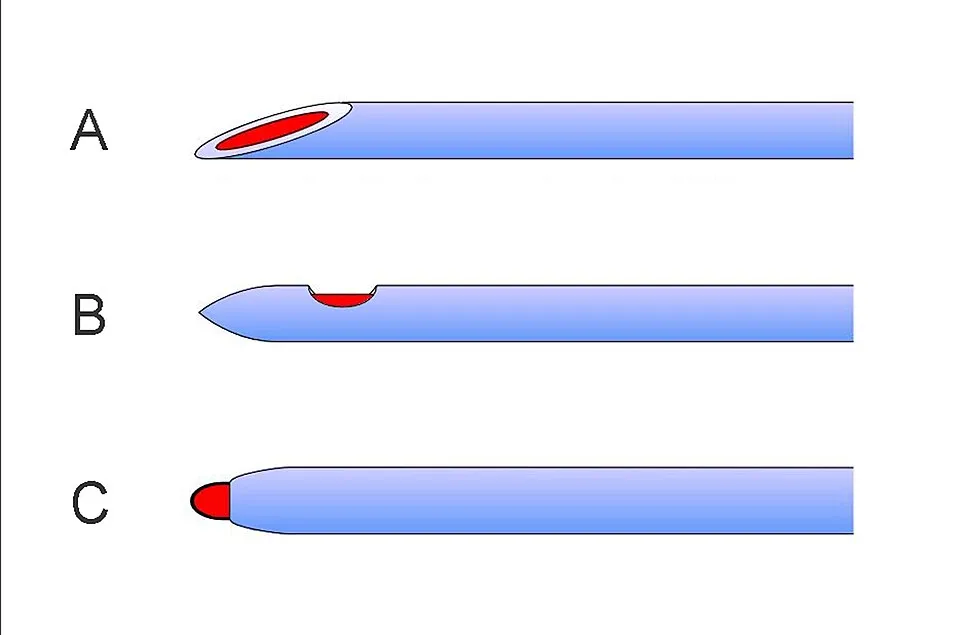
- Pencil-point needles of 25–27 G reduce post-dural puncture headache to about 1% or less
- NAP3: permanent harm after central neuraxial block about 2.0–4.2 per 100,000; paraplegia or death 0.7–1.8 per 100,000
Differential diagnosis
| Condition | Clues | Key test |
|---|---|---|
| General anaesthesia | Airway control and no neuraxial contraindication issues; preferred for long, upper abdominal or uncertain-duration surgery | Case and patient assessment |
| Epidural anaesthesia | Slower onset, segmental, titratable via catheter, larger LA dose; useful for analgesia | Technique choice |
| Combined spinal–epidural | Fast dense spinal plus catheter to extend duration | Technique choice |
| Peripheral nerve block | Limb surgery with less haemodynamic effect; allowed with some anticoagulants | Anatomical site and anticoagulant status |
| Failed or patchy spinal | Inadequate block to cold, pinprick or touch at 15–20 minutes | Systematic block testing before incision |
| High or total spinal | Hand weakness, dyspnoea, hypotension, bradycardia, loss of consciousness | Clinical; block level |
Exam pearls
Guideline
ASRA Pain Medicine antithrombotic guidelines 5th ed (2025) with ESAIC/ESRA 2022; International consensus on vasopressors at caesarean section 2018; Association of Anaesthetists skin antisepsis for neuraxial block 2014
References
- Cook TM, Counsell D, Wildsmith JA, et al.. Major complications of central neuraxial block: report on the Third National Audit Project of the Royal College of Anaesthetists. Br J Anaesth 2009.
- Kopp SL, Vandermeulen E, McBane RD, et al.. Regional anesthesia in the patient receiving antithrombotic or thrombolytic therapy: American Society of Regional Anesthesia and Pain Medicine Evidence-Based Guidelines (fifth edition). Reg Anesth Pain Med 2026.
- Kinsella SM, Carvalho B, Dyer RA, et al.. International consensus statement on the management of hypotension with vasopressors during caesarean section under spinal anaesthesia. Anaesthesia 2018.
- Association of Anaesthetists of Great Britain and Ireland; Obstetric Anaesthetists' Association; Regional Anaesthesia UK; et al.. Safety guideline: skin antisepsis for central neuraxial blockade. Anaesthesia 2014.
- Carpenter RL, Caplan RA, Brown DL, et al.. Incidence and risk factors for side effects of spinal anesthesia. Anesthesiology 1992.
- Neuman MD, Feng R, Carson JL, et al.. Spinal Anesthesia or General Anesthesia for Hip Surgery in Older Adults. N Engl J Med 2021.
Related topics
By Dr Khalid Seidi (B.Sc., M.D.) · MedEd World Clinical Knowledge library. Original teaching content checked against current guidelines (November 2026); confirm the latest local guidance before clinical use. Not a substitute for clinical judgement.