Clinical Knowledge › Surgery › Paediatric surgery
Wilms tumour
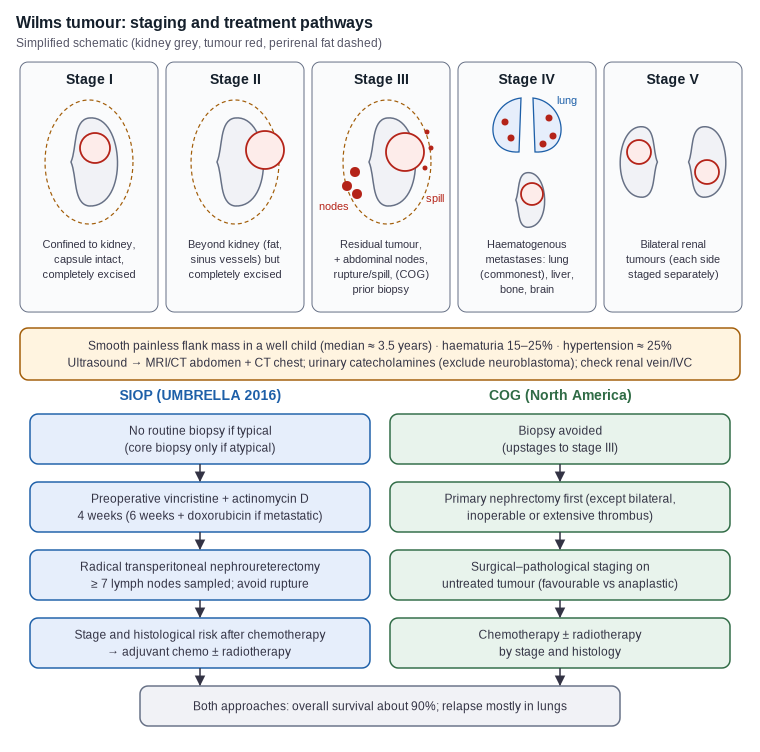
Wilms tumour (nephroblastoma) is an embryonal kidney malignancy arising from persistent metanephric blastema and the commonest renal cancer of childhood, accounting for about 90% of paediatric renal tumours and about 6% of all childhood cancers. Most children are aged 1–5 years (median about 3.5 years), and 5–7% have bilateral disease. Around 10% have a predisposition syndrome: WT1-related conditions (WAGR with aniridia, Denys–Drash, Frasier) and 11p15 overgrowth disorders such as Beckwith–Wiedemann syndrome, for whom 3-monthly abdominal ultrasound to about age 7 is recommended. The classic presentation is a smooth, painless flank mass in a well child, noticed by a parent while bathing; haematuria, hypertension and abdominal pain may occur. Ultrasound, then cross-sectional imaging of abdomen and chest, confirm and stage the disease. Two treatment philosophies achieve similar cure rates: the SIOP approach (Europe and much of the world) gives 4–6 weeks of preoperative chemotherapy before nephrectomy, whereas the North American COG approach operates first. Radical transperitoneal nephroureterectomy with lymph node sampling, without tumour rupture, is the surgical cornerstone. Survival exceeds 90% in high-income settings but is lower where access to care is limited.
Patient case, mechanism, investigations, management, flashcards and exam-style questions.Open the lesson →
Key facts
- Commonest childhood renal malignancy; median age about 3.5 years; 5–7% bilateral
- Classic: asymptomatic smooth flank mass in a well toddler; may have haematuria, hypertension (renin), fever or abdominal pain
- Syndromes: WAGR (WT1 + PAX6 deletion, 11p13), Denys–Drash and Frasier (WT1), Beckwith–Wiedemann (11p15); screen with ultrasound every 3 months to about age 7
- Ultrasound first, then CT or MRI abdomen and CT chest; check renal vein and IVC for tumour thrombus; urinary catecholamines help exclude neuroblastoma
- SIOP UMBRELLA 2016: preoperative vincristine + actinomycin D (4 weeks localised; 6 weeks with doxorubicin for metastatic) without routine biopsy
- COG: primary nephrectomy and surgical-pathological staging before chemotherapy (except bilateral, inoperable or extensive thrombus)
- Surgery: radical transperitoneal nephroureterectomy, lymph node sampling (at least 7 nodes in UMBRELLA), avoid rupture or spill (upstages to stage III)
- Lungs are the commonest metastatic site; anaplasia (especially diffuse) is the main unfavourable histology; overall survival over 90%
Differential diagnosis
| Condition | Clues | Key test |
|---|---|---|
| Neuroblastoma | Younger (under 2), unwell, mass crosses midline, encases vessels, calcification, periorbital bruising, opsoclonus–myoclonus | Urinary HVA/VMA, MIBG scan, imaging showing adrenal origin |
| Hydronephrosis (PUJ obstruction) | Cystic flank mass, may follow fluid load, infection | Ultrasound: dilated pelvis and calyces, normal parenchyma pattern |
| Multicystic dysplastic kidney | Neonatal non-functioning cystic mass | Ultrasound: non-communicating cysts; DMSA no function |
| Mesoblastic nephroma | Renal mass in the first 3–6 months of life | Imaging; nephrectomy is usually curative |
| Clear cell sarcoma or rhabdoid tumour of kidney | Bone metastases (clear cell) or very young child with brain lesions (rhabdoid) | Histology; SMARCB1 loss in rhabdoid |
| Renal cell carcinoma | Adolescent with haematuria and renal mass | Histology (often translocation type) |
| Hepatoblastoma or splenomegaly | Upper abdominal mass moving with respiration, raised AFP | Ultrasound, alpha-fetoprotein |
Exam pearls
Guideline
SIOP-RTSG UMBRELLA 2016 protocol (Nat Rev Urol 2017; best available treatment standard) and the COG risk-adapted approach
References
- van den Heuvel-Eibrink MM, Hol JA, Pritchard-Jones K, et al.. Position paper: Rationale for the treatment of Wilms tumour in the UMBRELLA SIOP-RTSG 2016 protocol. Nat Rev Urol 2017.
- Spreafico F, Fernandez CV, Brok J, et al.. Wilms tumour. Nat Rev Dis Primers 2021.
- Vujanić GM, Gessler M, Ooms AHAG, et al.. The UMBRELLA SIOP-RTSG 2016 Wilms tumour pathology and molecular biology protocol. Nat Rev Urol 2018.
- Brioude F, Kalish JM, Mussa A, et al.. Expert consensus document: Clinical and molecular diagnosis, screening and management of Beckwith–Wiedemann syndrome: an international consensus statement. Nat Rev Endocrinol 2018.
- Holcomb GW III, Murphy JP, St Peter SD, eds.. Holcomb and Ashcraft's Pediatric Surgery. 2020.
- Blaney SM, Helman LJ, Adamson PC, eds.. Pizzo and Poplack's Pediatric Oncology. 2021.
Related topics
By Dr Khalid Seidi (B.Sc., M.D.) · MedEd World Clinical Knowledge library. Original teaching content checked against current guidelines (November 2026); confirm the latest local guidance before clinical use. Not a substitute for clinical judgement.