Clinical Knowledge › Paediatrics › Paediatric neurology
Absence seizures
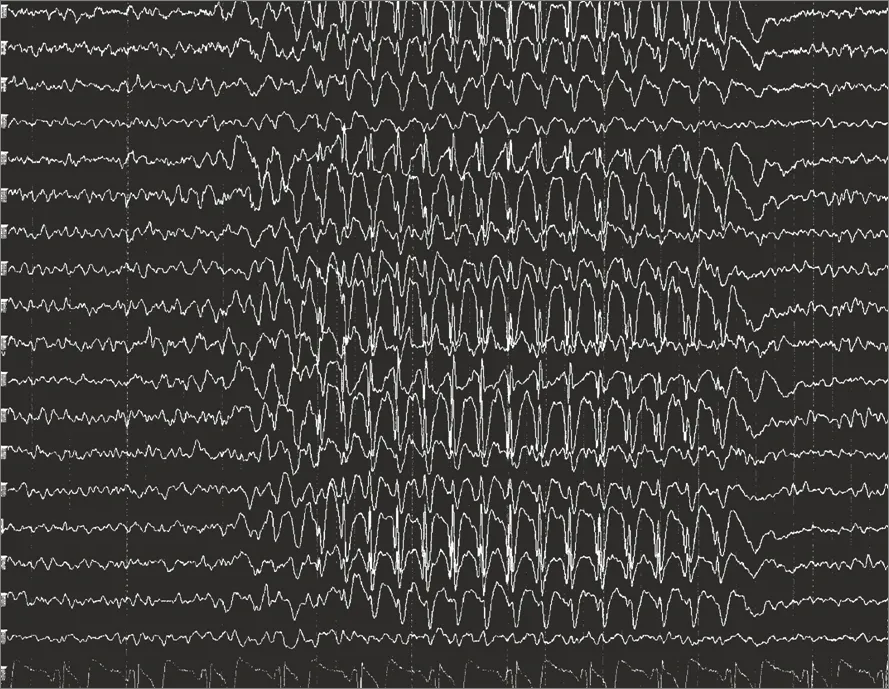
Typical absence seizures are brief (usually 4–20 seconds) episodes of sudden arrest of activity and loss of awareness with an abrupt start and end and no post-ictal confusion. They are the defining seizure of childhood absence epilepsy (CAE), an idiopathic generalised epilepsy that starts between 2 and 13 years (peak 5–7), affects girls more than boys and causes about 10% of childhood epilepsy. Children may have dozens of absences a day, and the problem is often first noticed as daydreaming or falling school performance. Hyperventilation for 3–5 minutes provokes an absence in most untreated children, and the EEG shows generalised 3 Hz spike-and-wave discharges on a normal background. Ethosuximide is first line; lamotrigine, levetiracetam or sodium valproate are second-line options, and valproate in girls and young people is restricted by MHRA safety rules. Carbamazepine and other sodium-channel or GABAergic drugs can make absences worse. Most children with CAE go into remission by adolescence, but attention and learning difficulties are common and need school support.
Patient case, mechanism, investigations, management, flashcards and exam-style questions.Open the lesson →
Key facts
- Typical absences last 4–20 seconds, start and stop abruptly and are followed by immediate recovery with no post-ictal phase
- Childhood absence epilepsy: onset 2–13 years (peak 5–7), normal development and examination, girls affected more often
- Hyperventilation for 3–5 minutes provokes an absence in about 90% of untreated children – a useful bedside test
- EEG: generalised, symmetrical 3 Hz (2.5–4 Hz) spike-and-wave discharges on a normal background
- Ethosuximide is first line (NICE NG217); it blocks T-type calcium channels in thalamic neurones
- Second line: lamotrigine, levetiracetam or sodium valproate; valproate needs MHRA safety measures
- Carbamazepine, oxcarbazepine, phenytoin, gabapentin, pregabalin, tiagabine, vigabatrin and phenobarbital may worsen absences
- Absences starting before 4 years should prompt testing for GLUT1 deficiency (low CSF glucose)
Differential diagnosis
| Condition | Clues | Key test |
|---|---|---|
| Daydreaming or inattention | Happens when bored, can be interrupted by touch or name, no eyelid flutter | Hyperventilation and EEG are normal |
| Focal impaired-awareness seizure | Lasts 30 seconds to 2 minutes, aura, complex automatisms, post-ictal confusion | EEG shows focal discharges; MRI may show a lesion |
| Atypical absences (e.g. Lennox–Gastaut syndrome) | Gradual onset and offset, tone changes, developmental impairment | EEG: slow (under 2.5 Hz) spike-and-wave on an abnormal background |
| Juvenile absence epilepsy | Onset around 9–13 years, fewer but longer absences, tonic–clonic seizures common | EEG: 3–5.5 Hz generalised spike-wave, often fragmented |
| ADHD (inattentive type) | Inattention is constant and situation-dependent, not brief episodes with abrupt return | Normal EEG; structured rating scales from home and school |
| GLUT1 deficiency syndrome | Absences before 4 years, drug resistance, paroxysmal movement disorder, symptoms worse before meals | Low CSF glucose with normal blood glucose; SLC2A1 testing |
| Hearing impairment | Child appears not to listen; no true episodes | Formal audiology |
Exam pearls
Guideline
NICE NG217 Epilepsies in children, young people and adults (2022, with later updates) and ILAE 2022 syndrome definitions; MHRA valproate safety measures (2024)
References
- National Institute for Health and Care Excellence. Epilepsies in children, young people and adults (NG217). NICE guideline 2022.
- Hirsch E, French J, Scheffer IE, et al.. ILAE definition of the idiopathic generalized epilepsy syndromes: position statement by the ILAE Task Force on Nosology and Definitions. Epilepsia 2022.
- Glauser TA, Cnaan A, Shinnar S, et al.. Ethosuximide, valproic acid, and lamotrigine in childhood absence epilepsy. N Engl J Med 2010.
- Medicines and Healthcare products Regulatory Agency. Valproate: new safety and educational materials and restrictions on use in patients under 55. Drug Safety Update 2024.
- Zuberi SM, Wirrell E, Yozawitz E, et al.. ILAE classification and definition of epilepsy syndromes with onset in neonates and infants: position statement by the ILAE Task Force on Nosology and Definitions. Epilepsia 2022.
- Paediatric Formulary Committee. BNF for Children. BMJ Group, Pharmaceutical Press and RCPCH Publications 2025.
Related topics
By Dr Khalid Seidi (B.Sc., M.D.) · MedEd World Clinical Knowledge library. Original teaching content checked against current guidelines (November 2026); confirm the latest local guidance before clinical use. Not a substitute for clinical judgement.