Clinical Knowledge › Paediatrics › Paediatric neurology
Infantile spasms (West syndrome)
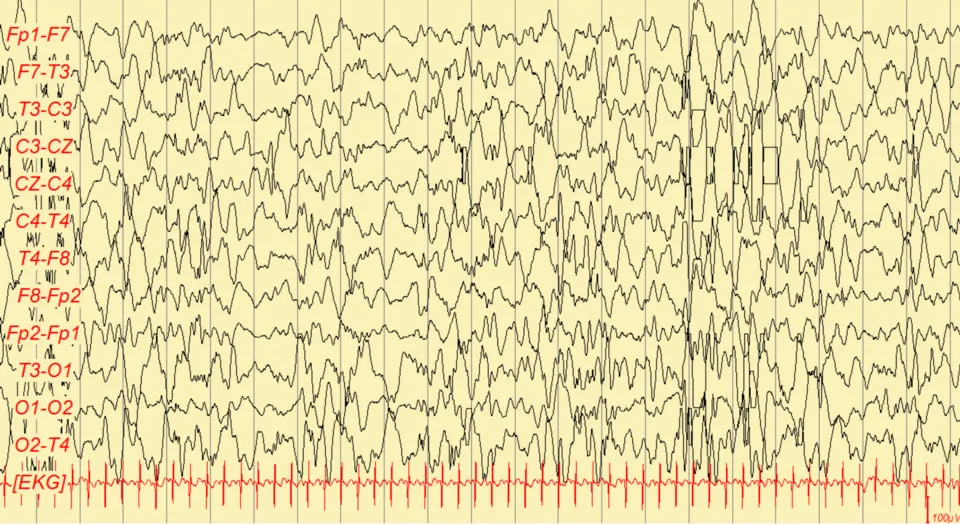
Infantile spasms are brief, sudden flexion, extension or mixed contractions of the neck, trunk and limbs, typically occurring in clusters on waking, in infants aged 3–12 months (range 1–24 months). West syndrome is the triad of epileptic spasms, hypsarrhythmia on EEG and developmental plateau or regression; the ILAE 2022 classification uses the wider term infantile epileptic spasms syndrome (IESS). It is a developmental and epileptic encephalopathy and an emergency, because delay worsens development. Spasms are often mistaken for colic, reflux or a startle. Causes include hypoxic-ischaemic injury, brain malformations, tuberous sclerosis complex, trisomy 21, genetic and metabolic disorders; in about a third no cause is found. Diagnosis rests on a parental video and an urgent sleep EEG, then MRI, genetic and metabolic tests. NICE NG217 advises referral to a tertiary paediatric neurologist within 24 hours and first-line high-dose prednisolone combined with vigabatrin, or vigabatrin alone in tuberous sclerosis. Most children have lasting developmental impairment.
Patient case, mechanism, investigations, management, flashcards and exam-style questions.Open the lesson →
Key facts
- Peak onset 3–7 months; incidence roughly 2–5 per 10 000 live births
- Spasms are 1–2-second contractions in clusters, often on waking or falling asleep
- West syndrome triad: spasms, hypsarrhythmia, developmental arrest or regression
- ILAE 2022 term: infantile epileptic spasms syndrome (IESS), onset 1–24 months
- Hypsarrhythmia: chaotic, high-amplitude slow waves with multifocal spikes; ictal electrodecremental response
- NICE NG217: seek tertiary neurology advice and refer within 24 hours; repeat sleep EEG 2 weeks after starting treatment
- First line: high-dose oral prednisolone plus vigabatrin; in tuberous sclerosis, vigabatrin alone first
- Vigabatrin can cause irreversible concentric visual field loss; steroids cause hypertension, hyperglycaemia and infection
Differential diagnosis
| Condition | Clues | Key test |
|---|---|---|
| Infantile colic | Crying with leg drawing in a thriving baby; no clusters of stereotyped jerks or regression | Clinical; normal EEG if done |
| Gastro-oesophageal reflux with Sandifer posturing | Arching and neck twisting related to feeds | Clinical; response to reflux measures; normal EEG |
| Benign myoclonus of early infancy | Spasm-like jerks in a developmentally normal infant | Normal video EEG during events |
| Benign sleep myoclonus of infancy | Jerks only in sleep, stop on waking, first weeks of life | Normal EEG; resolves by 3–6 months |
| Exaggerated startle (hyperekplexia) | Startle to touch or noise, stiffness, nose-tap response | Genetic testing (GLRA1); normal interictal EEG |
| Other early epileptic encephalopathy | Tonic seizures from first weeks, burst-suppression EEG | EEG; genetic panel |
| Shuddering attacks | Brief shivering in a normally developing infant, often with feeding | Normal video EEG |
Exam pearls
Guideline
NICE NG217 Epilepsies in children, young people and adults (2022, with later updates): infantile spasms syndrome; ILAE 2022 classification of syndromes with onset in neonates and infants
References
- National Institute for Health and Care Excellence. Epilepsies in children, young people and adults (NG217). NICE guideline 2022.
- Zuberi SM, Wirrell E, Yozawitz E, et al.. ILAE classification and definition of epilepsy syndromes with onset in neonates and infants: position statement by the ILAE Task Force on Nosology and Definitions. Epilepsia 2022.
- O'Callaghan FJK, Edwards SW, Alber FD, et al.. Safety and effectiveness of hormonal treatment versus hormonal treatment with vigabatrin for infantile spasms (ICISS): a randomised, multicentre, open-label trial. Lancet Neurol 2017.
- Lux AL, Edwards SW, Hancock E, et al.. The United Kingdom Infantile Spasms Study comparing vigabatrin with prednisolone or tetracosactide at 14 days: a multicentre, randomised controlled trial. Lancet 2004.
- O'Callaghan FJK, Edwards SW, Alber FD, et al.. Vigabatrin with hormonal treatment versus hormonal treatment alone (ICISS) for infantile spasms: 18-month outcomes of an open-label, randomised controlled trial. Lancet Child Adolesc Health 2018.
- Paediatric Formulary Committee. BNF for Children. BMJ Group, Pharmaceutical Press and RCPCH Publications 2025.
Related topics
By Dr Khalid Seidi (B.Sc., M.D.) · MedEd World Clinical Knowledge library. Original teaching content checked against current guidelines (November 2026); confirm the latest local guidance before clinical use. Not a substitute for clinical judgement.