Clinical Knowledge › Paediatrics › Paediatric neurology
Duchenne and Becker muscular dystrophy
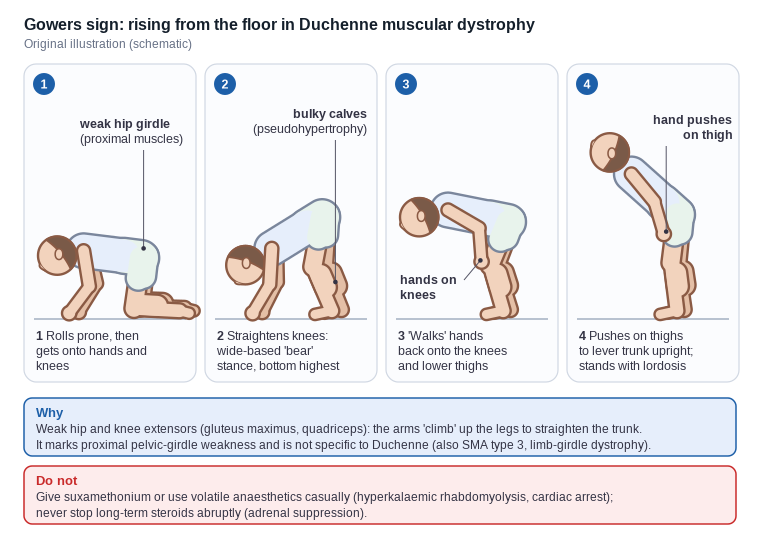
Duchenne and Becker muscular dystrophies are X-linked recessive dystrophinopathies caused by variants in the DMD gene at Xp21, the largest human gene. Duchenne muscular dystrophy (DMD) affects about 1 in 3500–5000 live-born boys; out-of-frame variants abolish dystrophin, so muscle fibres are damaged with each contraction and replaced by fat and fibrous tissue. Boys present at 2–5 years with delayed walking or speech, falls, a waddling gait, a Gowers sign and calf pseudohypertrophy. Creatine kinase is very high, and transaminases are raised from muscle, not liver. Genetic testing (MLPA for deletions and duplications, then sequencing) confirms the diagnosis. Becker muscular dystrophy (BMD) results from in-frame variants that leave some dystrophin; it starts later, progresses more slowly and is often dominated by cardiomyopathy. Care follows the 2018 international care considerations: daily glucocorticoids, ACE inhibitors, respiratory, bone, endocrine and psychosocial care. Newer therapies vary by country.
Patient case, mechanism, investigations, management, flashcards and exam-style questions.Open the lesson →
Key facts
- X-linked recessive; DMD gene at Xp21; about a third of cases arise from new variants
- DMD incidence about 1 in 3500–5000 male births; BMD about 1 in 18 000–30 000
- Reading-frame rule: out-of-frame variants cause Duchenne, in-frame variants cause Becker
- Signs: Gowers sign, calf pseudohypertrophy, waddling gait, toe-walking, lumbar lordosis, delayed motor and speech milestones
- Creatine kinase typically 10–100 times normal; ALT and AST raised from muscle
- Diagnosis: MLPA for deletions/duplications (about 75–80%), then gene sequencing; muscle biopsy if genetics negative
- Daily glucocorticoids (prednisolone 0.75 mg/kg/day or deflazacort 0.9 mg/kg/day) prolong walking and preserve lung and heart function
- Dilated cardiomyopathy and respiratory failure are the main causes of death; survival now often into the 30s
Differential diagnosis
| Condition | Clues | Key test |
|---|---|---|
| Spinal muscular atrophy | Hypotonia, fasciculations of tongue, absent reflexes; CK normal or mildly raised | SMN1 deletion testing |
| Limb-girdle muscular dystrophy | Proximal weakness in girls or boys, autosomal inheritance | Gene panel; muscle biopsy |
| Juvenile dermatomyositis | Subacute proximal weakness with heliotrope rash and Gottron papules | CK, myositis antibodies, MRI muscle |
| Cerebral palsy (spastic) | Toe-walking with brisk reflexes and perinatal risk factors; CK normal | MRI brain |
| Emery–Dreifuss muscular dystrophy | Early elbow and neck contractures, cardiac conduction block | EMD or LMNA testing; ECG |
| Pompe disease (late onset) | Proximal weakness with early respiratory involvement | Acid alpha-glucosidase enzyme assay |
| Hypothyroid myopathy | Weakness, raised CK, growth failure | Thyroid function tests |
Exam pearls
Guideline
Diagnosis and management of Duchenne muscular dystrophy: international care considerations (Lancet Neurology, 2018, parts 1–3); FOR-DMD trial (2022); regulatory updates 2023–2025
References
- Birnkrant DJ, Bushby K, Bann CM, et al.. Diagnosis and management of Duchenne muscular dystrophy, part 1: diagnosis, and neuromuscular, rehabilitation, endocrine, and gastrointestinal and nutritional management. Lancet Neurol 2018.
- Birnkrant DJ, Bushby K, Bann CM, et al.. Diagnosis and management of Duchenne muscular dystrophy, part 2: respiratory, cardiac, bone health, and orthopaedic management. Lancet Neurol 2018.
- Birnkrant DJ, Bushby K, Bann CM, et al.. Diagnosis and management of Duchenne muscular dystrophy, part 3: primary care, emergency management, psychosocial care, and transitions of care across the lifespan. Lancet Neurol 2018.
- Guglieri M, Bushby K, McDermott MP, et al.. Effect of different corticosteroid dosing regimens on clinical outcomes in boys with Duchenne muscular dystrophy: a randomized clinical trial. JAMA 2022.
- Guglieri M, Clemens PR, Perlman SJ, et al.. Efficacy and safety of vamorolone vs placebo and prednisone among boys with Duchenne muscular dystrophy: a randomized clinical trial. JAMA Neurol 2022.
- Mercuri E, Vilchez JJ, Boespflug-Tanguy O, et al.. Safety and efficacy of givinostat in boys with Duchenne muscular dystrophy (EPIDYS): a multicentre, randomised, double-blind, placebo-controlled, phase 3 trial. Lancet Neurol 2024.
Related topics
By Dr Khalid Seidi (B.Sc., M.D.) · MedEd World Clinical Knowledge library. Original teaching content checked against current guidelines (November 2026); confirm the latest local guidance before clinical use. Not a substitute for clinical judgement.