Clinical Knowledge › Paediatrics › Paediatric neurology
Tuberous sclerosis
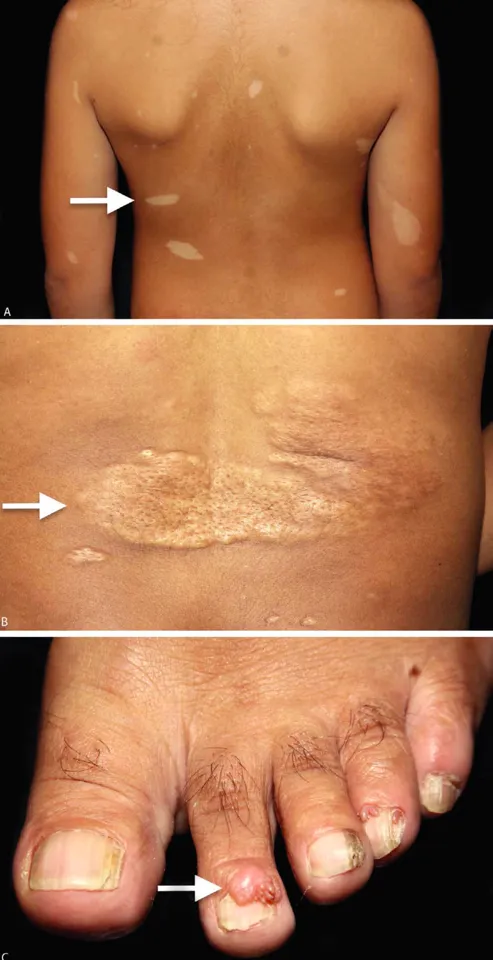
Tuberous sclerosis complex (TSC) is an autosomal dominant multisystem disorder caused by pathogenic variants in TSC1 (hamartin, 9q34) or TSC2 (tuberin, 16p13.3), with a birth incidence of about 1 in 6,000–10,000; about two-thirds of cases are de novo. Loss of the hamartin–tuberin brake overactivates mTOR, producing benign hamartomas in brain, skin, heart, kidney, lung and eye. It often first appears as fetal cardiac rhabdomyomas or as infantile spasms with hypsarrhythmia; up to 85% develop epilepsy and around half have intellectual disability or autism (TSC-associated neuropsychiatric disorders, TAND). Hypomelanotic (ash-leaf) macules, facial angiofibromas, shagreen patches and ungual fibromas are the visible clues. Diagnosis uses the 2021 international clinical and genetic criteria. Vigabatrin is first-line for infantile spasms; mTOR inhibitors (everolimus, topical sirolimus) treat SEGA, renal angiomyolipomas, refractory seizures and angiofibromas. Lifelong surveillance of brain, kidneys, lungs, heart and development is essential.
Patient case, mechanism, investigations, management, flashcards and exam-style questions.Open the lesson →
Key facts
- Autosomal dominant; TSC1 (hamartin) or TSC2 (tuberin); about two-thirds de novo; TSC2 variants usually more severe
- Hamartin–tuberin complex inhibits mTORC1; loss causes hamartomas in many organs
- Cardiac rhabdomyomas are often the earliest sign (fetal ultrasound) and regress in infancy
- Epilepsy in up to 85%, often starting in the first year; infantile spasms in about a third
- Vigabatrin is first-line treatment for infantile spasms in TSC; watch for peripheral visual field loss
- Skin: hypomelanotic macules (Wood's lamp), facial angiofibromas, shagreen patch, ungual fibromas, confetti lesions
- SEGA near the foramen of Monro can cause obstructive hydrocephalus; MRI brain every 1–3 years to age 25
- Renal angiomyolipomas can bleed; everolimus is first-line for growing lesions over 3 cm; TSC2–PKD1 deletion causes early polycystic kidneys
Differential diagnosis
| Condition | Clues | Key test |
|---|---|---|
| Neurofibromatosis type 1 | Café-au-lait (hyperpigmented) macules and freckling rather than hypopigmented macules | Clinical criteria, NF1 testing |
| Isolated naevus depigmentosus | Single stable hypopigmented patch without other features | Clinical follow-up; normal MRI and development |
| Vitiligo | Depigmented (milk-white), acquired, often symmetrical, enhances strongly with Wood's lamp | Clinical; thyroid antibodies |
| Other causes of infantile spasms (HIE, Down syndrome, CDKL5, cortical malformation) | Spasms without skin or cardiac signs | MRI brain, genetic testing, metabolic screen |
| Acne vulgaris | Facial papules mistaken for angiofibromas; comedones present, onset at puberty | Clinical; angiofibromas start at 2–5 years without comedones |
| Autosomal dominant polycystic kidney disease | Renal cysts without angiomyolipomas or neurocutaneous signs | Renal ultrasound/MRI, PKD1/PKD2 testing |
Exam pearls
Guideline
Updated International TSC Diagnostic Criteria and Surveillance and Management Recommendations (International TSC Consensus Group, 2021)
References
- Northrup H, Aronow ME, Bebin EM, et al.. Updated international tuberous sclerosis complex diagnostic criteria and surveillance and management recommendations. Pediatr Neurol 2021.
- Kotulska K, Kwiatkowski DJ, Curatolo P, et al.. Prevention of epilepsy in infants with tuberous sclerosis complex in the EPISTOP trial. Ann Neurol 2021.
- French JA, Lawson JA, Yapici Z, et al.. Adjunctive everolimus therapy for treatment-resistant focal-onset seizures associated with tuberous sclerosis (EXIST-3): a phase 3, randomised, double-blind, placebo-controlled study. Lancet 2016.
- O'Kelley SE, Capal JK, McPherson TO, et al.. Neurodevelopmental outcomes from the PREVeNT trial. Pediatr Neurol 2025.
- Franz DN, Belousova E, Sparagana S, et al.. Efficacy and safety of everolimus for subependymal giant cell astrocytomas associated with tuberous sclerosis complex (EXIST-1): a multicentre, randomised, placebo-controlled phase 3 trial. Lancet 2013.
- Thiele EA, Bebin EM, Bhathal H, et al.. Add-on cannabidiol treatment for drug-resistant seizures in tuberous sclerosis complex: a placebo-controlled randomized clinical trial. JAMA Neurol 2021.
Related topics
By Dr Khalid Seidi (B.Sc., M.D.) · MedEd World Clinical Knowledge library. Original teaching content checked against current guidelines (November 2026); confirm the latest local guidance before clinical use. Not a substitute for clinical judgement.