Clinical Knowledge › Paediatrics › Paediatric neurology
Cerebral palsy
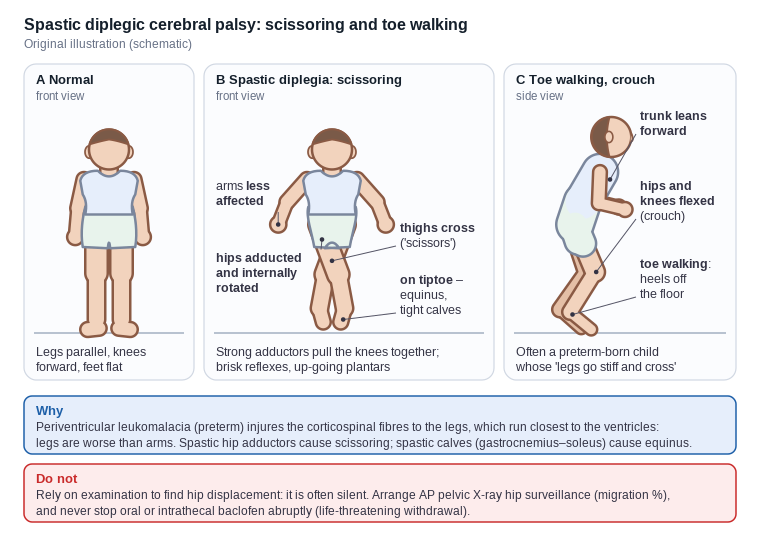
Cerebral palsy (CP) is a group of permanent disorders of movement and posture that limit activity and are attributed to a non-progressive disturbance of the developing fetal or infant brain. It is the commonest physical disability of childhood, affecting about 1.5–2 per 1000 live births in high-income countries and more where perinatal care is limited. Risk factors include preterm birth, growth restriction, infection, perinatal stroke, hypoxic-ischaemic encephalopathy and kernicterus. Spastic CP (unilateral or bilateral) accounts for about 80%; dyskinetic and ataxic forms make up the rest. Epilepsy, intellectual disability, sensory impairment, feeding difficulty, pain and hip displacement often coexist. Diagnosis can now be made, or a 'high risk of CP' label given, before 6 months corrected age using MRI, the Prechtl General Movements Assessment and the Hammersmith Infant Neurological Examination. Function is described with the Gross Motor Function Classification System (GMFCS I–V). Management is multidisciplinary and family-centred.
Patient case, mechanism, investigations, management, flashcards and exam-style questions.Open the lesson →
Key facts
- Prevalence about 1.5–2 per 1000 live births in high-income countries; risk rises steeply with lower gestational age
- Definition: permanent, non-progressive brain disturbance before about 2 years causing a motor disorder; the musculoskeletal effects progress
- Spastic CP about 80% (unilateral or bilateral); dyskinetic about 10–15%; ataxic about 5%
- Early diagnosis before 5 months corrected age: term-age MRI, General Movements Assessment (absent fidgety movements) and HINE
- GMFCS I–V describes gross motor function and predicts walking, hip displacement and comorbidities
- About 1 in 3 have epilepsy, about 1 in 2 have intellectual disability; 2 in 3 walk, 3 in 4 talk
- Hip displacement risk rises with GMFCS level; regular hip X-ray surveillance (migration percentage)
- Prevention: antenatal magnesium sulfate and corticosteroids for preterm birth, therapeutic hypothermia for HIE, prevention of kernicterus
Differential diagnosis
| Condition | Clues | Key test |
|---|---|---|
| Hereditary spastic paraplegia | Slowly progressive spastic legs, family history, normal MRI brain | Genetic panel; MRI brain and spine |
| Dopa-responsive dystonia | Dystonic gait worse later in the day, normal birth history | Trial of levodopa; GCH1 testing |
| Duchenne muscular dystrophy | Boy toe-walking with calf hypertrophy and Gowers sign; reflexes reduced | Creatine kinase markedly raised |
| Spinal cord lesion (tethered cord, tumour) | Spastic legs with bladder signs, back pain or sacral stigmata, normal arms | MRI spine |
| Metabolic disease (e.g. glutaric aciduria type 1, arginase deficiency) | Regression, macrocephaly, crises with illness | Urine organic acids, plasma amino acids, ammonia |
| Leukodystrophy | Loss of skills, white matter changes | MRI; specific enzyme and genetic tests |
| Ataxia telangiectasia | Progressive ataxia, conjunctival telangiectasia, infections | Raised alpha-fetoprotein; ATM testing |
Exam pearls
Guideline
NICE NG62 Cerebral palsy in under 25s: assessment and management (2017); international early diagnosis guideline (Novak et al. 2017); NICE CG145 spasticity in under 19s (2012, updated 2016)
References
- National Institute for Health and Care Excellence. Cerebral palsy in under 25s: assessment and management (NG62). NICE guideline 2017.
- Rosenbaum P, Paneth N, Leviton A, et al.. A report: the definition and classification of cerebral palsy April 2006. Dev Med Child Neurol Suppl 2007.
- Palisano R, Rosenbaum P, Walter S, et al.. Development and reliability of a system to classify gross motor function in children with cerebral palsy. Dev Med Child Neurol 1997.
- Novak I, Morgan C, Adde L, et al.. Early, accurate diagnosis and early intervention in cerebral palsy: advances in diagnosis and treatment. JAMA Pediatr 2017.
- National Institute for Health and Care Excellence. Spasticity in under 19s: management (CG145). NICE clinical guideline 2012.
- National Institute for Health and Care Excellence. Preterm labour and birth (NG25). NICE guideline 2015.
Related topics
By Dr Khalid Seidi (B.Sc., M.D.) · MedEd World Clinical Knowledge library. Original teaching content checked against current guidelines (November 2026); confirm the latest local guidance before clinical use. Not a substitute for clinical judgement.