Clinical Knowledge › Paediatrics › Paediatric neurology
Spinal muscular atrophy
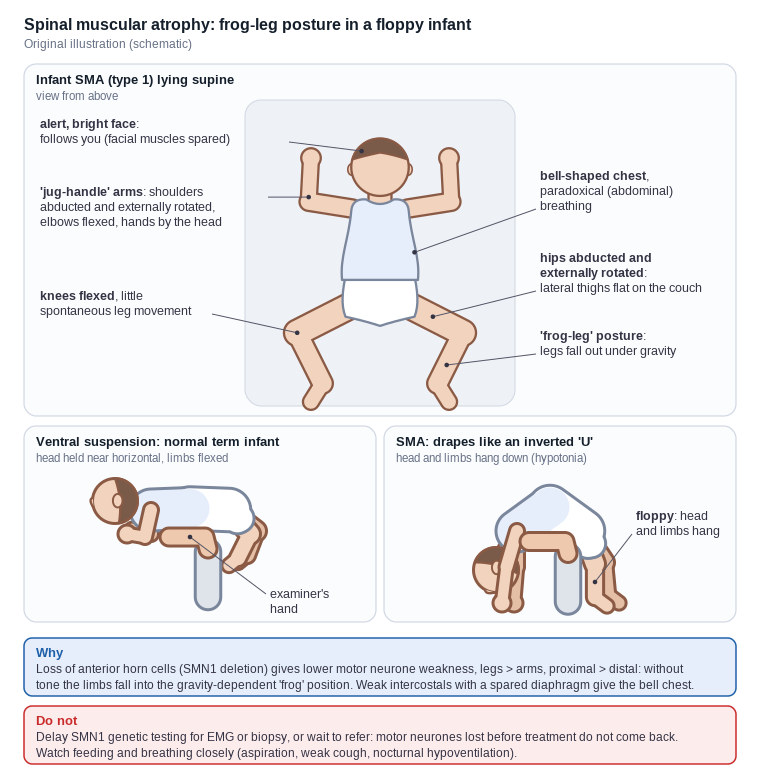
Spinal muscular atrophy (SMA) is an autosomal recessive disease of the anterior horn cells and historically the commonest genetic cause of infant death. About 95% of patients have a homozygous deletion of exon 7 of SMN1 on chromosome 5q13; the number of copies of the back-up gene SMN2 largely sets severity. The infant is alert and socially bright but floppy, with symmetrical proximal weakness worse in the legs, absent reflexes, tongue fasciculations, a bell-shaped chest and paradoxical (abdominal) breathing, while sensation and facial expression are spared. Classic type 1 presents before 6 months and, untreated, causes respiratory failure before age 2. Diagnosis is by SMN1 deletion testing with SMN2 copy number, increasingly through newborn screening. Three disease-modifying therapies – intrathecal nusinersen, one-off intravenous gene therapy onasemnogene abeparvovec and oral risdiplam – work best before symptoms appear, so time from diagnosis to treatment is critical. Multidisciplinary standards of care cover breathing, nutrition, orthopaedics and family support.
Patient case, mechanism, investigations, management, flashcards and exam-style questions.Open the lesson →
Key facts
- Autosomal recessive; incidence about 1 in 10,000 live births; carrier frequency about 1 in 40–60
- About 95% have homozygous deletion of SMN1 exon 7 (5q13); SMN2 copy number modifies severity (more copies, milder disease)
- Type 1 (about 60%): onset before 6 months, never sits; untreated death or permanent ventilation before 2 years
- Type 2: onset 6–18 months, sits but never walks; type 3: walks independently, onset after 18 months
- Lower motor neurone signs: hypotonia, areflexia, tongue fasciculations, proximal weakness; alert face, normal sensation
- Paradoxical breathing and bell-shaped chest: intercostals weak, diaphragm relatively spared
- Diagnosis: SMN1 deletion test (MLPA or qPCR) plus SMN2 copy number; EMG and muscle biopsy rarely needed
- Treat early: nusinersen (intrathecal ASO), onasemnogene abeparvovec (AAV9 gene therapy) or risdiplam (oral SMN2 splicing modifier)
Differential diagnosis
| Condition | Clues | Key test |
|---|---|---|
| Pompe disease (infantile) | Hypotonia with hypertrophic cardiomyopathy, macroglossia, hepatomegaly; CK raised | Dried blood spot acid alpha-glucosidase; ECG short PR, large QRS |
| Central (brain) hypotonia, e.g. HIE or Prader–Willi | Floppy but reflexes preserved or brisk, poor alertness, feeding difficulty, dysmorphism | Methylation test for Prader–Willi; MRI brain |
| Congenital myotonic dystrophy | Facial weakness, tented upper lip, talipes, polyhydramnios; mother has myotonia | DMPK CTG repeat testing in mother and baby |
| Infant botulism | Acute descending weakness, ptosis, dilated sluggish pupils, constipation; honey exposure | Stool Clostridium botulinum toxin |
| Congenital myasthenic syndrome | Fluctuating ptosis, ophthalmoplegia, apnoeic episodes; reflexes often present | Repetitive nerve stimulation, gene panel |
| Duchenne muscular dystrophy | Boy walking late, Gowers sign, calf pseudohypertrophy; CK very high | CK (10–100 times normal), DMD gene testing |
| SMA with respiratory distress type 1 (SMARD1) | Distal weakness and early diaphragmatic paralysis | IGHMBP2 gene testing; chest X-ray raised hemidiaphragm |
Exam pearls
Guideline
International Standards of Care for SMA (Mercuri and Finkel, 2018) with NICE technology appraisals TA588 nusinersen (2019), HST15 onasemnogene abeparvovec (2021) and TA755 risdiplam (2021); regulatory approvals to 2025
References
- Mercuri E, Finkel RS, Muntoni F, et al.. Diagnosis and management of spinal muscular atrophy: Part 1: Recommendations for diagnosis, rehabilitation, orthopedic and nutritional care. Neuromuscul Disord 2018.
- Finkel RS, Mercuri E, Meyer OH, et al.. Diagnosis and management of spinal muscular atrophy: Part 2: Pulmonary and acute care; medications, supplements and immunizations; other organ systems; and ethics. Neuromuscul Disord 2018.
- Finkel RS, Mercuri E, Darras BT, et al.. Nusinersen versus sham control in infantile-onset spinal muscular atrophy. N Engl J Med 2017.
- Mendell JR, Al-Zaidy S, Shell R, et al.. Single-dose gene-replacement therapy for spinal muscular atrophy. N Engl J Med 2017.
- Darras BT, Masson R, Mazurkiewicz-Bełdzińska M, et al.. Risdiplam-treated infants with type 1 spinal muscular atrophy versus historical controls. N Engl J Med 2021.
- National Institute for Health and Care Excellence. Nusinersen for treating spinal muscular atrophy (TA588); Onasemnogene abeparvovec for treating spinal muscular atrophy (HST15); Risdiplam for treating spinal muscular atrophy (TA755). NICE technology appraisal guidance 2021.
Related topics
By Dr Khalid Seidi (B.Sc., M.D.) · MedEd World Clinical Knowledge library. Original teaching content checked against current guidelines (November 2026); confirm the latest local guidance before clinical use. Not a substitute for clinical judgement.