Clinical Knowledge › Internal medicine › Endocrinology › Thyroid disorders
Amiodarone-induced thyroid dysfunction
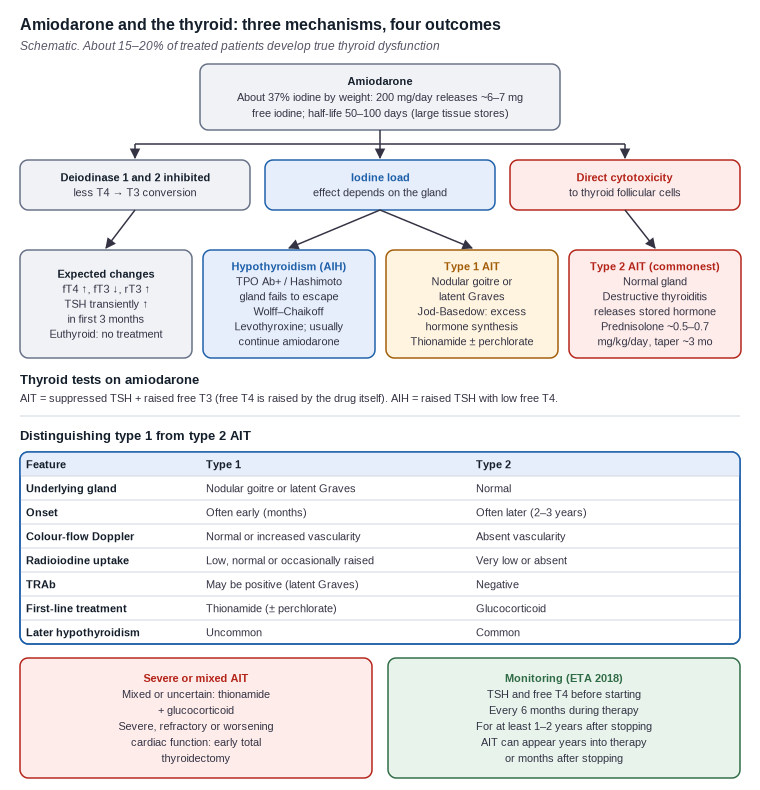
Amiodarone is an iodine-rich (about 37% by weight), highly lipophilic class III antiarrhythmic with a half-life of weeks to months. A 200 mg daily dose releases several milligrams of free iodine a day, many times the daily requirement. In everyone it inhibits type 1 and 2 deiodinase, so free T4 rises, free T3 falls and TSH may rise transiently in the first months without true dysfunction. About 15–20% of treated patients develop real thyroid disease. Amiodarone-induced hypothyroidism (AIH) is commoner in iodine-sufficient regions and in women with thyroid autoantibodies; it is treated with levothyroxine while amiodarone continues. Amiodarone-induced thyrotoxicosis (AIT) is more dangerous because it can worsen arrhythmias and heart failure. Type 1 AIT is iodine-induced excess hormone synthesis in an abnormal gland (nodular goitre or latent Graves disease) and responds to thionamides; type 2 AIT, now the commonest form, is a destructive thyroiditis in a normal gland and responds to glucocorticoids. Colour-flow Doppler and uptake studies help separate them, mixed forms exist, and severe or refractory cases go to early total thyroidectomy. Monitor TSH before and every 6 months during therapy and for at least a year after stopping.
Patient case, mechanism, investigations, management, flashcards and exam-style questions.Open the lesson →
Key facts
- Amiodarone is about 37% iodine by weight; a 200 mg tablet releases roughly 6–7 mg of free iodine daily
- Expected changes in euthyroid patients: free T4 up, free T3 down, reverse T3 up, TSH transiently up in the first 3 months (deiodinase inhibition)
- Amiodarone-induced hypothyroidism: failure to escape the Wolff–Chaikoff effect, especially with TPO antibodies; treat with levothyroxine and usually continue amiodarone
- Type 1 AIT: increased synthesis in an abnormal gland (nodular goitre, latent Graves); goitre, preserved vascularity on Doppler; treat with thionamides (± perchlorate)
- Type 2 AIT: destructive thyroiditis in a normal gland; no goitre, absent vascularity, very low uptake; treat with prednisolone
- AIT can appear years into therapy or months after stopping amiodarone because of its long half-life
- Severe, refractory or mixed AIT with deteriorating cardiac function: early total thyroidectomy
- Monitor TSH (with free T4) at baseline, then every 6 months during therapy and for at least 1–2 years after stopping
Differential diagnosis
| Condition | Clues | Key test |
|---|---|---|
| Expected amiodarone effect (euthyroid) | High-normal or slightly high free T4, low-normal free T3, normal TSH after first months, well patient | Repeat TSH and free T3 |
| Type 1 AIT | Pre-existing nodular goitre or Graves features, iodine-deficient area | Doppler: normal or increased vascularity; uptake detectable |
| Type 2 AIT | Normal gland, onset often after 2–3 years of therapy | Doppler: absent vascularity; very low uptake; sestamibi uptake absent |
| Graves disease unrelated to amiodarone | Orbitopathy, diffuse goitre | TRAb positive |
| Amiodarone-induced hypothyroidism | Fatigue, weight gain, high TSH with low free T4, often TPO antibody positive | TSH, free T4, TPO antibodies |
| Non-thyroidal illness in a cardiac patient | Low T3 and normal TSH in heart failure or after cardiac surgery | Clinical context; repeat after recovery |
| Recurrent arrhythmia from heart disease progression | New AF or VT without thyroid change | Normal TSH and free T3 |
Exam pearls
Guideline
European Thyroid Association 2018 Guidelines for the Management of Amiodarone-Associated Thyroid Dysfunction, with ATA 2016 hyperthyroidism guideline and ESC 2024 atrial fibrillation guideline
References
- Bartalena L, Bogazzi F, Chiovato L, Hubalewska-Dydejczyk A, Links TP, Vanderpump M.. 2018 European Thyroid Association (ETA) Guidelines for the Management of Amiodarone-Associated Thyroid Dysfunction. Eur Thyroid J 2018.
- Ross DS, Burch HB, Cooper DS, et al.. 2016 American Thyroid Association guidelines for diagnosis and management of hyperthyroidism and other causes of thyrotoxicosis. Thyroid 2016.
- Eskes SA, Wiersinga WM.. Amiodarone and thyroid. Best Pract Res Clin Endocrinol Metab 2009.
- Jonklaas J, Bianco AC, Bauer AJ, et al.. Guidelines for the treatment of hypothyroidism: prepared by the American Thyroid Association task force on thyroid hormone replacement. Thyroid 2014.
- Van Gelder IC, Rienstra M, Bunting KV, et al.. 2024 ESC Guidelines for the management of atrial fibrillation developed in collaboration with the European Association for Cardio-Thoracic Surgery (EACTS). Eur Heart J 2024.
- National Institute for Health and Care Excellence. Thyroid disease: assessment and management (NG145). NICE 2019.
Related topics
By Dr Khalid Seidi (B.Sc., M.D.) · MedEd World Clinical Knowledge library. Original teaching content checked against current guidelines (November 2026); confirm the latest local guidance before clinical use. Not a substitute for clinical judgement.