Clinical Knowledge › Internal medicine › Infectious diseases › Urinary and sexually transmitted infections
Anogenital warts (HPV)
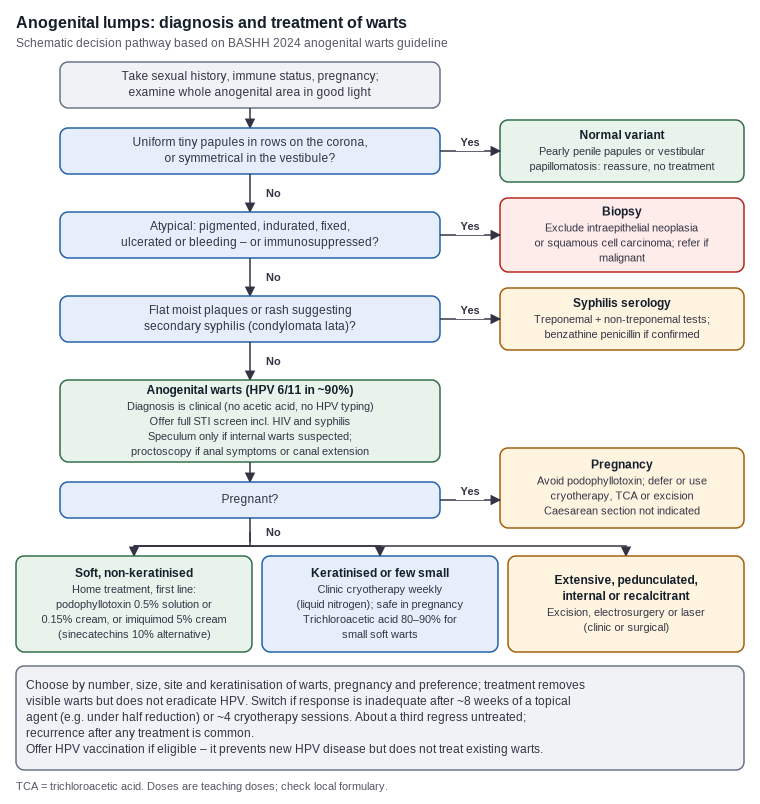
Anogenital warts (condylomata acuminata) are benign epithelial growths of the genital, perianal and anal skin and mucosa caused by human papillomavirus (HPV), in about 90% of cases the low-risk types 6 and 11. They are among the commonest sexually transmitted infections, spread by skin-to-skin contact, and appear weeks to months after exposure as soft, cauliflower-like, flat or keratinised papules that are usually painless. Diagnosis is clinical; biopsy is reserved for atypical, pigmented, indurated, ulcerated or refractory lesions and for people with immunosuppression, because high-risk HPV (16, 18 and others) can cause intraepithelial neoplasia and squamous cell carcinoma that may mimic warts. Treatment is cosmetic and symptomatic, not curative: self-applied podophyllotoxin or imiquimod, sinecatechins, or clinic-based cryotherapy, excision, electrosurgery or laser. About a third clear spontaneously, recurrence is common, and podophyllotoxin is avoided in pregnancy. Prophylactic HPV vaccination before sexual debut has caused dramatic falls in warts and is the key preventive measure.
Patient case, mechanism, investigations, management, flashcards and exam-style questions.Open the lesson →
Key facts
- HPV 6 and 11 (low-risk types) cause about 90% of anogenital warts; HPV 16 and 18 cause most HPV-related cancers
- Transmission is by direct skin-to-skin contact; incubation is usually 3 weeks to 8 months; condoms reduce but do not abolish risk
- Diagnosis is clinical; biopsy atypical, pigmented, indurated, fixed, bleeding or ulcerated lesions and those not responding to treatment
- Speculum examination is needed only if internal (vaginal or cervical) warts are suspected; proctoscopy if anal symptoms or perianal warts extending internally
- First-line options: podophyllotoxin 0.5% solution or 0.15% cream, imiquimod 5% cream, sinecatechins 10% ointment, or cryotherapy
- Podophyllotoxin is contraindicated in pregnancy; cryotherapy, excision, electrosurgery, laser and trichloroacetic acid are acceptable
- Without treatment about a third of warts regress within months; after any treatment recurrence occurs in up to a third or more
- Quadrivalent or nonavalent HPV vaccination before sexual debut prevents most warts; vaccination does not treat existing warts
Differential diagnosis
| Condition | Clues | Key test |
|---|---|---|
| Condylomata lata (secondary syphilis) | Flat, moist, grey-white plaques; rash elsewhere; lymphadenopathy | Treponemal serology and RPR |
| Molluscum contagiosum | Smooth, pearly, umbilicated papules on pubis, thighs or genitals | Clinical; curette shows molluscum bodies |
| Pearly penile papules / vestibular papillomatosis | Uniform small papules in rows on the corona or symmetrical in the vulval vestibule; normal variant | Clinical; no treatment needed |
| Intraepithelial neoplasia (VIN, PeIN, AIN; bowenoid papulosis) | Pigmented, flat, velvety or multifocal plaques, often in HIV or smokers | Biopsy (high-grade squamous intraepithelial lesion) |
| Squamous cell carcinoma or Buschke–Löwenstein tumour | Large, indurated, fixed, ulcerated or bleeding mass; older or immunosuppressed | Biopsy and staging |
| Skin tags and seborrhoeic keratoses | Soft pedunculated tags or 'stuck-on' pigmented keratoses | Clinical or dermoscopy; biopsy if doubt |
| Fordyce spots | Tiny yellow-white ectopic sebaceous glands on the penile shaft or labia | Clinical |
Exam pearls
Guideline
BASHH national guideline for the management of anogenital warts in adults (2024), with CDC STI Treatment Guidelines (2021), IUSTI-Europe anogenital warts guideline (2020) and WHO HPV vaccine position paper (2022)
References
- Nugent D, et al.. British Association for Sexual Health and HIV (BASHH) national guideline for the management of anogenital warts in adults (2024). Int J STD AIDS 2024.
- World Health Organization. Human papillomavirus vaccines: WHO position paper (2022 update). Wkly Epidemiol Rec 2022.
- Workowski KA, Bachmann LH, Chan PA, et al.. Sexually transmitted infections treatment guidelines, 2021. MMWR Recomm Rep 2021.
- Gilson R, Nugent D, Werner RN, Ballesteros J, Ross J.. 2019 IUSTI-Europe guideline for the management of anogenital warts. J Eur Acad Dermatol Venereol 2020.
- FUTURE I Investigators (Garland SM, et al.). Quadrivalent vaccine against human papillomavirus to prevent anogenital diseases. N Engl J Med 2007.
- Palefsky JM, Lee JY, Jay N, et al.. Treatment of anal high-grade squamous intraepithelial lesions to prevent anal cancer. N Engl J Med 2022.
Related topics
By Dr Khalid Seidi (B.Sc., M.D.) · MedEd World Clinical Knowledge library. Original teaching content checked against current guidelines (November 2026); confirm the latest local guidance before clinical use. Not a substitute for clinical judgement.