Clinical Knowledge › Internal medicine › Infectious diseases › Urinary and sexually transmitted infections
Trichomoniasis
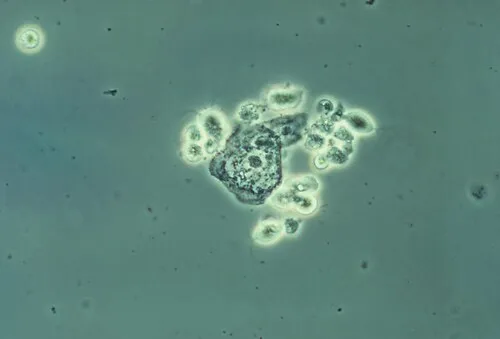
Trichomoniasis is a sexually transmitted infection caused by Trichomonas vaginalis, a flagellated, pear-shaped anaerobic protozoan that exists only as a trophozoite. It is the commonest curable non-viral STI worldwide and, unlike chlamydia, remains common in older women. It infects the vagina, urethra and paraurethral glands in women and the urethra and prostate in men. Most men and many women are asymptomatic; symptomatic women have a frothy, yellow-green, malodorous discharge with vulval itch, soreness, dysuria and a vaginal pH above 4.5, and a few have a 'strawberry' cervix. Infection increases the risk of HIV acquisition and transmission, and in pregnancy is linked with preterm birth and low birth weight. Nucleic acid amplification tests on vulvovaginal swabs or first-void urine are the most sensitive tests; wet-mount microscopy shows motile organisms but misses up to half of cases. Treatment is oral metronidazole, with a 7-day course now preferred for women after a randomised trial showed fewer failures than a single 2 g dose. Partners must be treated at the same time.
Patient case, mechanism, investigations, management, flashcards and exam-style questions.Open the lesson →
Key facts
- Trichomonas vaginalis: flagellated anaerobic protozoan, trophozoite only (no cyst), with jerky motility on wet mount
- Commonest curable non-viral STI worldwide; prevalence remains high in women over 40
- Frothy yellow-green offensive discharge, vulvovaginitis, dysuria and pH above 4.5; strawberry cervix in a few (more on colposcopy)
- NAAT on a vulvovaginal swab (women) or first-void urine (men) is the most sensitive test; wet mount sensitivity is only about 50–70%
- Treatment: metronidazole 400–500 mg twice daily for 7 days (preferred for women; BASHH 2021 for all); CDC 2021 allows 2 g single dose for men
- Treat current partners simultaneously and avoid sex until both have completed treatment
- Associated with HIV acquisition and transmission, preterm birth, low birth weight and pelvic inflammatory disease in women with HIV
- Metronidazole is safe in all trimesters of pregnancy; persistent infection after reinfection is excluded suggests nitroimidazole resistance
Differential diagnosis
| Condition | Clues | Key test |
|---|---|---|
| Bacterial vaginosis | Thin grey fishy discharge without inflammation or itch | Amsel criteria or Gram stain (clue cells); pH above 4.5 |
| Vulvovaginal candidiasis | Itch, thick white discharge, pH 4.5 or less | Microscopy for pseudohyphae; culture |
| Chlamydia or gonorrhoea cervicitis | Mucopurulent cervical discharge, contact bleeding | NAAT |
| Desquamative inflammatory vaginitis | Purulent discharge, raised pH, many parabasal cells, no organisms | Microscopy; negative NAAT |
| Atrophic vaginitis | Postmenopausal dryness, soreness, raised pH | Clinical; negative NAAT |
| Mycoplasma genitalium urethritis | Male urethritis not responding to doxycycline | M. genitalium NAAT |
Exam pearls
Guideline
BASHH UK national guideline on the management of Trichomonas vaginalis (2021), CDC Sexually Transmitted Infections Treatment Guidelines (2021), WHO guidelines for the management of symptomatic sexually transmitted infections (2021) and IUSTI/WHO European guideline on the management of vaginal discharge (2018)
References
- Sherrard J, Pitt R, Hobbs KR, et al.. British Association for Sexual Health and HIV (BASHH) United Kingdom national guideline on the management of Trichomonas vaginalis 2021. Int J STD AIDS 2022.
- Workowski KA, Bachmann LH, Chan PA, et al.. Sexually transmitted infections treatment guidelines, 2021. MMWR Recomm Rep 2021.
- World Health Organization. Guidelines for the management of symptomatic sexually transmitted infections. World Health Organization 2021.
- Sherrard J, Wilson J, Donders G, Mendling W, Jensen JS. 2018 European (IUSTI/WHO) International Union against sexually transmitted infections (IUSTI) World Health Organisation (WHO) guideline on the management of vaginal discharge. Int J STD AIDS 2018.
- Kissinger P, Muzny CA, Mena LA, et al.. Single-dose versus 7-day-dose metronidazole for the treatment of trichomoniasis in women: an open-label, randomised controlled trial. Lancet Infect Dis 2018.
- Kissinger P. Trichomonas vaginalis: a review of epidemiologic, clinical and treatment issues. BMC Infect Dis 2015.
Related topics
By Dr Khalid Seidi (B.Sc., M.D.) · MedEd World Clinical Knowledge library. Original teaching content checked against current guidelines (November 2026); confirm the latest local guidance before clinical use. Not a substitute for clinical judgement.