Clinical Knowledge › Internal medicine › Infectious diseases › Urinary and sexually transmitted infections
Bacterial vaginosis and vulvovaginal candidiasis
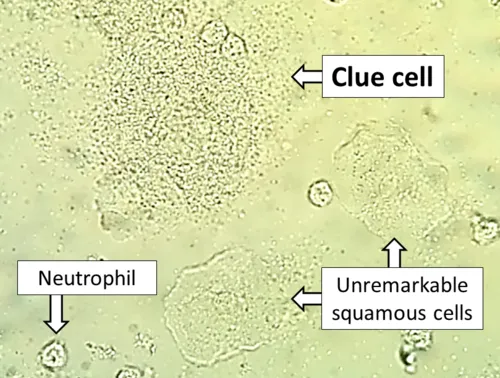
Bacterial vaginosis (BV) and vulvovaginal candidiasis (VVC) are the two commonest causes of abnormal vaginal discharge. BV is a dysbiosis in which protective lactobacilli are replaced by a polymicrobial biofilm of Gardnerella, Prevotella, Fannyhessea (Atopobium) vaginae and other anaerobes. It causes a thin, grey-white, fishy-smelling discharge without inflammation, with a vaginal pH above 4.5, and is diagnosed by Amsel criteria or a Gram-stain Nugent score. It is sexually associated, recurs in over half of women within a year, and increases the risk of preterm birth, post-procedure infection and STI and HIV acquisition. Symptomatic BV is treated with metronidazole or clindamycin; a 2025 trial showed that treating male partners reduced recurrence. VVC is a yeast infection, usually Candida albicans, triggered by antibiotics, pregnancy, diabetes and immunosuppression. It causes itch, soreness and a thick white discharge with a normal pH. It is treated with a single dose of oral fluconazole or a topical azole, topical azoles only in pregnancy, and induction plus maintenance fluconazole for recurrent disease. Non-albicans species need specific therapy.
Patient case, mechanism, investigations, management, flashcards and exam-style questions.Open the lesson →
Key facts
- BV: loss of lactobacilli with overgrowth of Gardnerella and anaerobes forming a vaginal biofilm; not a classic STI but sexually associated
- Amsel criteria (3 of 4): thin homogeneous discharge, pH above 4.5, positive whiff test, clue cells over 20% of epithelial cells
- Nugent score on Gram stain: 0–3 normal, 4–6 intermediate, 7–10 BV
- BV treatment: metronidazole 400–500 mg twice daily for 7 days, metronidazole 0.75% gel for 5 nights, or clindamycin 2% cream for 7 nights; recurrence over 50% within 12 months
- BV increases preterm birth, post-operative infection after gynaecological procedures, PID and HIV/STI acquisition
- VVC: itch, soreness, thick white curdy discharge, vulval erythema and fissuring, satellite lesions; pH 4.5 or less
- Uncomplicated VVC: fluconazole 150 mg orally once or clotrimazole 500 mg pessary once; in pregnancy use topical azoles only, for 7 days
- Recurrent VVC (4 or more episodes a year in BASHH; 3 or more in CDC 2021): confirm by culture and speciation, then fluconazole induction and maintenance for at least 6 months
Differential diagnosis
| Condition | Clues | Key test |
|---|---|---|
| Trichomoniasis | Frothy yellow-green discharge, vulvovaginitis, strawberry cervix, pH above 4.5 | NAAT for T. vaginalis |
| Chlamydia or gonorrhoea cervicitis | Mucopurulent cervical discharge, post-coital bleeding | NAAT |
| Physiological discharge | Clear or white, varies with cycle, no odour or itch | Normal pH and microscopy |
| Contact or irritant dermatitis | Vulval itch after new soap or pad, no discharge change | Negative microscopy; trial of avoidance |
| Lichen sclerosus | Chronic vulval itch, white atrophic plaques | Clinical; biopsy if uncertain |
| Desquamative inflammatory vaginitis | Purulent discharge, raised pH, parabasal cells | Microscopy; negative NAAT |
| Retained foreign body (e.g. tampon) | Very offensive discharge | Speculum examination |
Exam pearls
Guideline
BASHH national guideline for the management of vulvovaginal candidiasis (2019), BASHH UK national guideline for the management of bacterial vaginosis (2012), CDC STI Treatment Guidelines (2021), IUSTI/WHO European guideline on the management of vaginal discharge (2018), WHO symptomatic STI guidelines (2021) and ECMM/ISHAM/ASM global candidiasis guideline (2025)
References
- Saxon C, Edwards A, Rautemaa-Richardson R, et al.. British Association for Sexual Health and HIV national guideline for the management of vulvovaginal candidiasis (2019). Int J STD AIDS 2020.
- British Association for Sexual Health and HIV. UK national guideline for the management of bacterial vaginosis. BASHH 2012.
- Workowski KA, Bachmann LH, Chan PA, et al.. Sexually transmitted infections treatment guidelines, 2021. MMWR Recomm Rep 2021.
- Sherrard J, Wilson J, Donders G, Mendling W, Jensen JS. 2018 European (IUSTI/WHO) International Union against sexually transmitted infections (IUSTI) World Health Organisation (WHO) guideline on the management of vaginal discharge. Int J STD AIDS 2018.
- World Health Organization. Guidelines for the management of symptomatic sexually transmitted infections. World Health Organization 2021.
- Cornely OA, Sprute R, Bassetti M, et al.. Global guideline for the diagnosis and management of candidiasis: an initiative of the ECMM in cooperation with ISHAM and ASM. Lancet Infect Dis 2025.
Related topics
By Dr Khalid Seidi (B.Sc., M.D.) · MedEd World Clinical Knowledge library. Original teaching content checked against current guidelines (November 2026); confirm the latest local guidance before clinical use. Not a substitute for clinical judgement.