Clinical Knowledge › Internal medicine › Infectious diseases › Urinary and sexually transmitted infections
Syphilis
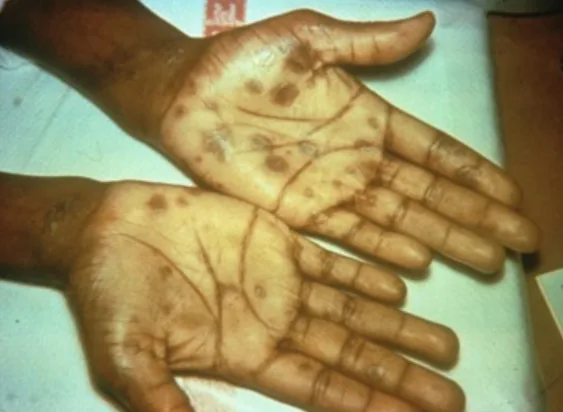
Syphilis is a systemic infection with the spirochaete Treponema pallidum, spread sexually and across the placenta. Primary syphilis is a painless, indurated chancre with rubbery regional lymph nodes about 3 weeks after exposure. Weeks later, secondary syphilis brings a generalised non-itchy rash involving the palms and soles, condylomata lata, mucous patches, lymphadenopathy and sometimes hepatitis, uveitis or meningitis. Latent infection has no signs and is detected only by serology; years later a minority develop tertiary disease: gummas, aortitis or neurosyphilis (tabes dorsalis, general paresis). Neurological, ocular and otic involvement can occur at any stage. Diagnosis combines a treponemal test (EIA or CLIA, confirmed with TPPA) with a non-treponemal test (RPR or VDRL) whose titre tracks activity; chancres can be tested by PCR or dark-ground microscopy. Benzathine penicillin G remains the treatment of choice, with doxycycline as the main alternative. Antenatal screening prevents congenital syphilis; doxycycline post-exposure prophylaxis reduces risk in high-risk groups.
Patient case, mechanism, investigations, management, flashcards and exam-style questions.Open the lesson →
Key facts
- Primary chancre: single painless indurated clean-based ulcer with painless rubbery inguinal nodes, appearing 9–90 days (median 21) after exposure
- Secondary syphilis (4–10 weeks after the chancre): non-itchy rash on trunk, palms and soles, condylomata lata, mucous patches, patchy alopecia, generalised lymphadenopathy
- Early latent = infection within the last 2 years (UK, Europe, WHO) or 1 year (CDC); late latent = beyond that or unknown duration
- Treponemal tests (EIA/CLIA, TPPA, FTA-ABS) stay positive for life; non-treponemal tests (RPR, VDRL) give a titre that falls with treatment
- An adequate response is a fourfold (two-dilution) fall in RPR or VDRL titre within 6–12 months
- Early syphilis: benzathine penicillin G 2.4 million units IM single dose; late latent or tertiary (non-neuro): weekly for 3 weeks
- Neurosyphilis, ocular and otosyphilis are treated as neurosyphilis with high-dose IV benzylpenicillin (or procaine penicillin plus probenecid) for 14 days
- Jarisch–Herxheimer reaction (fever, myalgia, headache within 24 hours of treatment) is common in early syphilis and is not penicillin allergy
Differential diagnosis
| Condition | Clues | Key test |
|---|---|---|
| Genital herpes | Multiple painful vesicles and shallow ulcers; tender nodes | HSV PCR of lesion swab |
| Chancroid (Haemophilus ducreyi) | Painful ragged ulcer with suppurating buboes; tropics | H. ducreyi PCR or culture |
| Lymphogranuloma venereum | Transient painless papule then large tender inguinal nodes or proctitis | Chlamydia NAAT with LGV genotyping |
| Pityriasis rosea | Herald patch, Christmas-tree pattern; spares palms and soles | Negative syphilis serology |
| Drug eruption or viral exanthem | Recent new drug or viral prodrome | Drug history; negative serology |
| Acute HIV seroconversion | Fever, rash, pharyngitis and lymphadenopathy | HIV antigen/antibody test and viral load |
| Behçet disease | Recurrent painful oral and genital ulcers, uveitis | Clinical criteria; pathergy; negative serology |
Exam pearls
Guideline
BASHH UK guidelines for the management of syphilis (2024) and syphilis in pregnancy (2024), CDC STI Treatment Guidelines (2021), WHO updated recommendations for the treatment of syphilis and syphilis testing (2024), European (IUSTI) syphilis guideline (2020) and BASHH doxyPEP guideline (2025)
References
- British Association for Sexual Health and HIV. BASHH UK guidelines for the management of syphilis 2024. Int J STD AIDS 2024.
- Workowski KA, Bachmann LH, Chan PA, et al.. Sexually transmitted infections treatment guidelines, 2021. MMWR Recomm Rep 2021.
- World Health Organization. Updated recommendations for the treatment of Neisseria gonorrhoeae, Chlamydia trachomatis and Treponema pallidum (syphilis), and new recommendations on syphilis testing and partner services. WHO, Geneva 2024.
- Saunders J, et al.. BASHH UK national guideline for the use of doxycycline post-exposure prophylaxis (doxyPEP) for the prevention of bacterial STIs. BASHH 2025.
- Janier M, Unemo M, Dupin N, et al.. 2020 European guideline on the management of syphilis. J Eur Acad Dermatol Venereol 2021.
- Luetkemeyer AF, Donnell D, Dombrowski JC, et al.. Postexposure doxycycline to prevent bacterial sexually transmitted infections. N Engl J Med 2023.
Related topics
By Dr Khalid Seidi (B.Sc., M.D.) · MedEd World Clinical Knowledge library. Original teaching content checked against current guidelines (November 2026); confirm the latest local guidance before clinical use. Not a substitute for clinical judgement.