Clinical Knowledge › Internal medicine › Infectious diseases › Zoonoses and parasitic infections
Anthrax and plague
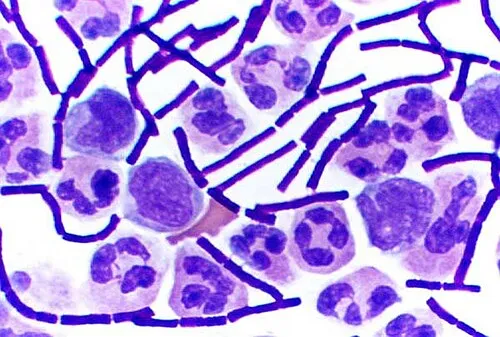
Anthrax and plague are rare but severe bacterial zoonoses that medical students should be able to recognise. Anthrax is caused by Bacillus anthracis, a spore-forming Gram-positive rod acquired from infected livestock and their products such as hides, wool and bone meal, and, in some countries, from contaminated injected heroin. Cutaneous anthrax, a painless black eschar surrounded by striking oedema, accounts for most naturally occurring cases; inhalational, gastrointestinal and injection forms cause toxin-mediated systemic illness with a high mortality and may be complicated by haemorrhagic meningitis. Plague is caused by Yersinia pestis, a Gram-negative coccobacillus maintained in wild rodents and transmitted by fleas; bubonic plague presents with fever and an exquisitely tender lymph node, while septicaemic and pneumonic forms progress within days. Both are notifiable, both are laboratory hazards, and both respond to prompt treatment: fluoroquinolones or doxycycline-based regimens, with combination intravenous therapy for severe disease.
Patient case, mechanism, investigations, management, flashcards and exam-style questions.Open the lesson →
Key facts
- Bacillus anthracis is an aerobic, non-motile, non-haemolytic Gram-positive rod forming chains with a 'boxcar' appearance
- Anthrax toxin has three parts: protective antigen plus oedema factor (an adenylate cyclase) and lethal factor (a protease); the capsule is poly-D-glutamate
- Cutaneous anthrax accounts for about 95% of natural cases: painless papule, vesicles, then a black eschar with extensive non-pitting oedema
- Inhalational anthrax causes haemorrhagic mediastinal lymphadenitis with a widened mediastinum and pleural effusions rather than lobar consolidation
- Anthrax is not transmitted from person to person; standard precautions are sufficient, with contact precautions for draining lesions
- Yersinia pestis is a Gram-negative coccobacillus with bipolar 'safety-pin' staining, spread by rodent fleas such as Xenopsylla cheopis
- Bubonic plague: fever with an exquisitely tender bubo 2-8 days after a flea bite, usually inguinal, femoral or axillary
- Pneumonic plague spreads by respiratory droplets and needs droplet precautions until 48 hours of effective therapy
Differential diagnosis
| Condition | Clues | Key test |
|---|---|---|
| Staphylococcal or streptococcal skin infection | Painful, purulent, warm lesion without a central black eschar | Gram stain and culture of pus |
| Ecthyma gangrenosum | Necrotic lesion in a neutropenic patient | Blood cultures, neutrophil count |
| Tularaemia (ulceroglandular) | Painful punched-out ulcer with tender regional node after hare or tick exposure | PCR or serology; warn the laboratory |
| Cat scratch disease | Subacute tender node after a cat scratch, mild systemic illness | Bartonella serology |
| Severe community-acquired pneumonia | Lobar consolidation without mediastinal widening or exposure history | Sputum and blood cultures, urinary antigens |
| Incarcerated inguinal hernia | Inguinal lump with obstruction rather than fever and node tenderness | Ultrasound or CT |
| Meningococcal sepsis | Petechial or purpuric rash with rapid shock | Blood culture and PCR |
| Influenza | Prodrome resembling early inhalational anthrax but normal mediastinum | Respiratory PCR and chest imaging |
Exam pearls
Guideline
CDC Guidelines for the Prevention and Treatment of Anthrax (2023) and CDC Antimicrobial Treatment and Prophylaxis of Plague (2021), with WHO plague guidance
References
- Bower WA, Yu Y, Person MK, et al.. CDC guidelines for the prevention and treatment of anthrax, 2023. MMWR Recomm Rep 2023.
- Nelson CA, Meaney-Delman D, Fleck-Derderian S, et al.. Antimicrobial treatment and prophylaxis of plague: recommendations for naturally acquired infections and bioterrorism response. MMWR Recomm Rep 2021.
- Bower WA, Schiffer J, Atmar RL, et al.. Use of anthrax vaccine in the United States: recommendations of the Advisory Committee on Immunization Practices, 2019. MMWR Recomm Rep 2019.
- Prentice MB, Rahalison L. Plague. Lancet 2007.
- Barbieri R, Signoli M, Cheve D, et al.. Yersinia pestis: the natural history of plague. Clin Microbiol Rev 2020.
- Bennett JE, Dolin R, Blaser MJ, eds.. Mandell, Douglas, and Bennett's Principles and Practice of Infectious Diseases. 2020.
Related topics
By Dr Khalid Seidi (B.Sc., M.D.) · MedEd World Clinical Knowledge library. Original teaching content checked against current guidelines (November 2026); confirm the latest local guidance before clinical use. Not a substitute for clinical judgement.