Clinical Knowledge › Internal medicine › Infectious diseases › Zoonoses and parasitic infections
Cat scratch disease
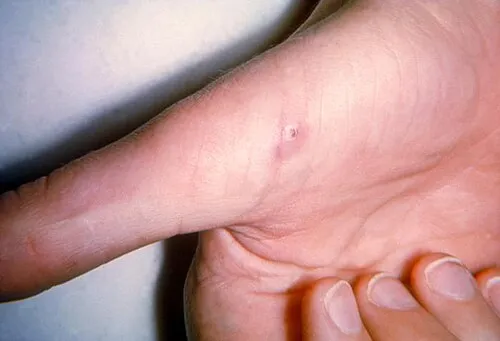
Cat scratch disease is infection with Bartonella henselae, a fastidious Gram-negative bacillus carried in the blood of cats, especially kittens, and spread between cats by fleas. Humans are inoculated when a scratch or bite is contaminated with infected flea faeces. It mainly affects children and young adults. Typically a papule or pustule appears at the inoculation site within about 3–10 days, followed 1–3 weeks later by tender regional lymphadenopathy, usually axillary, epitrochlear, cervical or inguinal, with mild fever; nodes may suppurate and take months to settle. About one in ten patients have atypical disease: Parinaud oculoglandular syndrome, neuroretinitis, hepatosplenic microabscesses with prolonged fever, encephalopathy or culture-negative endocarditis. In people with advanced HIV, B. henselae causes bacillary angiomatosis and peliosis hepatis. Diagnosis is clinical with Bartonella serology or PCR of node tissue. Typical disease is self-limiting; a 5-day course of azithromycin speeds node shrinkage, and complicated disease needs longer combination therapy.
Patient case, mechanism, investigations, management, flashcards and exam-style questions.Open the lesson →
Key facts
- Bartonella henselae is a small, pleomorphic, fastidious Gram-negative bacillus seen with the Warthin–Starry silver stain
- Cats (especially kittens under 1 year) are the reservoir and are often bacteraemic without illness; cat fleas transmit infection between cats
- Typical sequence: inoculation papule after 3–10 days, then tender regional lymphadenopathy 1–3 weeks after the scratch
- Lymphadenopathy usually resolves in 2–4 months; about 10–15% of nodes suppurate
- Atypical forms include Parinaud oculoglandular syndrome, neuroretinitis (macular star), hepatosplenic disease, encephalopathy and osteomyelitis
- In advanced HIV, B. henselae and B. quintana cause bacillary angiomatosis (vascular skin papules mimicking Kaposi sarcoma); peliosis hepatis is caused by B. henselae
- Bartonella is a classic cause of blood-culture-negative endocarditis
- Diagnosis: IgG serology (high titre supports recent infection) or PCR of node aspirate; node histology shows stellate necrotising granulomas
Differential diagnosis
| Condition | Clues | Key test |
|---|---|---|
| Infectious mononucleosis | Generalised lymphadenopathy, pharyngitis, splenomegaly, atypical lymphocytes | Heterophile antibody, EBV VCA IgM |
| Pyogenic (staphylococcal or streptococcal) lymphadenitis | Acutely hot, red node with high fever and neutrophilia | Ultrasound, aspirate culture; responds to flucloxacillin or cefalexin |
| Non-tuberculous mycobacterial lymphadenitis | Young child, unilateral cervical node, violaceous skin, little fever | Excision biopsy and mycobacterial culture |
| Tuberculous lymphadenitis | Matted cervical nodes, weight loss, TB exposure | FNA for AFB, Xpert MTB/RIF, culture |
| Toxoplasmosis | Posterior cervical nodes, contact with cat litter or undercooked meat | Toxoplasma IgM and IgG avidity |
| Lymphoma | Painless, progressive, rubbery nodes, B symptoms | Excision biopsy |
| Tularaemia | Ulceroglandular disease after rabbit or tick exposure | Francisella serology or PCR |
Exam pearls
Guideline
IDSA practice guidelines for skin and soft tissue infections (2014 update), with expert recommendations for the treatment of Bartonella infections (2004)
References
- Florin TA, Zaoutis TE, Zaoutis LB.. Beyond cat scratch disease: widening spectrum of Bartonella henselae infection. Pediatrics 2008.
- Angelakis E, Raoult D.. Pathogenicity and treatment of Bartonella infections. Int J Antimicrob Agents 2014.
- Okaro U, Addisu A, Casanas B, Anderson B.. Bartonella species, an emerging cause of blood-culture-negative endocarditis. Clin Microbiol Rev 2017.
- Stevens DL, Bisno AL, Chambers HF, et al.. Practice guidelines for the diagnosis and management of skin and soft tissue infections: 2014 update by the Infectious Diseases Society of America. Clin Infect Dis 2014.
- Bass JW, Freitas BC, Freitas AD, et al.. Prospective randomized double blind placebo-controlled evaluation of azithromycin for treatment of cat-scratch disease. Pediatr Infect Dis J 1998.
- Rolain JM, Brouqui P, Koehler JE, Maguina C, Dolan MJ, Raoult D.. Recommendations for treatment of human infections caused by Bartonella species. Antimicrob Agents Chemother 2004.
Related topics
By Dr Khalid Seidi (B.Sc., M.D.) · MedEd World Clinical Knowledge library. Original teaching content checked against current guidelines (November 2026); confirm the latest local guidance before clinical use. Not a substitute for clinical judgement.