Clinical Knowledge › Internal medicine › Infectious diseases › Zoonoses and parasitic infections
Tapeworms and cysticercosis
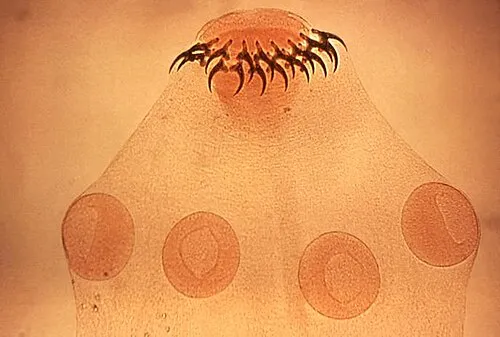
Adult tapeworms (cestodes) live in the human small bowel and usually cause little more than discomfort and passage of proglottids. Taenia saginata comes from undercooked beef, Taenia solium from undercooked pork, Diphyllobothrium (Dibothriocephalus) latum from raw freshwater fish and Hymenolepis nana from faecal-oral spread. The clinically important disease is cysticercosis, which follows ingestion of T. solium eggs shed by a human tapeworm carrier: the larvae encyst in muscle, subcutaneous tissue, eye and, most importantly, brain. Neurocysticercosis is the commonest preventable cause of acquired epilepsy worldwide, typically presenting with new-onset seizures and a single or few ring-enhancing or calcified lesions on CT or MRI. Management depends on cyst number, stage and location: antiseizure drugs for everyone with seizures, corticosteroids before and during antiparasitic therapy, albendazole with or without praziquantel for viable parenchymal cysts, and surgery or shunting for hydrocephalus from ventricular or subarachnoid disease.
Patient case, mechanism, investigations, management, flashcards and exam-style questions.Open the lesson →
Key facts
- Taeniasis = adult worm in the human gut; cysticercosis = larval cysts in human tissue after swallowing T. solium eggs
- Only Taenia solium causes human cysticercosis; eating undercooked pork gives taeniasis, swallowing eggs gives cysticercosis
- T. solium carriers infect themselves and household contacts by faecal-oral spread, so cases cluster in families
- Neurocysticercosis is the leading preventable cause of acquired epilepsy in endemic regions of Latin America, sub-Saharan Africa and Asia
- A single enhancing lesion with perilesional oedema in a young person from an endemic area suggests a degenerating parenchymal cyst
- Corticosteroids are started before albendazole to limit inflammation when cysts die
- Examine the eyes before antiparasitic therapy: intraocular cysts can cause blindness when they degenerate
- Diphyllobothrium competes for vitamin B12 and can cause megaloblastic anaemia
Differential diagnosis
| Condition | Clues | Key test |
|---|---|---|
| Tuberculoma | Endemic TB, constitutional symptoms, larger irregular lesion | Chest imaging, MRI features, biopsy or CSF testing |
| Cerebral toxoplasmosis | HIV with low CD4 count, multiple lesions in basal ganglia | HIV test, Toxoplasma serology, response to therapy |
| Brain abscess | Fever, progressive focal deficit, restricted diffusion on MRI | MRI with diffusion-weighted imaging, blood cultures |
| Brain metastasis or primary tumour | Older patient, known cancer, progressive deficit | Contrast MRI, CT body, biopsy |
| Idiopathic epilepsy | Normal imaging, no endemic exposure | EEG and MRI |
| Hydatid disease of the brain | Large single unilocular cyst without scolex-sized nodule | Imaging and Echinococcus serology |
| Pyogenic meningitis | Acute fever, meningism, neutrophilic CSF | Lumbar puncture and culture |
Exam pearls
Guideline
IDSA/ASTMH Clinical Practice Guidelines for the Diagnosis and Treatment of Neurocysticercosis (2017), WHO guidelines on management of Taenia solium neurocysticercosis (2021) and WHO guidance on Taenia solium control
References
- White AC Jr, Coyle CM, Rajshekhar V, et al.. Diagnosis and treatment of neurocysticercosis: 2017 clinical practice guidelines. Clin Infect Dis 2018.
- World Health Organization. Ending the neglect to attain the Sustainable Development Goals: a road map for neglected tropical diseases 2021-2030. WHO 2020.
- Barman P, Sankhyan N, Suthar R, et al.. Low lesion clearance rates in neurocysticercosis: is it time to review guidelines?. J Child Neurol 2025.
- Farrar J, Garcia PJ, Hotez PJ, et al., eds.. Manson's Tropical Diseases. 2023.
- Bennett JE, Dolin R, Blaser MJ, eds.. Mandell, Douglas, and Bennett's Principles and Practice of Infectious Diseases. 2020.
- Penman ID, Ralston SH, Strachan MWJ, Hobson RP, eds.. Davidson's Principles and Practice of Medicine. 2022.
Related topics
By Dr Khalid Seidi (B.Sc., M.D.) · MedEd World Clinical Knowledge library. Original teaching content checked against current guidelines (November 2026); confirm the latest local guidance before clinical use. Not a substitute for clinical judgement.