Clinical Knowledge › Paediatrics › Child development, behaviour and safeguarding
Autism spectrum disorder
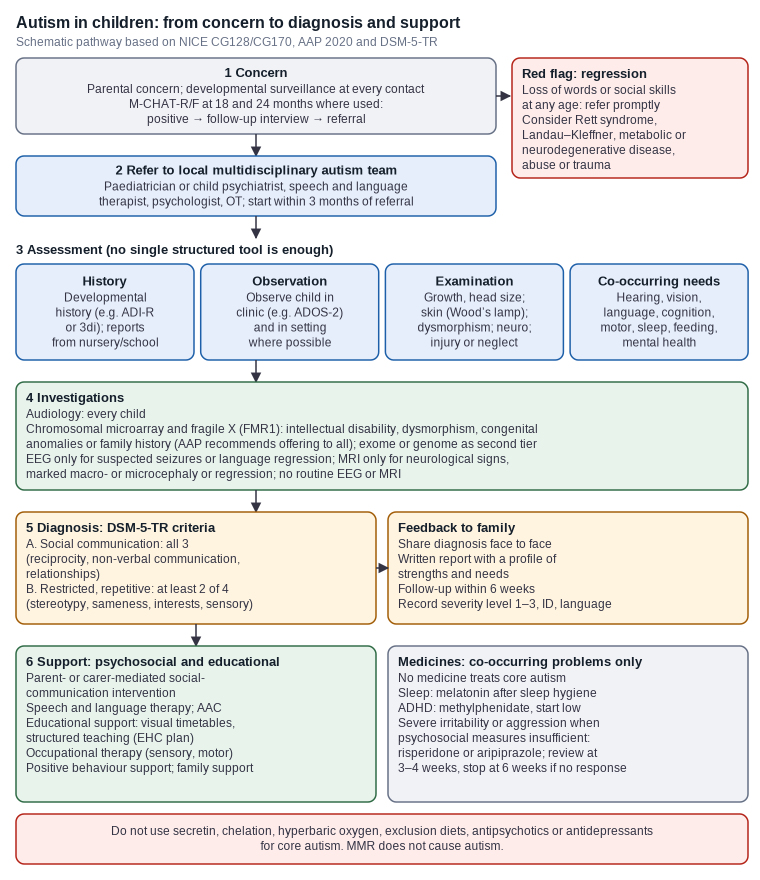
Autism spectrum disorder (ASD) is a lifelong neurodevelopmental condition defined by persistent differences in social communication and interaction together with restricted, repetitive patterns of behaviour, interests or activities, including sensory hyper- or hypo-reactivity, present from early childhood and causing functional impairment. It affects at least 1 in 100 children worldwide and about 1 in 31 eight-year-olds in recent US surveillance, with a male excess and frequent under-recognition in girls. Heritability is high; fragile X syndrome, tuberous sclerosis and copy-number variants are identifiable in a minority. Early signs are lack of joint attention, pointing, response to name and pretend play, delayed or unusual language, and any regression. Diagnosis is clinical and multidisciplinary, with a hearing test, developmental and co-occurring condition assessment, and genetic testing when indicated. Management is psychosocial and educational, centred on the family; medicines treat co-occurring problems such as sleep, ADHD or severe irritability, not core autism.
Patient case, mechanism, investigations, management, flashcards and exam-style questions.Open the lesson →
Key facts
- Core domains (DSM-5-TR): persistent deficits in all three areas of social communication plus at least two of four restricted or repetitive behaviours, including sensory differences
- Prevalence about 1% worldwide; US ADDM 2022 data: 1 in 31 eight-year-olds, boys about 3–4 times more often than girls
- Sibling recurrence risk is roughly 10–20%; heritability estimates exceed 60%
- Any loss of language or social skills at any age is a red flag that needs prompt specialist assessment
- AAP recommends autism-specific screening (M-CHAT-R/F) at 18 and 24 months alongside developmental surveillance
- Every child assessed for autism needs a formal hearing test; genetic testing (microarray, fragile X) when there is intellectual disability, dysmorphism or a family history
- No medicine treats core autism; risperidone or aripiprazole may be used short term for severe irritability or aggression with metabolic monitoring
- MMR vaccine does not cause autism; the original claim was fraudulent and retracted
Differential diagnosis
| Condition | Clues | Key test |
|---|---|---|
| Hearing impairment | Poor response to name and speech delay but normal social interest, gesture and joint attention | Formal audiology (age-appropriate audiometry, tympanometry) |
| Developmental language disorder | Language below age, but intact eye contact, pointing, pretend play and wish to communicate | Speech and language therapy assessment |
| Global developmental delay or intellectual disability | Social skills in keeping with overall developmental level | Developmental assessment; microarray and fragile X testing |
| Rett syndrome (MECP2) | Girl with regression at 6–18 months, hand wringing, deceleration of head growth, breathing irregularities | MECP2 gene testing |
| Landau–Kleffner syndrome | Loss of language after normal development (age 3–7), often with seizures | Sleep EEG showing continuous spike-wave activity |
| Attachment disorder or severe deprivation | History of neglect or institutional care; social difficulties improve with nurturing care | Social history; observation over time |
| ADHD | Inattention and impulsivity without core social-communication differences; often co-occurs | Multi-informant rating scales and history |
| Selective mutism or social anxiety | Speaks normally at home but not in certain settings; interest in relationships intact | History from several settings |
Exam pearls
Guideline
NICE CG128 Autism in under 19s: recognition, referral and diagnosis (2011, updated 2017); NICE CG170 Autism in under 19s: support and management (2013, updated 2021); AAP clinical report on identification, evaluation and management of ASD (2020); DSM-5-TR (2022)
References
- National Institute for Health and Care Excellence. Autism spectrum disorder in under 19s: recognition, referral and diagnosis (CG128). NICE clinical guideline 2011.
- National Institute for Health and Care Excellence. Autism spectrum disorder in under 19s: support and management (CG170). NICE clinical guideline 2013.
- Hyman SL, Levy SE, Myers SM; Council on Children with Disabilities. Identification, evaluation, and management of children with autism spectrum disorder. Pediatrics 2020.
- Lord C, Elsabbagh M, Baird G, Veenstra-Vanderweele J. Autism spectrum disorder. Lancet 2018.
- Lord C, Charman T, Havdahl A, et al.. The Lancet Commission on the future of care and clinical research in autism. Lancet 2022.
- Shaw KA, Williams S, Patrick ME, et al.. Prevalence and early identification of autism spectrum disorder among children aged 4 and 8 years - Autism and Developmental Disabilities Monitoring Network, 16 sites, United States, 2022. MMWR Surveill Summ 2025.
Related topics
By Dr Khalid Seidi (B.Sc., M.D.) · MedEd World Clinical Knowledge library. Original teaching content checked against current guidelines (November 2026); confirm the latest local guidance before clinical use. Not a substitute for clinical judgement.