Clinical Knowledge › Paediatrics › Child development, behaviour and safeguarding
Speech and language delay
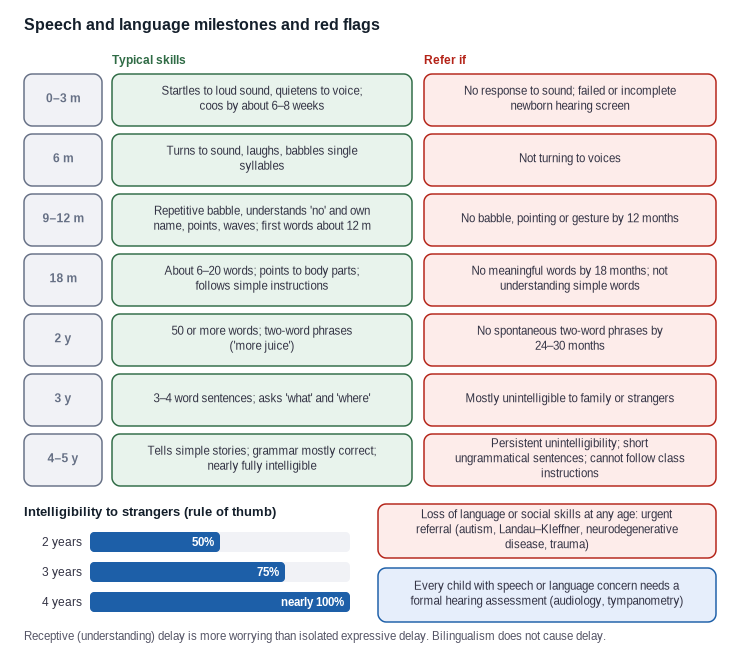
Speech and language delay is one of the commonest developmental concerns in young children. Language is understanding (receptive) and using (expressive) words and grammar; speech is the production of sounds, fluency and voice. Delay can be isolated or part of a wider problem. The key causes are hearing loss (including glue ear), global developmental delay, autism, developmental language disorder (DLD, affecting about 7% of school entrants), neurological and structural problems such as cerebral palsy and cleft palate, and limited language input or neglect. Red flags include no babble or gesture by 12 months, no words by 18 months, no two-word phrases by 24–30 months, unintelligible speech at 3 years, and any loss of skills. Every child needs a formal hearing test and developmental assessment. Speech and language therapy, parent-delivered strategies and education support are the mainstays. Untreated DLD carries lasting literacy, behavioural and mental health effects.
Patient case, mechanism, investigations, management, flashcards and exam-style questions.Open the lesson →
Key facts
- Receptive language (understanding) delay is more worrying than isolated expressive delay; children who understand well and use gesture often catch up
- Classic limit ages: no babble or pointing by 12 months, no single words by 18 months, no two-word phrases by about 24–30 months
- Rule of thumb for intelligibility to strangers: about 50% at 2 years, 75% at 3 years and nearly 100% at 4 years
- Every child with speech or language delay needs a formal age-appropriate hearing assessment
- Otitis media with effusion (glue ear) is the commonest cause of conductive hearing loss in young children
- Developmental language disorder (CATALISE) affects about 7% of children at school entry and is a lifelong condition without a known biomedical cause
- Bilingualism does not cause language delay; delay in all languages needs assessment, ideally with an interpreter
- Loss of language skills at any age is a red flag: think autism, Landau–Kleffner syndrome, neurodegenerative disease or trauma
Differential diagnosis
| Condition | Clues | Key test |
|---|---|---|
| Hearing loss (conductive or sensorineural) | Delayed or unclear speech, inconsistent response to sound, history of ear infections or risk factors | Age-appropriate audiometry and tympanometry |
| Autism spectrum disorder | Lack of joint attention, pointing and pretend play; echolalia; repetitive behaviours | Autism assessment |
| Global developmental delay or intellectual disability | Delay in motor, social and self-care skills as well as language | Developmental assessment; microarray and fragile X |
| Developmental language disorder | Language below expectations with normal hearing and social interest; may have family history | Speech and language therapy assessment |
| Childhood apraxia of speech or dysarthria | Inconsistent sound errors and groping (apraxia) or slurred, weak speech with drooling and feeding problems (dysarthria, e.g. cerebral palsy) | Speech and language therapy and neurological examination |
| Cleft palate or velopharyngeal insufficiency | Hypernasal speech, nasal regurgitation of feeds; may have bifid uvula (submucous cleft) | Oral examination, palpate palate, cleft team referral |
| Selective mutism | Speaks fluently at home but consistently silent at school or with strangers | History from several settings |
| Landau–Kleffner syndrome | Loss of language comprehension and speech at 3–7 years after normal development, with or without seizures | Sleep EEG |
Exam pearls
Guideline
CATALISE consensus on developmental language disorder (2016–2017); USPSTF recommendation on screening for speech and language delay (2024); AAP clinical report on developmental surveillance and screening (2020); CDC/AAP evidence-informed milestones (2022)
References
- Bishop DVM, Snowling MJ, Thompson PA, Greenhalgh T; CATALISE consortium. CATALISE: a multinational and multidisciplinary Delphi consensus study. Identifying language impairments in children. PLoS One 2016.
- Bishop DVM, Snowling MJ, Thompson PA, Greenhalgh T; CATALISE-2 consortium. Phase 2 of CATALISE: a multinational and multidisciplinary Delphi consensus study of problems with language development: terminology. J Child Psychol Psychiatry 2017.
- Norbury CF, Gooch D, Wray C, et al.. The impact of nonverbal ability on prevalence and clinical presentation of language disorder: evidence from a population study. J Child Psychol Psychiatry 2016.
- US Preventive Services Task Force. Screening for speech and language delay and disorders in children: US Preventive Services Task Force recommendation statement. JAMA 2024.
- Lipkin PH, Macias MM; Council on Children with Disabilities. Promoting optimal development: identifying infants and young children with developmental disorders through developmental surveillance and screening. Pediatrics 2020.
- Zubler JM, Wiggins LD, Macias MM, et al.. Evidence-informed milestones for developmental surveillance tools. Pediatrics 2022.
Related topics
By Dr Khalid Seidi (B.Sc., M.D.) · MedEd World Clinical Knowledge library. Original teaching content checked against current guidelines (November 2026); confirm the latest local guidance before clinical use. Not a substitute for clinical judgement.