Clinical Knowledge › Paediatrics › Child development, behaviour and safeguarding
Sudden unexpected death in infancy (SUDI)
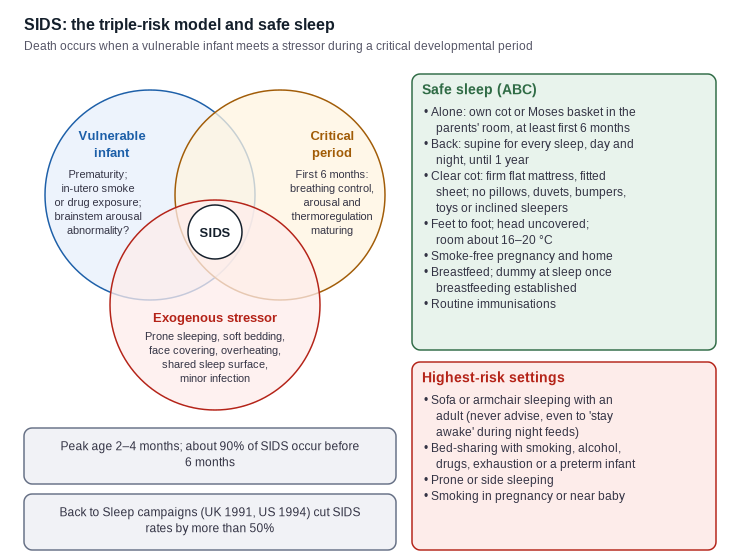
Sudden unexpected death in infancy (SUDI, called SUID in the United States) is the death of an infant under 12 months that was not anticipated and has no obvious cause at presentation. After a full investigation, which includes a specialist post-mortem examination, a review of the clinical history and an examination of the death scene, some deaths are explained (infection, metabolic disease, cardiac channelopathy, accidental suffocation or inflicted injury). Those that remain unexplained and occurred during sleep are termed sudden infant death syndrome (SIDS). Deaths peak at 2–4 months and 90% occur before 6 months. The triple-risk model links a vulnerable infant, a critical developmental period and an outside stressor such as prone sleeping, overheating or a hazardous shared sleep surface. Safe-sleep messages (back to sleep, clear cot, smoke-free home, never on a sofa) have cut SIDS rates by more than half. The doctor's role combines resuscitation, a structured joint-agency investigation and compassionate bereavement care.
Patient case, mechanism, investigations, management, flashcards and exam-style questions.Open the lesson →
Key facts
- SUDI/SUID: sudden unexpected death under 12 months; SIDS is the unexplained subset after autopsy, history and scene investigation
- Peak age 2–4 months; about 90% of SIDS occur before 6 months; more common in boys and in winter historically
- Strongest modifiable risks: prone or side sleeping, smoking in pregnancy and around the baby, sofa sleeping, bed-sharing with an impaired adult, soft bedding
- Protective factors: supine sleep, firm flat separate sleep surface in the parents' room (ideally first 6 months), breastfeeding, dummy at sleep, immunisation
- Back to Sleep campaigns (UK 1991, US 1994) reduced SIDS by more than 50%
- Triple-risk model: vulnerable infant + critical developmental period + exogenous stressor
- Investigation: joint agency response with home visit, specialist paediatric post-mortem, skeletal survey, microbiology, metabolic and toxicology samples
- Families need a key worker, bereavement support and follow-up; next-baby support schemes (for example CONI in the UK) help
Differential diagnosis
| Condition | Clues | Key test |
|---|---|---|
| Accidental suffocation or overlay | Found face-down in soft bedding, wedged, or in an adult bed or sofa with an adult | Scene investigation and doll re-enactment |
| Inflicted injury (abuse) | Bruises, fractures, retinal or intracranial haemorrhage, inconsistent history | Skeletal survey, post-mortem, ophthalmic examination at autopsy |
| Overwhelming infection | Prodromal illness, fever, rash | Blood, CSF and respiratory cultures; histology |
| Inborn error of metabolism (for example MCAD deficiency) | Preceding fasting or illness, hypoglycaemia, fatty liver at autopsy | Acylcarnitines, newborn screening card, bile and frozen tissue |
| Cardiac channelopathy or cardiomyopathy | Family history of sudden death or syncope; structurally normal heart | Molecular autopsy (long QT, Brugada genes), parental ECGs |
| Poisoning | Access to drugs (opioids, methadone), adult medicines in the home | Post-mortem toxicology |
Exam pearls
Guideline
AAP Sleep-related infant deaths: updated 2022 recommendations; RCPath/RCPCH multi-agency SUDIC guidelines (2016); England Child Death Review statutory guidance (2018)
References
- Moon RY, Carlin RF, Hand I. Sleep-Related Infant Deaths: Updated 2022 Recommendations for Reducing Infant Deaths in the Sleep Environment. Pediatrics 2022.
- Blair PS, Sidebotham P, Evason-Coombe C, et al.. Hazardous cosleeping environments and risk factors amenable to change: case-control study of SIDS in south west England. BMJ 2009.
- Carpenter R, McGarvey C, Mitchell EA, et al.. Bed sharing when parents do not smoke: is there a risk of SIDS? An individual level analysis of five major case-control studies. BMJ Open 2013.
- Hauck FR, Thompson JM, Tanabe KO, et al.. Breastfeeding and reduced risk of sudden infant death syndrome: a meta-analysis. Pediatrics 2011.
- Garstang J, Ellis C, Sidebotham P. An evidence-based guide to the investigation of sudden unexpected death in infancy. Forensic Sci Med Pathol 2015.
- Royal College of Pathologists. Sudden unexpected death in infancy and childhood: multi-agency guidelines for care and investigation (2nd edition). RCPath/RCPCH guidance 2016.
Related topics
By Dr Khalid Seidi (B.Sc., M.D.) · MedEd World Clinical Knowledge library. Original teaching content checked against current guidelines (November 2026); confirm the latest local guidance before clinical use. Not a substitute for clinical judgement.