Clinical Knowledge › Paediatrics › Child development, behaviour and safeguarding
Self-harm in adolescents
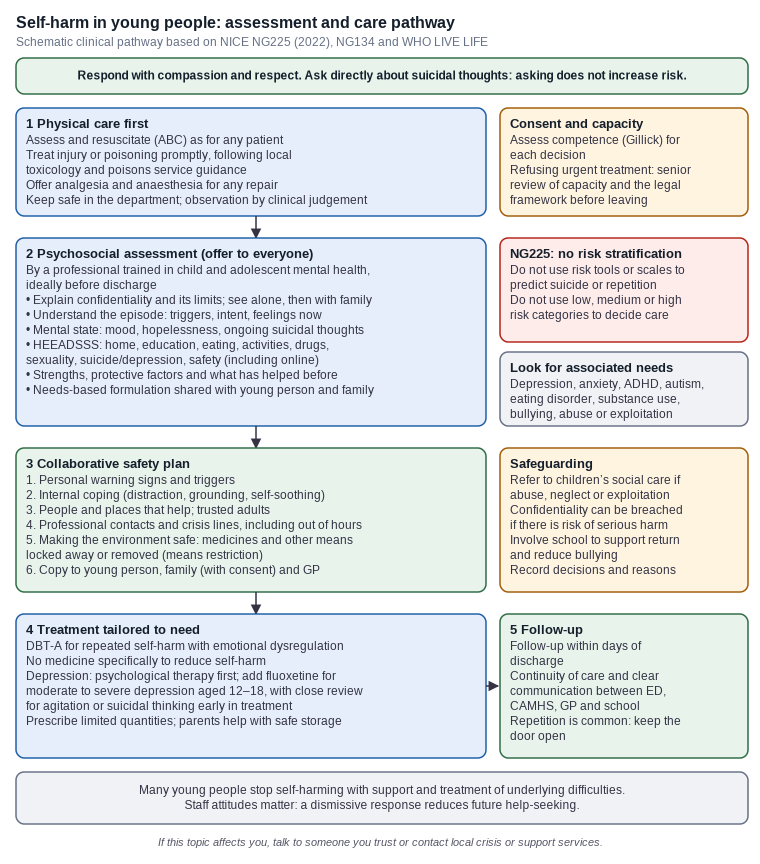
Self-harm is intentional self-poisoning or self-injury, whatever the motive or degree of suicidal intent. About 1 in 10 to 1 in 5 adolescents report self-harm, most often cutting; only a minority present to hospital, where self-poisoning (often with paracetamol) predominates. Self-harm is usually a way of coping with overwhelming distress rather than an attempt to die, but it is the strongest single predictor of later suicide. Every young person deserves compassionate care: treat the physical injury or overdose, keep them safe, and arrange a psychosocial assessment by a professional trained in child and adolescent mental health covering needs, family, school, online life and safeguarding. NICE NG225 (2022) advises against using risk scales or low/medium/high risk categories to decide who receives care, and recommends a collaborative safety plan, involvement of parents or carers where appropriate, means restriction and follow-up. Dialectical behaviour therapy for adolescents has the best evidence for reducing repetition; medication is not a specific treatment for self-harm.
Patient case, mechanism, investigations, management, flashcards and exam-style questions.Open the lesson →
Key facts
- Self-harm: intentional self-poisoning or self-injury irrespective of motivation or suicidal intent
- Community prevalence in adolescents 10–20%; peak 13–16 years; girls more often than boys, but boys have higher suicide rates
- Cutting predominates in the community; self-poisoning (paracetamol, SSRIs, NSAIDs) predominates in hospital presentations
- Self-harm markedly increases the risk of later suicide and of unnatural death
- Everyone presenting after self-harm needs a psychosocial assessment by a trained CAMHS professional (NICE NG225)
- Do not use risk assessment tools or global risk stratification to decide treatment or discharge (NG225)
- Safety planning, means restriction (lock away medicines), family involvement and follow-up are core
- DBT-A may reduce repetition (Cochrane 2021, low-certainty evidence); no medication specifically treats self-harm; treat underlying depression (fluoxetine first-line with therapy)
Differential diagnosis
| Condition | Clues | Key test |
|---|---|---|
| Depressive disorder | Low mood, anhedonia, sleep and appetite change over 2 weeks or more | Mental state examination; mood rating scales |
| Emerging borderline personality traits / emotional dysregulation | Repeated self-harm, unstable relationships, impulsivity | Specialist assessment over time |
| Psychosis | Hallucinations or delusions directing self-harm | Mental state examination; urgent psychiatric review |
| Child abuse or exploitation | Disclosure, injuries inconsistent with account, older boyfriend, missing from home | Safeguarding referral |
| Accidental injury or poisoning | No intent, clear accidental mechanism | Careful history from young person alone |
| Substance misuse | Intoxication, impulsivity, mixed overdose | Toxicology, substance use history |
| Eating disorder | Weight loss, purging, laxative overdose | Weight, %mBMI, electrolytes |
Exam pearls
Guideline
NICE NG225 Self-harm: assessment, management and preventing recurrence (2022); NICE NG134 Depression in children and young people (2019); WHO LIVE LIFE (2021)
References
- National Institute for Health and Care Excellence. Self-harm: assessment, management and preventing recurrence (NG225). NICE guideline 2022.
- Hawton K, Saunders KE, O'Connor RC. Self-harm and suicide in adolescents. Lancet 2012.
- Horowitz LM, Bridge JA, Teach SJ, et al.. Ask Suicide-Screening Questions (ASQ): a brief instrument for the pediatric emergency department. Arch Pediatr Adolesc Med 2012.
- Geulayov G, Casey D, McDonald KC, et al.. Incidence of suicide, hospital-presenting non-fatal self-harm, and community-occurring non-fatal self-harm in adolescents in England (the iceberg model of self-harm): a retrospective study. Lancet Psychiatry 2018.
- Morgan C, Webb RT, Carr MJ, et al.. Incidence, clinical management, and mortality risk following self harm among children and adolescents: cohort study in primary care. BMJ 2017.
- Witt KG, Hetrick SE, Rajaram G, et al.. Interventions for self-harm in children and adolescents. Cochrane Database Syst Rev 2021.
Related topics
By Dr Khalid Seidi (B.Sc., M.D.) · MedEd World Clinical Knowledge library. Original teaching content checked against current guidelines (November 2026); confirm the latest local guidance before clinical use. Not a substitute for clinical judgement.