Clinical Knowledge › Paediatrics › Child development, behaviour and safeguarding
Non-accidental injury
Non-accidental injury (NAI), or physical abuse, is injury deliberately inflicted on a child by a parent, carer or other person. It is most dangerous in infants: most abusive fractures and nearly all abusive head trauma occur under 2 years, and abusive head trauma is the leading cause of death from physical abuse. The doctor's task is not to prove abuse but to recognise when an injury is not explained by the history or the child's developmental stage, to treat the injury, to keep the child safe and to share concerns with children's social care (or the local child protection agency). Key warning patterns are bruising in a non-mobile infant, bruises on the torso, ears or neck, patterned bruises, burns with sharp margins, classic metaphyseal lesions, posterior rib fractures and subdural haemorrhage with retinal haemorrhages. Children under 2 with suspected physical abuse need a skeletal survey with follow-up views, neuroimaging when indicated, ophthalmology review and blood tests to exclude bleeding and bone disorders. Clear documentation and multi-agency working protect the child.
Patient case, mechanism, investigations, management, flashcards and exam-style questions.Open the lesson →
Key facts
- Physical abuse is most frequent and most lethal in children under 2 years; most abusive fractures occur under 18 months
- 'Those who don't cruise rarely bruise': any bruise in a non-mobile infant needs explanation and usually a child protection assessment
- TEN-4-FACESp: bruising to Torso, Ears or Neck in a child under 4, any bruise under 4.99 months, or bruising of Frenulum, Angle of jaw, Cheek, Eyelid, Subconjunctiva, or a pattern
- Highly specific fractures: classic metaphyseal lesions, posterior rib fractures, scapular, sternal and spinous process fractures
- Abusive head trauma: subdural haemorrhage, multilayered retinal haemorrhages to the periphery and encephalopathy, often with apnoea
- Under 2 years with suspected physical abuse: full skeletal survey, repeat views at about 11–14 days, CT head under 1 year, ophthalmology and bloods
- Exclude mimics: osteogenesis imperfecta, rickets, bleeding disorders, congenital dermal melanocytosis, birth injury, cultural practices
- Refer the same day to children's social care (or child protection services); the child's safety comes before the diagnosis is certain
Differential diagnosis
| Condition | Clues | Key test |
|---|---|---|
| Accidental injury | Mechanism consistent with development; prompt presentation; bruises over bony prominences on the front of the body | Detailed history, scene description, developmental assessment |
| Osteogenesis imperfecta | Blue or grey sclerae, dentinogenesis imperfecta, wormian bones, family history, osteopenia | Skeletal survey review, COL1A1/COL1A2 genetic testing |
| Bleeding disorder (haemophilia, von Willebrand disease, ITP) | Excess bruising with minor trauma, mucosal bleeding, family history | FBC, film, PT, APTT, fibrinogen, factor VIII/IX, von Willebrand screen |
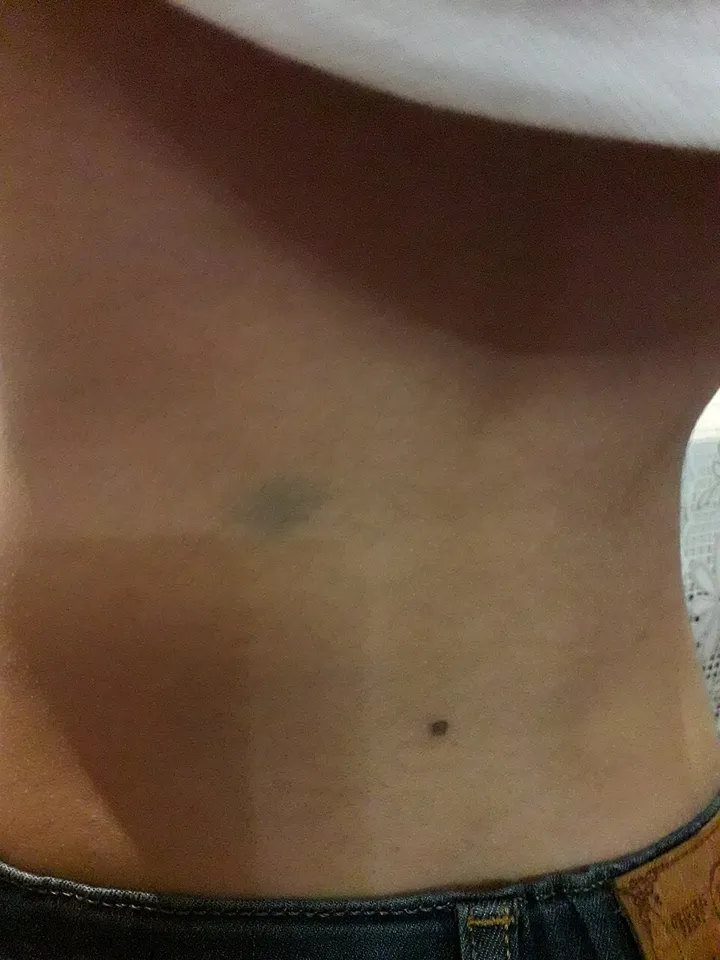
| Congenital dermal melanocytosis | Blue-grey macules on sacrum or buttocks present since birth, unchanged on review, not tender | Clinical review; document at the newborn check |
| Rickets or metabolic bone disease of prematurity | Prematurity, poor vitamin D, wide frayed metaphyses, low phosphate or high ALP | Calcium, phosphate, ALP, PTH, 25-hydroxyvitamin D; wrist X-ray |
| Birth injury | Clavicle fracture or cephalhaematoma in the first weeks; callus at 7–14 days | Birth history and timing of healing on X-ray |
| Cultural practices (cupping, coining) | Linear or circular marks in a symmetrical pattern on the back, explained openly | History; consider safeguarding advice even if benign |
| Glutaric aciduria type 1 | Macrocephaly, bilateral subdural collections, widened Sylvian fissures, dystonia | Urine organic acids, plasma acylcarnitines |
Exam pearls
Guideline
NICE CG89 Child maltreatment (2009, updated 2017) and NG76 (2017); RCR/SCoR radiological investigation of suspected physical abuse (2017, revised 2018); AAP clinical reports (2014–2015); Working Together to Safeguard Children (England, 2023)
References
- National Institute for Health and Care Excellence. Child maltreatment: when to suspect maltreatment in under 18s (CG89). NICE clinical guideline 2009.
- National Institute for Health and Care Excellence. Child abuse and neglect (NG76). NICE guideline 2017.
- Royal College of Radiologists and Society and College of Radiographers. The radiological investigation of suspected physical abuse in children. RCR/SCoR guidance 2017.
- Christian CW. The evaluation of suspected child physical abuse. Pediatrics 2015.
- Flaherty EG, Perez-Rossello JM, Levine MA, et al.. Evaluating children with fractures for child physical abuse. Pediatrics 2014.
- Pierce MC, Kaczor K, Lorenz DJ, et al.. Validation of a Clinical Decision Rule to Predict Abuse in Young Children Based on Bruising Characteristics. JAMA Netw Open 2021.
Related topics
By Dr Khalid Seidi (B.Sc., M.D.) · MedEd World Clinical Knowledge library. Original teaching content checked against current guidelines (November 2026); confirm the latest local guidance before clinical use. Not a substitute for clinical judgement.