Clinical Knowledge › Neurology › Headache, facial pain and cranial nerve disorders
Bell palsy
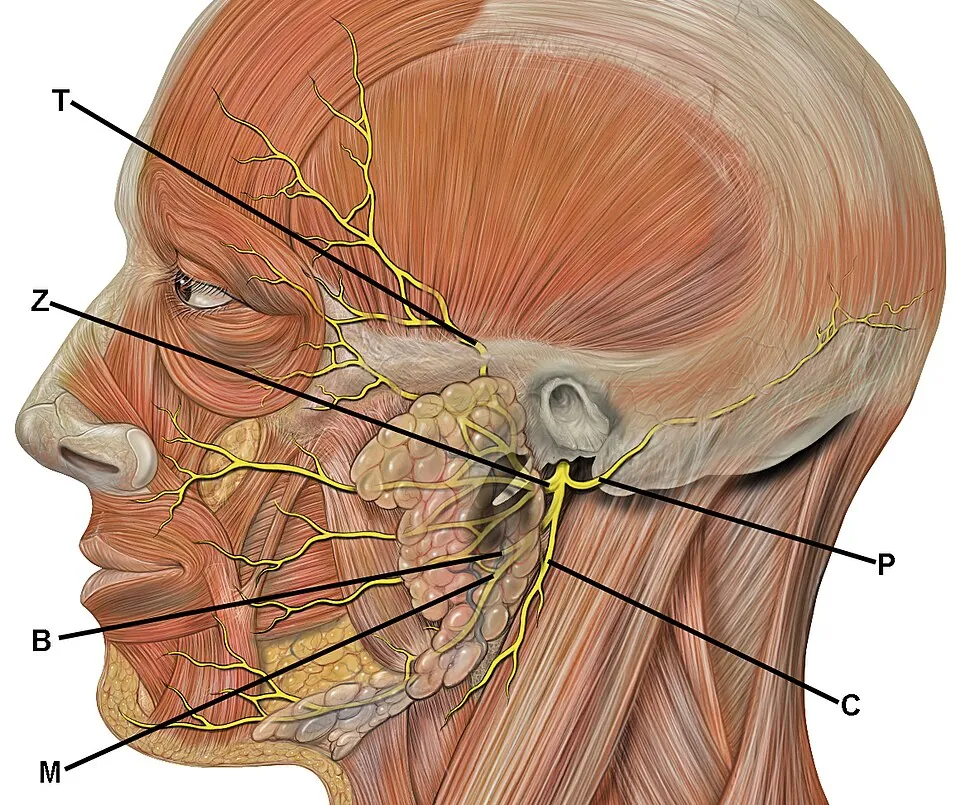
Bell palsy is an acute, idiopathic, unilateral lower motor neurone facial nerve palsy that develops over less than 72 hours. It is the commonest cause of facial paralysis, with an incidence of about 15–30 per 100 000 a year; pregnancy, diabetes and obesity increase risk, and reactivation of herpes simplex virus with nerve swelling in the narrow facial canal is the leading hypothesis. Patients develop weakness of the whole half of the face, including the forehead, often with postauricular pain, altered taste, hyperacusis and a dry or watery eye. Diagnosis is clinical after excluding other causes: forehead sparing suggests a central (upper motor neurone) lesion such as stroke, while vesicles in the ear indicate Ramsay Hunt syndrome, and bilateral, recurrent or slowly progressive palsy needs investigation. Oral prednisolone started within 72 hours improves recovery; antivirals alone are ineffective. Eye protection with lubricants and taping prevents exposure keratopathy. About 70% recover fully untreated, more with steroids; synkinesis and crocodile tears can follow severe nerve damage.
Patient case, mechanism, investigations, management, flashcards and exam-style questions.Open the lesson →
Key facts
- Acute unilateral LMN facial weakness developing over <72 hours, involving the forehead; diagnosis of exclusion
- Incidence 15–30 per 100 000 per year; risk increased in pregnancy (especially third trimester and postpartum), diabetes and obesity
- Associated features: postauricular pain, hyperacusis (nerve to stapedius), loss of taste in the anterior two-thirds of the tongue (chorda tympani), reduced tearing
- Forehead sparing indicates an upper motor neurone lesion (e.g. stroke) because the upper face has bilateral cortical innervation
- Give oral prednisolone within 72 hours of onset (e.g. 50 mg daily for 10 days, or 60 mg for 5 days then taper); do not give antivirals alone
- Protect the eye: lubricant drops by day, ointment and taping at night; urgent ophthalmology if eye pain, redness or visual change
- Refer if atypical, bilateral, recurrent, no improvement by 3 weeks, or incomplete recovery at 3–4 months
- About 70% recover fully without treatment; prednisolone increases complete recovery to over 80–90% at 9 months
Differential diagnosis
| Condition | Clues | Key test |
|---|---|---|
| Stroke (UMN facial palsy) | Forehead sparing, limb weakness or dysarthria, sudden onset | Urgent CT/MRI |
| Ramsay Hunt syndrome | Vesicles in ear canal or palate, severe ear pain, vertigo, hearing loss | Clinical; VZV PCR |
| Lyme disease | Endemic area, tick bite, erythema migrans, often bilateral | Borrelia serology |
| Parotid tumour | Slowly progressive over weeks, parotid mass, branch involvement | Ultrasound/MRI parotid |
| Otitis media or cholesteatoma | Ear discharge, hearing loss, otoscopic findings | Otoscopy; CT temporal bone |
| Guillain–Barré syndrome | Bilateral facial weakness with areflexia and limb weakness | Nerve conduction studies; CSF protein |
| Sarcoidosis (Heerfordt syndrome) | Bilateral palsy, parotid swelling, uveitis, fever | Chest imaging, ACE, biopsy |
| Vestibular schwannoma or skull base tumour | Hearing loss, tinnitus, slowly progressive | MRI internal auditory meatus |
Exam pearls
Guideline
AAO-HNS Clinical Practice Guideline: Bell's palsy (2013); Canadian Bell palsy guideline (2014); AAN evidence-based guideline update (2012); NICE Clinical Knowledge Summary
References
- Baugh RF, Basura GJ, Ishii LE, et al.. Clinical practice guideline: Bell's palsy. Otolaryngol Head Neck Surg 2013.
- de Almeida JR, Guyatt GH, Sud S, et al.. Management of Bell palsy: clinical practice guideline. CMAJ 2014.
- Gronseth GS, Paduga R. Evidence-based guideline update: steroids and antivirals for Bell palsy. Report of the Guideline Development Subcommittee of the American Academy of Neurology. Neurology 2012.
- Sullivan FM, Swan IR, Donnan PT, et al.. Early treatment with prednisolone or acyclovir in Bell's palsy. N Engl J Med 2007.
- Engström M, Berg T, Stjernquist-Desatnik A, et al.. Prednisolone and valaciclovir in Bell's palsy: a randomised, double-blind, placebo-controlled, multicentre trial. Lancet Neurol 2008.
- Peitersen E. Spontaneous course of facial nerve palsy. Acta Otolaryngol Suppl 2002.
Related topics
By Dr Khalid Seidi (B.Sc., M.D.) · MedEd World Clinical Knowledge library. Original teaching content checked against current guidelines (November 2026); confirm the latest local guidance before clinical use. Not a substitute for clinical judgement.