Clinical Knowledge › Neurology › Headache, facial pain and cranial nerve disorders
Tension-type headache
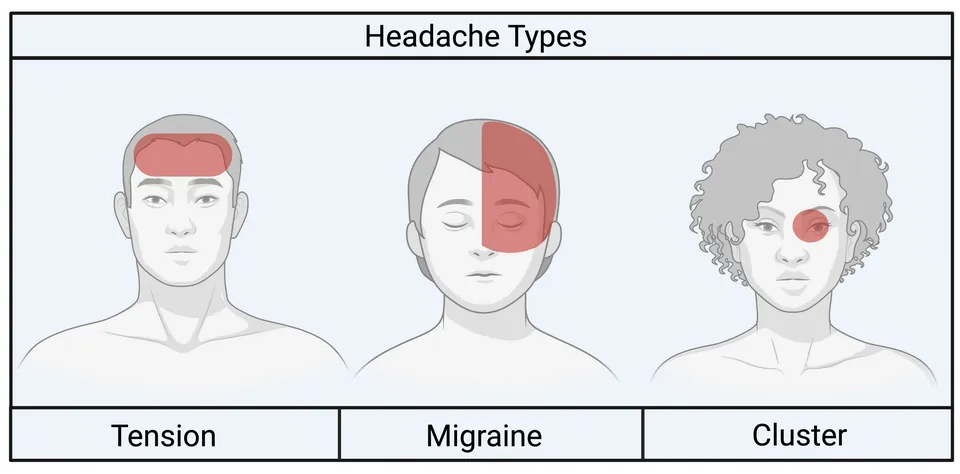
Tension-type headache (TTH) is the most common primary headache disorder, affecting up to two-thirds of people at some point and around a quarter in any year. It causes recurrent bilateral, pressing or tightening ('band-like') headaches of mild-to-moderate intensity lasting from 30 minutes to several days, which are not worsened by routine activity and lack the nausea and marked light and sound sensitivity of migraine. ICHD-3 divides it into infrequent episodic, frequent episodic and chronic forms (15 or more days a month for over 3 months), with or without pericranial muscle tenderness. Episodic attacks probably arise from peripheral myofascial nociception, whereas chronic TTH reflects central sensitisation. Diagnosis is clinical after excluding red flags and medication overuse. Acute attacks respond to aspirin, paracetamol or an NSAID, limited to fewer than 15 days a month; opioids should be avoided. For frequent or chronic TTH, acupuncture, psychological and physical therapies, and amitriptyline as prophylaxis reduce headache days.
Patient case, mechanism, investigations, management, flashcards and exam-style questions.Open the lesson →
Key facts
- Most prevalent primary headache: lifetime prevalence 30–78%; about 26% of adults affected each year; slight female predominance
- ICHD-3: 30 minutes to 7 days, with ≥2 of bilateral, pressing/tightening (non-pulsating), mild–moderate, not aggravated by routine activity
- No nausea or vomiting, and no more than one of photophobia or phonophobia (chronic TTH may have mild nausea)
- Subtypes: infrequent episodic (<1 day/month), frequent episodic (1–14 days/month), chronic (≥15 days/month for >3 months)
- Examination is normal apart from possible pericranial muscle tenderness on manual palpation
- Acute treatment: aspirin, paracetamol or NSAIDs on fewer than 15 days a month; do not use opioids
- NICE suggests up to 10 sessions of acupuncture over 5–8 weeks for chronic TTH; amitriptyline is first-line drug prophylaxis in European guidance
- Frequent analgesic use risks medication-overuse headache, the main differential of chronic daily headache
Differential diagnosis
| Condition | Clues | Key test |
|---|---|---|
| Migraine without aura | Unilateral, pulsating, moderate–severe, nausea, photophobia and phonophobia, worse with activity | Clinical (ICHD-3) |
| Medication-overuse headache | Daily headache with simple analgesics ≥15 days/month or combination analgesics/triptans ≥10 days | Medication diary; improvement after withdrawal |
| Idiopathic intracranial hypertension | Daily headache, transient visual obscurations, papilloedema | Fundoscopy, MRI/MRV, LP opening pressure |
| Cervicogenic headache | Unilateral neck pain radiating forwards, worse with neck movement | Examination of neck; diagnostic nerve block |
| Giant cell arteritis | New headache over 50, scalp tenderness, jaw claudication | ESR/CRP, temporal artery ultrasound/biopsy |
| Space-occupying lesion | Progressive headache, worse on waking or with Valsalva, focal signs | MRI brain |
| Depression or anxiety-associated headache | Low mood, poor sleep, multiple somatic symptoms | PHQ-9/GAD-7; clinical assessment |
Exam pearls
Guideline
ICHD-3 (2018); NICE CG150 Headaches in over 12s (updated 2021); EFNS guideline on the treatment of tension-type headache (2010)
References
- Headache Classification Committee of the International Headache Society. The International Classification of Headache Disorders, 3rd edition. Cephalalgia 2018.
- National Institute for Health and Care Excellence. Headaches in over 12s: diagnosis and management (CG150). NICE (last updated 2021) 2012.
- Bendtsen L, Evers S, Linde M, Mitsikostas DD, Sandrini G, Schoenen J. EFNS guideline on the treatment of tension-type headache – report of an EFNS task force. Eur J Neurol 2010.
- Ashina S, Mitsikostas DD, Lee MJ, et al.. Tension-type headache. Nat Rev Dis Primers 2021.
- GBD 2016 Headache Collaborators. Global, regional, and national burden of migraine and tension-type headache, 1990–2016: a systematic analysis for the Global Burden of Disease Study 2016. Lancet Neurol 2018.
- Linde K, Allais G, Brinkhaus B, et al.. Acupuncture for the prevention of tension-type headache. Cochrane Database Syst Rev 2016.
Related topics
By Dr Khalid Seidi (B.Sc., M.D.) · MedEd World Clinical Knowledge library. Original teaching content checked against current guidelines (November 2026); confirm the latest local guidance before clinical use. Not a substitute for clinical judgement.