Clinical Knowledge › Neurology › Headache, facial pain and cranial nerve disorders
Fourth and sixth nerve palsies
The trochlear (fourth) nerve supplies the superior oblique, which intorts the eye and depresses it in adduction; the abducens (sixth) nerve supplies the lateral rectus, which abducts the eye. Fourth nerve palsy causes vertical or oblique diplopia worse looking down, as when reading or descending stairs, with a head tilt away from the affected side; head trauma and decompensated congenital palsy are the commonest causes, and the three-step test localises it. Sixth nerve palsy causes horizontal diplopia worse at distance and towards the affected side, with esotropia. Its long course over the petrous apex makes it a false-localising sign of raised intracranial pressure, and it is also affected by microvascular ischaemia, skull base tumours such as nasopharyngeal carcinoma, petrous apicitis, cavernous sinus disease and Wernicke encephalopathy. Assessment includes fundoscopy, inflammatory markers in older patients and MRI when atypical or not recovering. Treatment addresses the cause and relieves diplopia with occlusion, prisms, botulinum toxin or surgery.
Patient case, mechanism, investigations, management, flashcards and exam-style questions.Open the lesson →
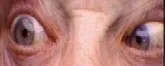
Key facts
- CN IV (superior oblique): intorsion and depression in adduction; the only nerve to exit the dorsal brainstem and to decussate; longest intracranial course
- Fourth nerve palsy: vertical/oblique diplopia worse on downgaze (reading, stairs), ipsilateral hypertropia, head tilt away from the affected side
- Parks–Bielschowsky three-step test: hypertropia worse on contralateral gaze and ipsilateral head tilt localises a superior oblique palsy
- Commonest causes of CN IV palsy: trauma (often minor head injury) and decompensated congenital palsy; microvascular in older adults
- CN VI (lateral rectus): horizontal diplopia worse at distance and on gaze towards the lesion, esotropia, face turn towards the affected side
- Sixth nerve palsy is a false-localising sign of raised (or low) intracranial pressure because of its long course over the petrous apex
- A pontine CN VI nucleus lesion causes ipsilateral horizontal gaze palsy (both eyes), not an isolated abduction deficit
- Image (MRI) young patients, those with additional signs, papilloedema, or no recovery by 3 months; check ESR/CRP in those over 50 (GCA)
Differential diagnosis
| Condition | Clues | Key test |
|---|---|---|
| Myasthenia gravis | Variable fatigable diplopia, ptosis, normal pupils | Ice pack test; AChR/MuSK antibodies; SFEMG |
| Thyroid eye disease | Restricted elevation or abduction, proptosis, lid retraction | Thyroid tests; orbital CT/MRI showing muscle enlargement |
| Skew deviation | Vertical misalignment with brainstem/cerebellar signs, no torsion pattern of SO palsy | Upright–supine test; MRI brainstem |
| Internuclear ophthalmoplegia | Impaired adduction with abducting nystagmus | MRI (MLF lesion) |
| Duane retraction syndrome | Congenital limited abduction, globe retraction on adduction, minimal diplopia | Clinical; long-standing |
| Orbital floor fracture | Trauma, restricted upgaze, infraorbital numbness | CT orbits; forced duction test |
| Decompensated phoria | Gradual intermittent diplopia, full ductions | Orthoptic assessment |
Exam pearls
Guideline
Neuro-ophthalmology consensus practice for acute ocular motor palsies; prospective evidence on presumed microvascular palsies (Tamhankar 2013); national guidance on raised intracranial pressure and GCA
References
- Tamhankar MA, Biousse V, Ying GS, et al.. Isolated third, fourth, and sixth cranial nerve palsies from presumed microvascular versus other causes: a prospective study. Ophthalmology 2013.
- Patel SV, Mutyala S, Leske DA, Hodge DO, Holmes JM. Sixth nerve palsy: etiology and prognosis in a population-based cohort. Ophthalmology 2012.
- Dosunmu EO, Hatt SR, Leske DA, Hodge DO, Holmes JM. Isolated trochlear nerve palsy: etiology, prognosis in adults. Am J Ophthalmol 2010.
- Liu GT, Volpe NJ, Galetta SL. Liu, Volpe, and Galetta's Neuro-Ophthalmology: Diagnosis and Management. 2019.
- Rucker JC, Tomsak RL. Diplopia: diagnosis and management. Curr Treat Options Neurol 2007.
- Ropper AH, Samuels MA, Klein JP, Prasad S. Adams and Victor's Principles of Neurology. 2023.
Related topics
By Dr Khalid Seidi (B.Sc., M.D.) · MedEd World Clinical Knowledge library. Original teaching content checked against current guidelines (November 2026); confirm the latest local guidance before clinical use. Not a substitute for clinical judgement.