Clinical Knowledge › Neurology › Headache, facial pain and cranial nerve disorders
Medication-overuse headache
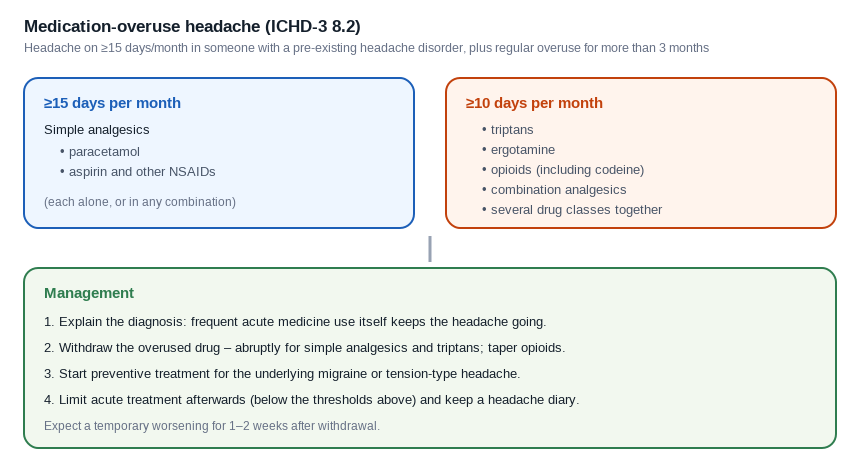
Medication-overuse headache (MOH) is a chronic secondary headache that develops in people with a pre-existing headache disorder, usually migraine or tension-type headache, who regularly overuse acute headache medicines. ICHD-3 defines it as headache on 15 or more days a month with overuse for more than 3 months of simple analgesics on 15 or more days a month, or of triptans, opioids, ergots or combination analgesics on 10 or more days a month. It affects about 1–2% of adults, more often women in mid-life, and is a major cause of chronic daily headache and treatment failure. Repeated drug exposure probably sensitises central pain pathways. Diagnosis rests on a careful medication history and headache diary. Management combines education, withdrawal of the overused drugs (abrupt for simple analgesics and triptans, gradual for opioids, barbiturates and benzodiazepines), early preventive treatment of the underlying headache (topiramate, onabotulinumtoxinA or CGRP-targeted therapies for chronic migraine) and follow-up to prevent relapse, which occurs in about a third.
Patient case, mechanism, investigations, management, flashcards and exam-style questions.Open the lesson →
Key facts
- MOH = headache ≥15 days/month in a person with a pre-existing headache disorder plus regular overuse of acute medication for >3 months
- Overuse thresholds: simple analgesics (paracetamol, aspirin, NSAIDs) ≥15 days/month; triptans, opioids, ergots, combination analgesics or multiple classes ≥10 days/month
- Prevalence about 1–2%; commonest in women aged 30–50 with migraine
- Opioids, barbiturate combinations and codeine carry the highest risk; NSAIDs the lowest
- Treatment: education, withdrawal of overused drugs and early preventive treatment of the underlying headache
- Withdraw simple analgesics and triptans abruptly; taper opioids, barbiturates and benzodiazepines (inpatient support may be needed)
- Headache often worsens for 1–2 weeks after withdrawal before improving; most improve within 2 months
- Relapse occurs in about 30% within a year; regular follow-up and diaries reduce it
Differential diagnosis
| Condition | Clues | Key test |
|---|---|---|
| Chronic migraine without overuse | ≥15 headache days, ≥8 migraine days, acute medication below thresholds | Medication diary |
| Chronic tension-type headache | Daily pressing headache with low analgesic use | Diary; ICHD-3 criteria |
| New daily persistent headache | Daily headache from a clearly remembered day of onset | History; exclude secondary causes |
| Idiopathic intracranial hypertension | Daily headache with papilloedema | Fundoscopy; MRI/MRV; LP pressure |
| Spontaneous intracranial hypotension | Orthostatic headache relieved by lying | MRI with gadolinium (pachymeningeal enhancement) |
| Sleep apnoea headache | Morning headache with snoring and daytime sleepiness | Sleep study |
| Space-occupying lesion | Progressive headache with focal signs or papilloedema | MRI brain |
Exam pearls
Guideline
ICHD-3 (2018); NICE CG150 Headaches in over 12s (updated 2021); EAN 2020 guideline on the management of medication-overuse headache
References
- Headache Classification Committee of the International Headache Society. The International Classification of Headache Disorders, 3rd edition. Cephalalgia 2018.
- National Institute for Health and Care Excellence. Headaches in over 12s: diagnosis and management (CG150). NICE (last updated 2021) 2012.
- Diener HC, Antonaci F, Braschinsky M, et al.. European Academy of Neurology guideline on the management of medication-overuse headache. Eur J Neurol 2020.
- Carlsen LN, Munksgaard SB, Nielsen M, et al.. Comparison of 3 treatment strategies for medication overuse headache: a randomized clinical trial. JAMA Neurol 2020.
- Vandenbussche N, Laterre D, Lisicki M, Lodder J, Magis D. Medication-overuse headache: a widely recognized entity amidst ongoing debate. J Headache Pain 2018.
- Diener HC, Dodick D, Evers S, et al.. Pathophysiology, prevention, and treatment of medication overuse headache. Lancet Neurol 2019.
Related topics
By Dr Khalid Seidi (B.Sc., M.D.) · MedEd World Clinical Knowledge library. Original teaching content checked against current guidelines (November 2026); confirm the latest local guidance before clinical use. Not a substitute for clinical judgement.