Clinical Knowledge › Neurology › Headache, facial pain and cranial nerve disorders
Trigeminal neuralgia
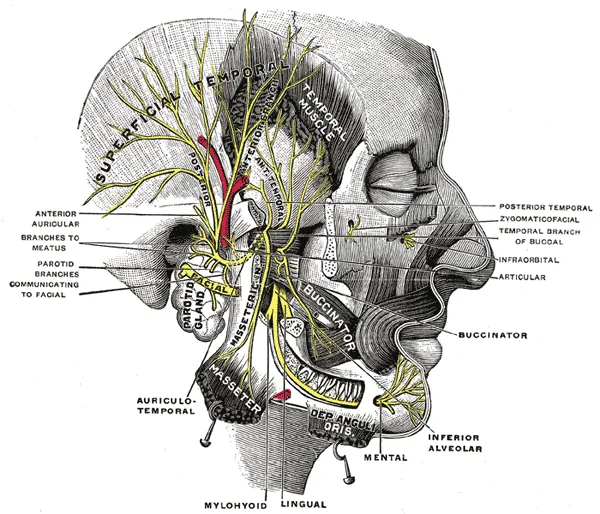
Trigeminal neuralgia is a chronic facial pain disorder of recurrent, unilateral, brief electric-shock-like pains in one or more divisions of the trigeminal nerve, most often the maxillary and mandibular divisions. Paroxysms last from a fraction of a second to 2 minutes and are typically triggered by innocuous stimuli such as touching the face, chewing, talking, brushing teeth or a cold breeze. It mainly affects women over 50. Classical trigeminal neuralgia is caused by neurovascular compression of the nerve root entry zone, usually by the superior cerebellar artery, causing focal demyelination and ectopic discharges; secondary forms result from multiple sclerosis or cerebellopontine angle tumours. Sensory loss or bilateral symptoms suggest a secondary cause, and MRI is recommended for all. Carbamazepine or oxcarbazepine is first line; lamotrigine, gabapentin, pregabalin and baclofen are alternatives. Microvascular decompression offers the most durable relief for medically refractory classical disease, and ablative procedures or radiosurgery suit older or frailer patients.
Patient case, mechanism, investigations, management, flashcards and exam-style questions.Open the lesson →
Key facts
- Paroxysms of unilateral electric-shock-like facial pain lasting <1 second to 2 minutes in the trigeminal distribution (V2 and V3 most common)
- Triggered by innocuous stimuli in trigger zones: light touch, chewing, talking, shaving, brushing teeth, cold wind
- Classification (ICHD-3/IASP): classical (neurovascular compression with root changes), secondary (MS, CPA tumour) and idiopathic
- Classical TN: compression of the nerve root entry zone, usually by the superior cerebellar artery, causing focal demyelination
- Neurological examination is normal in classical TN; sensory loss, bilateral pain or onset under 40 suggests a secondary cause such as MS
- MRI with high-resolution 3D sequences and MRA is recommended in all patients to detect secondary causes and neurovascular compression
- Carbamazepine (or oxcarbazepine) is first line; screen for HLA-B*15:02 in people of Han Chinese, Thai and other South-East Asian ancestry before carbamazepine
- Microvascular decompression gives the longest pain-free intervals for classical TN; percutaneous ablation and stereotactic radiosurgery are alternatives
Differential diagnosis
| Condition | Clues | Key test |
|---|---|---|
| Dental pain (pulpitis, cracked tooth) | Localised to a tooth, thermal sensitivity, longer lasting | Dental examination, X-ray |
| Post-herpetic neuralgia | Continuous burning pain after zoster, usually V1, allodynia, scarring | History of rash; sensory changes |
| SUNCT/SUNA | Short stabbing attacks with prominent autonomic features (tearing, red eye), often V1 | Clinical; MRI; lamotrigine response |
| Temporomandibular disorder | Dull jaw pain with chewing, clicking, tender muscles | Examination of TMJ and masticatory muscles |
| Persistent idiopathic facial pain | Continuous poorly localised dull pain, no triggers | Clinical diagnosis of exclusion |
| Giant cell arteritis | Jaw claudication, temporal headache, age over 50 | ESR/CRP, temporal artery ultrasound |
| Glossopharyngeal neuralgia | Paroxysmal pain in throat, tonsil and ear triggered by swallowing | Clinical; MRI |
Exam pearls
Guideline
EAN 2019 guideline on trigeminal neuralgia; ICHD-3 (2018) and IASP classification; NICE CG173 Neuropathic pain in adults (updated 2020)
References
- Bendtsen L, Zakrzewska JM, Abbott J, et al.. European Academy of Neurology guideline on trigeminal neuralgia. Eur J Neurol 2019.
- Headache Classification Committee of the International Headache Society. The International Classification of Headache Disorders, 3rd edition (13.1 Trigeminal neuralgia). Cephalalgia 2018.
- National Institute for Health and Care Excellence. Neuropathic pain in adults: pharmacological management in non-specialist settings (CG173). NICE (last updated 2020) 2013.
- Cruccu G, Finnerup NB, Jensen TS, et al.. Trigeminal neuralgia: new classification and diagnostic grading for practice and research. Neurology 2016.
- Cruccu G, Di Stefano G, Truini A. Advances in diagnosis and treatment of trigeminal neuralgia. N Engl J Med 2020.
- Barker FG 2nd, Jannetta PJ, Bissonette DJ, Larkins MV, Jho HD. The long-term outcome of microvascular decompression for trigeminal neuralgia. N Engl J Med 1996.
Related topics
By Dr Khalid Seidi (B.Sc., M.D.) · MedEd World Clinical Knowledge library. Original teaching content checked against current guidelines (November 2026); confirm the latest local guidance before clinical use. Not a substitute for clinical judgement.