Clinical Knowledge › Obstetrics and gynaecology › Complications of later pregnancy
Breech presentation and external cephalic version
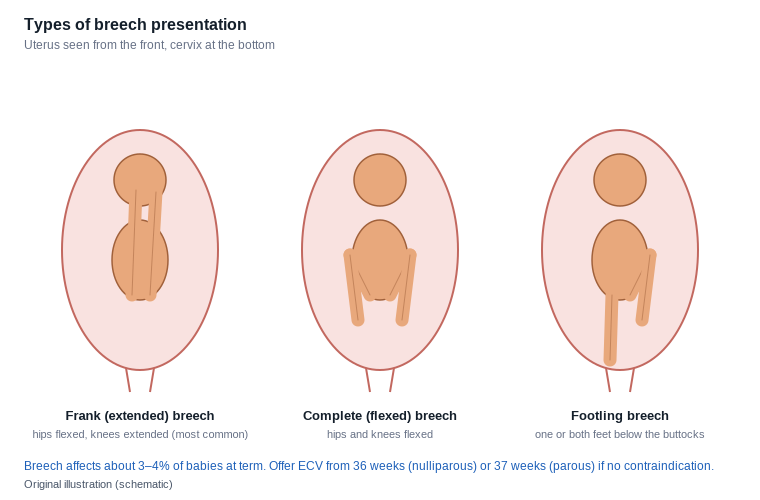
Breech presentation means the fetal buttocks or feet lie over the pelvic inlet. It is common in mid-pregnancy (about 20% at 28 weeks) but falls to 3–4% at term as most fetuses turn spontaneously. Frank (extended) breech is the commonest type; complete (flexed) and footling breech carry more risk of cord prolapse. Associations include prematurity, uterine anomalies and fibroids, placenta praevia, abnormal liquor volume, multiple pregnancy and fetal anomalies. Breech is suspected by palpating a hard, ballotable head at the fundus and confirmed by ultrasound. External cephalic version (ECV) is offered from 36+0 weeks in nulliparous and 37+0 weeks in parous women; it succeeds in about half, is safe, and halves the chance of caesarean birth. If ECV fails or is declined, planned caesarean at 39+0 weeks reduces perinatal mortality and early morbidity compared with planned vaginal breech birth (Term Breech Trial), but selected women may choose a vaginal breech birth with skilled attendants. RhD-negative women need anti-D after ECV, and babies who were breech at or after 36 weeks need hip ultrasound.
Patient case, mechanism, investigations, management, flashcards and exam-style questions.Open the lesson →
Key facts
- About 20% of fetuses are breech at 28 weeks, 3–4% at term
- Types: frank (extended – hips flexed, knees extended), complete (flexed – hips and knees flexed), footling/incomplete (one or both feet lowest)
- Offer ECV from 36+0 weeks (nulliparous) or 37+0 weeks (parous); success about 50% (about 40% nulliparous, 60% parous)
- ECV absolute contraindications (RCOG): caesarean needed anyway (e.g. placenta praevia), APH within 7 days, abnormal CTG, major uterine anomaly, ruptured membranes, multiple pregnancy (except second twin)
- Tocolysis with a beta-agonist (e.g. terbutaline 250 micrograms SC; teaching dose, check local protocol) improves ECV success
- RhD-negative women: Kleihauer test and anti-D immunoglobulin after ECV
- Term Breech Trial: planned caesarean reduced perinatal death or serious neonatal morbidity (1.6% vs 5.0%); no difference in 2-year neurodevelopment
- Planned caesarean for breech at 39+0 weeks; confirm presentation by ultrasound immediately before surgery; hip ultrasound for babies breech at or after 36 weeks
Differential diagnosis
| Condition | Clues | Key test |
|---|---|---|
| Transverse or oblique lie | Head in a flank, empty pelvis, wide uterus | Ultrasound |
| Unstable lie | Presentation changes between visits after 37 weeks | Repeated ultrasound; look for praevia or polyhydramnios |
| Cephalic presentation with deep engagement | Hard head hard to feel abdominally; fundal buttocks mistaken for head | Ultrasound or vaginal examination |
| Face presentation | Soft features on vaginal examination mistaken for breech (mouth versus anus) | Ultrasound; on examination the mouth has gums and the malar bones form a triangle with it |
| Compound presentation | Hand or foot alongside the head | Ultrasound or examination in labour |
Exam pearls
Guideline
RCOG Green-top Guideline No. 20a External cephalic version and reducing the incidence of term breech presentation (2017); RCOG Green-top Guideline No. 20b Management of breech presentation (2017); NICE NG201 Antenatal care (2021) and NG192 Caesarean birth (2021); ACOG Committee Opinion No. 745 Mode of term singleton breech delivery (2018)
References
- Impey LWM, Murphy DJ, Griffiths M, Penna LK; RCOG. External cephalic version and reducing the incidence of term breech presentation: Green-top Guideline No. 20a. BJOG 2017.
- Impey LWM, Murphy DJ, Griffiths M, Penna LK; RCOG. Management of breech presentation: Green-top Guideline No. 20b. BJOG 2017.
- Hannah ME, Hannah WJ, Hewson SA, Hodnett ED, Saigal S, Willan AR; Term Breech Trial Collaborative Group. Planned caesarean section versus planned vaginal birth for breech presentation at term: a randomised multicentre trial. Lancet 2000.
- American College of Obstetricians and Gynecologists. Mode of term singleton breech delivery: ACOG Committee Opinion No. 745. Obstet Gynecol 2018.
- National Institute for Health and Care Excellence. Caesarean birth (NG192). NICE guideline NG192 2021.
- National Institute for Health and Care Excellence. Antenatal care (NG201). NICE guideline NG201 2021.
Related topics
By Dr Khalid Seidi (B.Sc., M.D.) · MedEd World Clinical Knowledge library. Original teaching content checked against current guidelines (November 2026); confirm the latest local guidance before clinical use. Not a substitute for clinical judgement.