Clinical Knowledge › Obstetrics and gynaecology › Complications of later pregnancy
Prolonged pregnancy
Prolonged (post-term) pregnancy is a pregnancy that reaches 42+0 weeks (294 days) or more from the first day of the last menstrual period; 41+0 to 41+6 weeks is called late term. With early ultrasound dating and policies of induction, only 1–2% of pregnancies now reach 42 weeks, compared with 5–10% when dates were based on menstrual history alone. Risk factors include nulliparity, previous prolonged pregnancy, maternal obesity, a male fetus and, rarely, fetal anencephaly or placental sulfatase deficiency. The prospective risk of stillbirth, neonatal death, meconium aspiration, macrosomia, shoulder dystocia and hypoxic injury rises gradually beyond 40–41 weeks as placental reserve falls and liquor reduces. Management starts with accurate dating by first-trimester crown–rump length, discussion of options from 39 weeks, membrane sweeping, and an offer of induction of labour from 41+0 weeks (NICE NG207; WHO), supported by SWEPIS and INDEX. The Bishop score guides cervical ripening. Women who decline induction need increased fetal monitoring from 42 weeks.
Patient case, mechanism, investigations, management, flashcards and exam-style questions.Open the lesson →
Key facts
- Late term = 41+0 to 41+6 weeks; post-term (prolonged) = 42+0 weeks (294 days) or more
- Accurate dating by crown–rump length at 10+0–13+6 weeks (head circumference if later) is the most effective way to reduce false 'post-term' diagnoses
- Prospective risk of stillbirth and neonatal death rises progressively after about 40 weeks
- NICE NG207: offer induction of labour from 41+0 weeks, aiming for birth by 42+0 weeks; discuss options from 39 weeks
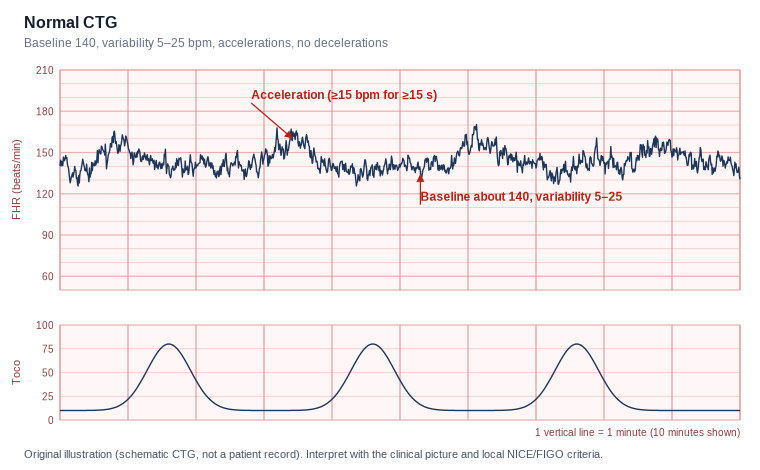
- If induction is declined: from 42+0 weeks offer at least twice-weekly CTG and ultrasound measurement of the deepest pool of amniotic fluid
- Membrane sweeping at term increases spontaneous labour within 48 hours and reduces formal induction; it is an adjunct, not a substitute
- Bishop score (dilatation, effacement/length, station, consistency, position): NICE uses 6 or less as unfavourable – ripen the cervix first
- Postmaturity syndrome: dry peeling skin, long nails, absent vernix, meconium staining, wasted appearance
Differential diagnosis
| Condition | Clues | Key test |
|---|---|---|
| Incorrect dating | Irregular cycles, recent hormonal contraception, no early scan | Review first-trimester crown–rump length scan |
| Fetal growth restriction | Small fundal height and reduced movements near term | Ultrasound biometry, liquor and umbilical artery Doppler |
| Oligohydramnios from other causes | Reduced liquor with ruptured membranes or renal anomaly | Speculum examination; detailed anomaly scan |
| Fetal anencephaly or adrenal hypoplasia | Failure to initiate labour; absent cranial vault | Ultrasound; low maternal oestriol |
| Placental sulfatase deficiency | Male fetus, very low oestriol, later X-linked ichthyosis | Maternal serum/urinary oestriol; neonatal assessment |
Exam pearls
Guideline
NICE NG207 Inducing labour (2021); WHO recommendations: induction of labour at or beyond term (2018); NICE NG201 Antenatal care (2021); ACOG Practice Bulletin No. 146 Management of late-term and postterm pregnancies (2014, reaffirmed)
References
- National Institute for Health and Care Excellence. Inducing labour (NG207). NICE guideline NG207 2021.
- World Health Organization. WHO recommendations: induction of labour at or beyond term. World Health Organization, Geneva 2018.
- American College of Obstetricians and Gynecologists. Management of late-term and postterm pregnancies: ACOG Practice Bulletin No. 146. Obstet Gynecol 2014.
- Wennerholm UB, Saltvedt S, Wessberg A, et al.. Induction of labour at 41 weeks versus expectant management and induction of labour at 42 weeks (SWEdish Post-term Induction Study, SWEPIS): multicentre, open label, randomised, superiority trial. BMJ 2019.
- Keulen JKJ, Bruinsma A, Kortekaas JC, et al.. Induction of labour at 41 weeks versus expectant management until 42 weeks (INDEX): multicentre, randomised non-inferiority trial. BMJ 2019.
- Grobman WA, Rice MM, Reddy UM, et al.. Labor induction versus expectant management in low-risk nulliparous women. N Engl J Med 2018.
Related topics
By Dr Khalid Seidi (B.Sc., M.D.) · MedEd World Clinical Knowledge library. Original teaching content checked against current guidelines (November 2026); confirm the latest local guidance before clinical use. Not a substitute for clinical judgement.