Clinical Knowledge › Obstetrics and gynaecology › Complications of later pregnancy
Placental abruption
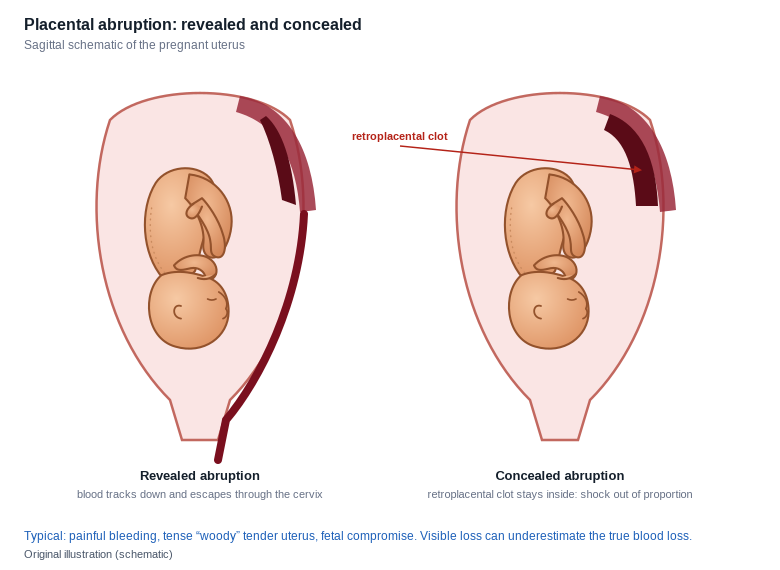
Placental abruption is the separation of a normally sited placenta from the uterine wall before the birth of the baby, usually after 20 weeks. It complicates about 0.5–1% of pregnancies and is a major cause of antepartum haemorrhage, stillbirth, preterm birth and maternal disseminated intravascular coagulation. Bleeding from decidual arteries forms a retroplacental clot that may escape through the cervix (revealed) or stay hidden behind the placenta (concealed). Risk factors include previous abruption, hypertension and pre-eclampsia, smoking and cocaine use, abdominal trauma (including domestic abuse), preterm prelabour rupture of membranes, sudden uterine decompression and multiple pregnancy. The classic picture is constant abdominal pain, dark vaginal bleeding, a tender, tense ('woody') uterus, frequent contractions and fetal distress, with shock that may be out of proportion to the visible loss. Diagnosis is clinical; ultrasound often misses the clot. Management combines resuscitation, correction of coagulopathy with early fibrinogen replacement, anti-D for RhD-negative women and a delivery decision based on fetal condition and gestation: immediate caesarean for fetal compromise, and vaginal birth if the baby has died.
Patient case, mechanism, investigations, management, flashcards and exam-style questions.Open the lesson →
Key facts
- Premature separation of a normally implanted placenta after 20 weeks; 0.5–1% of pregnancies
- Revealed (blood escapes), concealed (about 20%, blood trapped behind placenta) or mixed
- Risk factors: previous abruption (recurrence about 5–15%), hypertension/pre-eclampsia, smoking, cocaine, trauma, PPROM, polyhydramnios decompression, multiple pregnancy, FGR, thrombophilia
- Painful dark bleeding, tender hard uterus, tachysystole or hypertonus, fetal distress or death; shock out of proportion to visible loss
- Diagnosis is clinical; ultrasound misses many abruptions and a normal scan does not exclude it
- DIC is common with large abruptions and fetal death: fibrinogen below 2 g/L predicts severe PPH; replace fibrinogen early
- Live fetus with compromise: category 1 caesarean after resuscitation; fetal death: vaginal birth after correcting coagulopathy
- Ask about trauma and domestic abuse; give anti-D (with Kleihauer) to RhD-negative women
Differential diagnosis
| Condition | Clues | Key test |
|---|---|---|
| Placenta praevia | Painless bright red bleeding, soft uterus, malpresentation | Transvaginal ultrasound for placental site |
| Uterine rupture | Previous caesarean, sudden pain, loss of contractions, palpable fetal parts, fetal bradycardia | Clinical; emergency laparotomy |
| Labour (show) | Intermittent contractions with relaxation between, light blood-stained mucus | Clinical; CTG with normal resting tone |
| Vasa praevia | Bleeding at membrane rupture with acute fetal bradycardia; mother stable | Clinical; antenatal transvaginal colour Doppler |
| Chorioamnionitis | Fever, uterine tenderness, fetal tachycardia | Temperature, WBC, blood cultures |
| Acute surgical abdomen (appendicitis, red degeneration of fibroid) | Localised pain, no bleeding, fetus usually well | Ultrasound or MRI |
| Severe pre-eclampsia/HELLP | Epigastric pain, hypertension, proteinuria; may coexist with abruption | BP, PCR, platelets, LFT |
Exam pearls
Guideline
RCOG Green-top Guideline No. 63 Antepartum haemorrhage (2011); RCOG Green-top Guideline No. 52 Prevention and management of postpartum haemorrhage (2016); NICE PH50 Domestic violence and abuse (2014); MBRRACE-UK Saving Lives, Improving Mothers' Care (2024)
References
- Royal College of Obstetricians and Gynaecologists. Antepartum haemorrhage (Green-top Guideline No. 63). RCOG, London 2011.
- Oyelese Y, Ananth CV.. Placental abruption. Obstet Gynecol 2006.
- Mavrides E, Allard S, Chandraharan E, et al.. Prevention and management of postpartum haemorrhage (Green-top Guideline No. 52). BJOG 2017.
- Tikkanen M.. Placental abruption: epidemiology, risk factors and consequences. Acta Obstet Gynecol Scand 2011.
- WOMAN Trial Collaborators.. Effect of early tranexamic acid administration on mortality, hysterectomy, and other morbidities in women with post-partum haemorrhage (WOMAN): an international, randomised, double-blind, placebo-controlled trial. Lancet 2017.
- National Institute for Health and Care Excellence. Domestic violence and abuse: multi-agency working (PH50). NICE 2014.
Related topics
By Dr Khalid Seidi (B.Sc., M.D.) · MedEd World Clinical Knowledge library. Original teaching content checked against current guidelines (November 2026); confirm the latest local guidance before clinical use. Not a substitute for clinical judgement.