Clinical Knowledge › Obstetrics and gynaecology › Complications of later pregnancy
Fetal growth restriction
Fetal growth restriction (FGR) is failure of a fetus to reach its genetic growth potential; it differs from small for gestational age (SGA), which simply means an estimated fetal weight (EFW) or abdominal circumference below the 10th centile. Most FGR is caused by placental dysfunction (maternal vascular malperfusion), often with pre-eclampsia; other causes are maternal (smoking, hypertension, renal disease, antiphospholipid syndrome, undernutrition) and fetal (aneuploidy, syndromes, congenital infection). Consensus criteria separate early-onset FGR (before 32 weeks: severe Doppler change, hypoxia, pre-eclampsia) from late-onset FGR (32 weeks or later: subtle Doppler change, high stillbirth risk if missed). Umbilical artery Doppler is the key surveillance test, with middle cerebral artery, cerebroplacental ratio, ductus venosus and computerised CTG guiding timing. There is no drug that reverses FGR: management is surveillance and well-timed delivery, with corticosteroids and magnesium sulfate if preterm. Aspirin 150 mg at night from before 16 weeks reduces risk in high-risk women.
Patient case, mechanism, investigations, management, flashcards and exam-style questions.Open the lesson →
Key facts
- SGA = EFW or AC below the 10th centile; severe SGA below the 3rd centile; FGR = pathological failure to reach growth potential
- Delphi consensus: early FGR (before 32 weeks) and late FGR (32 weeks or later) defined by biometry plus Doppler criteria
- Placental dysfunction is the commonest cause; also smoking, hypertension, pre-eclampsia, APS, renal disease, aneuploidy, CMV, toxoplasmosis, malaria, multiple pregnancy
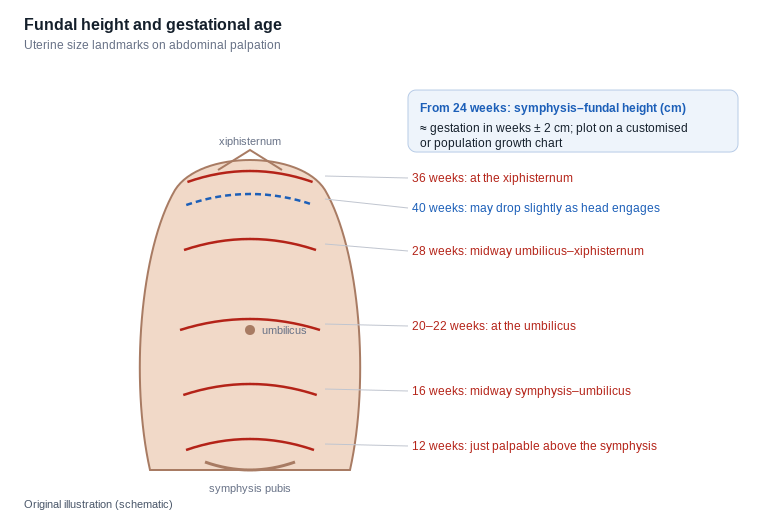
- Measure symphysis–fundal height from 24–26 weeks; refer for scan if below 10th centile, static growth, or SFH unreliable (BMI over 35, large fibroids)
- Umbilical artery Doppler sequence: raised PI, then absent end-diastolic flow (AEDF), then reversed (REDF); DV a-wave absence or reversal is a late, ominous sign
- Brain sparing: low MCA PI and cerebroplacental ratio below the 5th centile, especially important in late FGR
- Antenatal corticosteroids before about 35 weeks and magnesium sulfate for neuroprotection below 30–32 weeks if birth is planned
- Aspirin 150 mg at night from before 16 weeks to 36 weeks for women at high risk of placental dysfunction; stop smoking
Differential diagnosis
| Condition | Clues | Key test |
|---|---|---|
| Constitutionally small (healthy SGA) fetus | Small parents, normal growth velocity, normal Dopplers and fluid | Serial growth and umbilical artery Doppler |
| Incorrect dating | Small for 'dates' but consistent interval growth | Review first-trimester crown–rump length dating |
| Aneuploidy or genetic syndrome | Early, symmetric FGR with structural anomalies or polyhydramnios | Detailed anatomy scan; karyotype or microarray |
| Congenital infection (CMV, toxoplasmosis, rubella, syphilis) | Echogenic bowel, ventriculomegaly, calcification, hydrops | Maternal serology; amniotic fluid PCR |
| Oligohydramnios from ruptured membranes | Small SFH with fluid leak, normal biometry | Speculum; amniotic fluid assessment |
| Twin-specific growth problems (selective FGR, TTTS) | Discordant growth in monochorionic twins | Chorionicity and serial twin scans |
Exam pearls
Guideline
RCOG Green-top Guideline No. 31 Investigation and care of a small-for-gestational-age fetus and a growth restricted fetus (2024); ISUOG Practice Guidelines: diagnosis and management of SGA and FGR (2020); ACOG Practice Bulletin No. 227 and SMFM Consult Series No. 52 (2020–2021); FIGO initiative on FGR (2021); NHS Saving Babies' Lives Care Bundle v3 (2023)
References
- Morris RK, Johnstone E, Lees C, Morton V, Smith G.. Investigation and care of a small-for-gestational-age fetus and a growth restricted fetus (Green-top Guideline No. 31). BJOG 2024.
- Lees CC, Stampalija T, Baschat A, et al.. ISUOG Practice Guidelines: diagnosis and management of small-for-gestational-age fetus and fetal growth restriction. Ultrasound Obstet Gynecol 2020.
- American College of Obstetricians and Gynecologists. Fetal growth restriction: ACOG Practice Bulletin No. 227. Obstet Gynecol 2021.
- Martins JG, Biggio JR, Abuhamad A.. Society for Maternal-Fetal Medicine Consult Series #52: Diagnosis and management of fetal growth restriction. Am J Obstet Gynecol 2020.
- Gordijn SJ, Beune IM, Thilaganathan B, et al.. Consensus definition of fetal growth restriction: a Delphi procedure. Ultrasound Obstet Gynecol 2016.
- Lees CC, Marlow N, van Wassenaer-Leemhuis A, et al.. 2 year neurodevelopmental and intermediate perinatal outcomes in infants with very preterm fetal growth restriction (TRUFFLE): a randomised trial. Lancet 2015.
Related topics
By Dr Khalid Seidi (B.Sc., M.D.) · MedEd World Clinical Knowledge library. Original teaching content checked against current guidelines (November 2026); confirm the latest local guidance before clinical use. Not a substitute for clinical judgement.