Clinical Knowledge › Obstetrics and gynaecology › Complications of later pregnancy
Placenta praevia
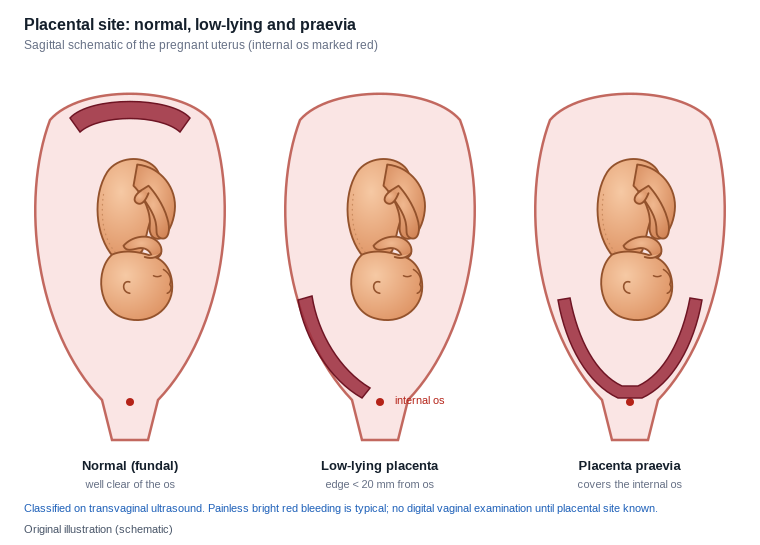
Placenta praevia is a placenta implanted in the lower uterine segment that covers the internal cervical os; a low-lying placenta has its edge within 20 mm of the os on transvaginal ultrasound after 16 weeks. About 1 in 200 pregnancies is affected at term, but many placentas that appear low at the 20-week scan move away from the os as the lower segment forms. Risk factors include previous caesarean section, previous praevia, assisted conception, multiparity, older maternal age, smoking and multiple pregnancy. The classic presentation is painless, bright red vaginal bleeding in the third trimester with a soft, non-tender uterus and often a high or malpresenting fetal head. Digital vaginal examination must be avoided until praevia is excluded; transvaginal ultrasound is safe and the most accurate test. Women with a low placenta at 20 weeks have a repeat scan at 32 weeks (and 36 weeks if needed). Bleeding requires resuscitation, anti-D if RhD-negative and corticosteroids when preterm birth is likely. Uncomplicated praevia is delivered by planned caesarean at about 36–37 weeks, earlier with recurrent bleeding, by a senior team prepared for major haemorrhage and placenta accreta spectrum.
Patient case, mechanism, investigations, management, flashcards and exam-style questions.Open the lesson →
Key facts
- Placenta praevia: placenta lies directly over the internal os; low-lying: edge within 20 mm of the os on transvaginal ultrasound after 16 weeks
- Incidence about 0.4–0.5% at term; most low placentas at 20 weeks resolve (only about 1 in 10 persists)
- Previous caesarean section is the key risk factor and, with an anterior praevia, raises the risk of placenta accreta spectrum
- Painless, bright red, often recurrent bleeding after 24–28 weeks; uterus soft and non-tender; fetal heart usually normal
- Never perform a digital vaginal examination before placental site is known; speculum and transvaginal scan are safe
- Follow-up scan at 32 weeks if low at 20 weeks; repeat at 36 weeks if still low-lying and asymptomatic (RCOG)
- Planned delivery: uncomplicated praevia at 36+0–37+0 weeks; with previous bleeding or risk factors at 34+0–36+6 weeks (RCOG); ACOG 36+0–37+6
- Caesarean is usual if the placental edge is under 20 mm from the os in the third trimester; prepare for PPH (poorly contracting lower segment)
Differential diagnosis
| Condition | Clues | Key test |
|---|---|---|
| Placental abruption | Painful bleeding, tender hard uterus, fetal distress, shock out of proportion | Clinical; CTG, coagulation; ultrasound often normal |
| Vasa praevia | Bleeding at membrane rupture with acute fetal bradycardia; mother stable | Transvaginal colour Doppler antenatally |
| Uterine rupture | Pain, loss of contractions, fetal distress in a scarred uterus | Clinical; emergency laparotomy |
| Cervical ectropion, polyp or cervicitis | Light postcoital spotting; lesion visible on speculum | Speculum, swabs, cervical screening history |
| Show of labour | Blood-stained mucus with contractions at term | Speculum and assessment once praevia excluded |
| Cervical cancer | Contact bleeding, abnormal cervix | Speculum, colposcopy and biopsy |
Exam pearls
Guideline
RCOG Green-top Guideline No. 27a Placenta praevia and placenta accreta spectrum (2018; revised edition 2026); RCOG Green-top Guideline No. 63 Antepartum haemorrhage (2011); SOGC Guideline No. 402 Placenta praevia (2020); ACOG Committee Opinion No. 831 timing of indicated late-preterm and early-term birth (2021)
References
- Jauniaux ERM, Alfirevic Z, Bhide AG, et al.. Placenta praevia and placenta accreta: diagnosis and management. Green-top Guideline No. 27a. BJOG 2019.
- Jauniaux E, Bhide A, Hussein AM, et al.. Placenta praevia and placenta accreta spectrum: diagnosis and management. Green-top Guideline No. 27a. BJOG 2026.
- Royal College of Obstetricians and Gynaecologists. Antepartum haemorrhage (Green-top Guideline No. 63). RCOG, London 2011.
- Jain V, Bos H, Bujold E.. Guideline No. 402: Diagnosis and management of placenta previa. J Obstet Gynaecol Can 2020.
- American College of Obstetricians and Gynecologists. Medically indicated late-preterm and early-term deliveries (Committee Opinion No. 831). Obstet Gynecol 2021.
- Silver RM.. Abnormal placentation: placenta previa, vasa previa, and placenta accreta. Obstet Gynecol 2015.
Related topics
By Dr Khalid Seidi (B.Sc., M.D.) · MedEd World Clinical Knowledge library. Original teaching content checked against current guidelines (November 2026); confirm the latest local guidance before clinical use. Not a substitute for clinical judgement.